Showing posts with label Islam. Show all posts

Wednesday, January 12, 2011

brick-a-brack 12/01/11

  • Think you are being persecuted? (From Alex)


  • This is more than a little whimsical, which of course makes it true art.  HT Doug Chaplin


  • And finally, thanks to Calum for sharing this but not sharing that,

Friday, December 10, 2010

brick-a-brack 10/12/10

Don't expect much from me for the next week or so, but always glad to furnish you with some fascinating reading from around the biblioblogosphere!

Wednesday, October 20, 2010

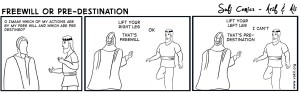
An Islamic Take on Predestination and Free Will

I came across this (thanks Myk!) and thought it worth sharing.  Incidentally if you want to be exposed to a friendlier and more thoughtful face of Islam, as opposed to the usual portrayal of muslims in the media, the blog this came from is good place to start.

Saturday, September 18, 2010

weekend reading

Sunday, September 12, 2010

blogging the Q'ran/ Koran/ Qua'ran/ etc.

A bunch of links here, an assortment of juicy bits here, and one johnny-no-mates here.
Peace and grace to you all.

Saturday, September 11, 2010

As an alternative to book burning

Tall Skinny Kiwi is hosting a blog the Q'ran day to mark 9/11 and as an alternative to all the hoo-haa over you know who saying he'd do you know what.  I'd love to participate, but haven't had enough notice this being something of an epically  busy weekend.  Besides, it really it is the Yanks who should be pulling out all the stops on this one as atonement for having media outlets that give massive free publicity to such slack jawed morons.  If you ignored them, they might not go away, but they would not be able to upset more than their immediate neighbours.

Thursday, September 9, 2010

Burning the Q'ran, a theological T-shirt for you, a worship test, etc


[Pic by ASBO Jesus]
Well I really didn't want to weigh in on all the hullaballoo about that unregenerate fundamentalist moron Terry Jones, because all I'll do is get angry and be rude, and I try to keep blogging a positive experience.  James does better and suggests a positive alternative to burning books, while Jim just goes on and on (but he's dead right, apart from the first link, which is just wrong on so many levels).

In Europe, however, this


is just one of a number of fasinating Christian T-shirts exegeted by TSK, well worth studying them all.

And in the UK, Alex proposes a new way of testing if people in your church are really paying attention or just going through the motions:


Other posts worthy of note
Let me know what you think, :-)

Friday, August 6, 2010

Jesus is Lord of the Bible Too

Continuing to reflect on differences between Christianity and Islam (for background see previous post) I've been struck by the fact that although Christians often say that they "start with the Bible" they really don't.  At least, most of them don't, and those that do are usually a little unhinged.  This is because the Christian faith starts for most of us with an encounter of Christ through his Spirit and/or through his community and/or through his word.  We are not called as Christians primarily to submit to a book, however inspired, but to submit to Christ.  It is not that Muslims submit to a book, per se, but their submission to Allah is controlled and completed by their adherence to the Q'ran.  That is because the Q'ran was written to codify a religion, in Muslim belief dictated by the angel Gabriel to Mohammed.  In many ways while there might have been muslims, there was no religion of Islam until the Q'ran was written to codify it (I realise that the Q'ran was received over time, but the essence of what I say is, I hope, correct.  If it is not please correct me).

But because Christianity, while "a religion of the book," is first and formost a religion of a person: Jesus the Christ, it is more than possible to be a Christian without knowing or having access to the Bible.  Indeed, many Christians throughout history and even today had and have no access to the scriptures.  The New Testament was collected subsequent to the emergence of Christianity, and most of the documents it contains are not self consciously intended as scripture.  The works that comprise the New Testament were collected and recognised only on the basis of their adherence to an unwritten "rule of faith," that is the oral testimnoy and teaching of the apostolic and sub-apostolic church about Christ.

So here is another fundamental contrast in Islamic and Christian approaches to their scriptures.  For the Muslim Mohammed was the receiver of the the Q'ran, and consequently the greatest and seal of all the prophets.  But Christ did not give Christians the Bible, it was written about him, to testify to him.  Mohammed's authority came from the Q'ran as Allah's dictated word.  But, in Christian belief, Jesus does not derive his authority from the scripture but the other way round.  Scripture is only authorative as and in that it testifies to Christ.  This is important and true, for Christians, not just of the New Testament, but of the Old also.  For when Christ talks of fulfilling scripture, or the NT describes ways in which he does, it is not meant that the OT has prescribed who and what Jesus must do to be the Christ, but rather it describes the one who is to come, whose reality gives shape to all creation and the whole story of God's salvation.

And here we, the Christians, might start an argument for Jesus' divinity (and from there the Trinity), because it is the very shape of scripture that testifies that Jesus was not just a man who happened to fit the necessary mould to be the Christ, but that the whole of God's work of salvation, starting with God's promises to Abraham, has been moulded around Jesus Christ, predicated on his reality.  Jesus Christ did not come into being to complete the plan.  The plan came into being to express the reality of Jesus Christ.

Let me know what you think :-)

Wednesday, August 4, 2010

Why Muslims don't get Christian Hermeneutics

I was in the audience for a debate between a Christian and a Muslim about whether or not God was a Trinity yesterday.  It has given me heaps to reflect on, it was a fascinating event to witness on many levels.  Hopefully this is the first of a series of reflections coming out of that event.  One fascinating insight, that I perhaps should have forseen but didn't, was how much of the debate boiled down to hermeneutics (how you interpret scripture).

Muslim Scripture
One human author
Dictated
Untranslated - Arabic
A religious textbook
Intended to found a religion

Christian Scripture
40 human authors (or there abouts)
Inspired
Translated from original languages - Hebrew, Aramaic, Greek
An eclectic library of documents loosely arranged in a narrative sequence
A library collected by religious groups (Jews and Christians) who found those texts representative of their already established religions

Without an articulation of these essential differences between our very conceptions of what constitutes scripture Muslims and Christians will find it impossible to meaningfully discuss the issues that arise from those scriptures.  That said, I could not fault my Muslim cousins for their hermeneutics yesterday because there are plenty of (misguided) Christians who treat the Bible as if it were the Q'ran.  At least the Muslim has the excuse that the Bible is not his or her holy scriptures!

Wednesday, July 14, 2010

French Values or Islamophobia?

It would be easy to dismiss the French ban on the face veil as a similarly petty and unhelpful expression of anti-Islamic sentiment as last year's Swiss ban on mosque minarets. And there can be little doubt that such anti-Islamic feeling is behind much of the popular support for the move.  However, in both cases there is a sense that the bans were not just about Islamophobia but also about attempting to preserve national character.  France has had a long history of aggressive measures to protect against, not Islam, but American cultural polution.  Should this ban be seen as anything different?  It probably should because rather than attempting to stop a foreign cultual import entering the country to its detriment this ban targets those already in the country who should have a legitimate right to freedom of religious expression.

As a positive alternative; rather than stop women wearing the veil, a perfectly sensible move given the way some men look at women in public, why not legislate that the men who are caught leering have to wear blinkers? 

Wednesday, April 28, 2010

Islam, a big bully?

When you see clips like this (HT JMG), with the brilliant Colbert lampooning the absurd and irrational claims of Islamic clerics, it is hard to believe that Islam could at the same time be forcing western media to self censorship.

The Colbert ReportMon - Thurs 11:30pm / 10:30c
Boobquake Day Causes Earthquake
www.colbertnation.com
Colbert Report Full EpisodesPolitical HumorFox News

But this is exactly what is happening as revealed in this excellent NYT article (HT JH).  In it Ross Douthat writes,
Our culture has few taboos that can’t be violated, and our establishment has largely given up on setting standards in the first place.
Except where Islam is concerned. There, the standards are established under threat of violence, and accepted out of a mix of self-preservation and self-loathing.
This is what decadence looks like: a frantic coarseness that “bravely” trashes its own values and traditions, and then knuckles under swiftly to totalitarianism and brute force. 
The whole article is chilling as he details how both academic institutions and the entertainment industry have bowed to the pressure to censor disrespectful mentions of Muhammed.  The funny thing is I have always been annoyed at the way the media thinks blasphemy is somehow les offensive that sex or violence, and I would never ever condone the deliberate slandering of a religious figure who is revered by millions.  All religious discussion should be done in a way that respects and humanises the other parties.  And yet I am really annoyed that comedy central censored South Park's depictions of Muhammed, not because I want Muhammed to be profaned but because the threat of violence has garned special treatment for Islam, which is most surely a reward for bad behaviour if ever there was one.

The fact is that when the "Christian" West is seen to be disrespectful to Islam it is those Christians in the east who suffer the most, the minority groups that make an easy target for the rage against the blasphemies of the "Christian" West.  This was seen most clearly with the whole Rensburg lecture debacle, where a citation made in an academic context by a western celebrity was able to inspire violence against Christian minority groups across the Muslim world. As such we cannot advocate that we should live in a world where Mohammed is insulted and mocked, not because we are worried about violence against ourselves, but because those who are most likely to suffer for such are those who live in countries a long way from the benefit of our police forces and justice systems that protect our "right" to free speech.

Wednesday, March 10, 2010

Roundup

The soul of a dead human is apparently worth NZ$1,415, unless the buyer got a discount for buying in bulk?

RCAP has a new feature,"Conversations with Matua," this month managing to mix assault, incest and the prophet Amos.  Matua is a rather useful Maori word for parent, not least because it is gender non-specific. 

Barnabas Fund reacts to the change in Western Christian perceptions of Islam.

Christian Kiwis get kicked out of Morocco, but claim not to be missionaries.  Isn't caring for orphans part of Christian mission? I think what they mean was that they weren't actively proselytising.  But shaming Morocco by taking better care of its orphans than its Muslim society does is surely even more provocative.

John Hobbins continues an excellent series on slavery in the OT:

I know it seems like I am stalking Hobbins, but he really does blog a lot of good stuff, and this stuff (above) is really very important.

And perhaps most interestingly, a Zimbabwean tribe, the Lemba, have been genetically proven to share a common ancestor with the priestly Jewish line of Cohen, the ancestor they share dates back to around the time of ... wait for it ... Moses and Aaron!  Assuming of course that they existed at all. [HT Chris]

Wednesday, December 16, 2009

Yet another instance of 2 Chron 7:14 abuse!

I get so tired of hearing 2 Chron 7:14 quoted by western Christians in regard to their own nations. In its context it is quite clearly about ancient Israel and the unique relationship it would enjoy as the site of God's temple. Today the temple site has a mosque built on it and Garth George seems to think that it is actually about New Zealand. So in its literal sense it no longer applies. Quite what modern Christians are supposed to take from it is another matter, but it certainly isn't a promise of national social or religious renewal if enough people pray for it. Don't even get me started on his use of Isaiah 6:9-10, which is apparently a rebuke for a failure to take interest in Maori/Pakeha tensions!

Tuesday, October 13, 2009

can human rights dehumanize us?

Currently reading a very impressive article "Rhetoric, Postemodernism, and Theological education," by A.K.M Adam writing in To Teach, to Delight, and to Move, 2004, the following quotes are from page 69:

"Modern ethical reasoning speaks "human rights" as its native language, asserting the fundamental interchangeability of any human person - though these are usually defined in markedly particular terms (citizens of the United States have "free speech" as a human right, but not adequate health care, whereas citizens of China have "adequate health care" as a human right, but not free speech)."

This to me is a very important insight, the language of human rights is very relative depending on your cultural location. Hence so much misunderstanding between the West and radical Islam, to the westerner the sexual display of women in public is their human right, but to a conservative Muslim, or orthodox Jew, it is her human right to be covered up and protected from the lust of men, and it is mens right to be protected from her lust inducing potential! Yet most rights campaigners assume that their concept of human rights is universal and that no other possibilities exist. This is most tellingly manifest in the talk we have now in NZ regarding sexual rights. That prostitutes have a right to sell their bodies on the streets and homosexuals have a right to adopt children or marry is the obvious manifest universal truth to the liberal majority, and yet is it really being a reactionary conservative to suggest that these are not truly human rights at all, but rather arbitrary ones?

"To the extent that such a person a hypothetical person is universal, of course, [they are] no one in particular - but the God of Christian theology knows everyone particularly, so that the extent that theologians permit a modern insistence on universality to dominate their doctrines, they collaborate with the modern proclivity toward homogenisation."

This one could really screw with your mind, how do you do theology if you have to accept that God deals with everyone on a case by case basis?! What does this really mean? Is this a demand for situation ethics? Are there not universal axioms that can be applied to the human race? The idea that no person can be interchanged with another really makes the issue of 'rights' a very thorny one, because people 'rights' are always going to impinge on the rights of others. Especially in a world where people don't recognise the subjectivity of those rights.

In this way the idea of 'rights' dehumanizes and puts all the attention on the person as victim demanding to be treated fairly. By contrast we gain our humanity by living up to our responsibilities to each other, often giving to and serving those who in our world might have no rights to our resources and concern. It means nothing to assert that a street urchin in an Indian metroplolis has a right to food. It means a great deal to assert that maybe I have a responsibility to feed her. As a victim whose rights are being ignored, she is dehumanized; just one more statistic. As someone to whom I am inescapably connected she is a human who belongs to me, and to whom I belong. If I meet her rights I place myself above her as her saviour. If I fulfill my responsibilities, she allows me to be who I should be, and we are both beneath the saviour who called me to serve and who blesses her through me.

Just thinking out loud, :-), let me know what you think.

Wednesday, January 14, 2009

Why All Theology is Contextual and Why It Matters

For the last forty years there has been an increasing shift in the academic study of theology towards an understanding of theology as contextual. This is both a good thing and a scary thing and its something everybody needs to get a handle on and understand. I am currently reading a book called Models of Contextual Theology by Stephen Bevans (Orbis, 2005) which I found for a bargain price on Trademe (the NZ version of EBay). I thought I would share my reading/thinking with you on the blog and I would appreciate your thoughts, whether you can see the relevance and importance of thinking contextually, and how the insights of thinking about faith contextually affects your own thinking. What follows here is not so much from the book as a prelude to the book from me. After this I intend to deal with the book chapter by chapter...

What is contextual theology?

Contextual theology is an insight coming from the post-modern era that essentially recognises that depending on who, where, and when you are things can look very different than if you were someone, somewhere, sometime else. This obvious when we apply it to something like fashion. In the 80's fluro socks and 'power ties' were the height of fashion. Wearing clothes like that now would be a shortcut to ridicule. Old music videos that were once the height of cool are now the epitome of kitch. Now that is fine for something obviously changeable and subjective like styles of clothing or dance moves but surely that cannot apply to issues of truth? Surely if God is real then theology should be like maths. 2+2=4, how can who, where, when you are change that? Well Theology, like maths, is language dependant, the language you use enables you to express concepts but also limits you in the concepts which you can express. Not only that, but your language is embedded in your culture which creates further potential but also limits the concepts you can express. Now I expect that 2+2=4 in any language, but once you try and explain concepts like 'pi' or the 'square root of the hypotenuse' then you are relying on concepts and language that has been especially created around those concepts. If you do not know those concepts then maths is meaningless. For theology the situation is more extreme because all theological language is analogy.

Why is all theological language analogy?

If I say "there is a rock" and point somewhere, and you know what the word rock means, then you can look at what I am pointing at and see if there is a rock there or not. But what happens when we say something like "God is a/my/our rock"? When I say that you do not think of the same thing that you think of when I say "there is a rock." Instead you think analogically: perhaps that God is big, unmovable, reliable. That is certainly what I tend to think of when I read such language in the Bible. But what if I come from a tribe in a rain forest where the only rocks are small and good for throwing at monkeys? To say "God is my rock" has a very different meaning, the analogy does not work. Now suppose I am from a culture that has lots of big dependable rocks but no concept of a supreme being called God. If you say "God is my rock" I merely think you have a rock, whose name is "God." The difference between talking about rocks and talking about God is that you can take someone who has never seen a rock to a rock and say "there is a rock." But when you are talking about God you are always reliant on comparing God to something else because you cannot actually point to God. Now while those example were a little extreme to make the point what happens everytime Christianity is brought to a new culture and/or language the analogies we use potentially take on a different meaning. So theology must be done in a way that is aware of the way culture/language changes things.
Here is a more likely example: I am used to talking about God as 'Father,' because I came from a stable and happy family home this is a positive image for me. But what is my context was different? what if I had had an abusive father? Would that still be an apropriate analogy if the word 'father' only meant hurt and betrayal and abuse? It surely wouldn't. Either the word would need to be filled with a new meaning or a new analogy found. But regardless of positive or negative experiences of 'father' how does a 21st century western experience of 'father' differ from a 1st cetury middle eastern one? Are the analogies the same or are there subtle differences? How do we decide if those differences are important or not? And how do you decide if the analogy needs to be replaced or if you can just modify it a little?

Why is Islam like Maths?

Now Islam gets around this problem the same way that Maths does. Rather than try to translate concepts from one culture to another, if you want to comprehend those concepts you simply need to learn the language. So to become Muslim you really need to become, at least in part, Arab. The scripture must be learnt in Arabic. The prayers must be said in Arabic. and your lifestyle and world view must become, in part at least, Arabic. (This is of course a broad generalisation) If you want to learn Maths you simply cannot avoid learning the language of Maths. But Christianity is different because it carries in its very DNA the drive to jump culture and context rather than transplant the same culture/language everywhere. In the Bible the same God is worshipped, encountered, and described in various Hebrew (tribal, monarchial, and exilic) and Greek (Judean, missionary, persecution) Contexts. To do theology you do not have to be a Hebrew or a Greek, you only have to be yourself. But to do it well you do need to be aware how who, when and where you are can affect what you read and think and know. And when you do that you are doing contextual theology, theology that is aware of its own context.

Let me know what you think :)

Tuesday, December 9, 2008

Mercy and Justice in Islam and Christianity

David Neff writes in December's Christianity Today (p42):

"One insight from the "Loving God and Neighbor [sic] Together" dialogue between Muslims and Christians held this July at Yale University was the difference between our understandings of love, compassion, and mercy.
"The Christian participants had been taught by Jesus that love should be indiscriminate - just as the mercy shown by the Good Samaritan was conditioned on nothing but the wounded mans need. That may not be the way we generally behave, but... it is the standard against which we measure ourselves.
"The Muslim participants startled us Christians by talking about the limits their religion brought to their compassion. Orphans, widows, and others in need through no fault of their own deserve compassion, they said. But in Islamic ethics, there was no obligation to help the person whose drunkenness or gambling or otherwise unwise behavior [sic] put them in difficulty.
"Reflecting on what I heard those Muslim leaders say, the tension was not between a generous God and a stingy God... but between mercy that was defined and conditioned by justice (the Muslim view) and justice that was conditioned and defined by mercy (the Christian view)."

Now, pardon the long quote, but isn't that seriously interesting? Our view of God radically affects the way we view ourselves and treat other people. Some questions for discussion:
  1. What advantages does the Muslim view hold?
  2. If you were/are a Muslim how would you differentiate between those who were deserving of mercy and those who were not (e.g. an alchoholic orphan)?
  3. If you (Mulsim/Christian/other) have ever received compassion what was it about you that brought compassion from others?
  4. On what grounds do we (anybody) expect God to have compassion on us?
  5. If you are a Christian how do you ensure that you love indiscriminately, like your God?

Let me know what you think :)
A Fresh Crop of New Blogs

I've been hearing rumours that blogging is making a comeback. Some of us never went away, but I admit, it's been slim picking round ...