Showing posts with label Bible reading. Show all posts

Thursday, January 6, 2011

Egocentric Literalists: Quote of the Day

I often say that what lies at the heart of most lovers of literature is a single impulse: “Let me read a story about someone who is unique and interesting, someone just like me.”   Ego-centrism, to a great extent, is the highest form of literalism.

There is so much truth in that statement i could unpack it for hours, but i don't have those hours today so you'll have to do it yourself.  The rest of the article is worth a read too, and it is not too long.

Saturday, September 18, 2010

weekend reading

Thursday, September 2, 2010

Today!

Today I have printed off my thesis for submission and spiral bound it, I feel giddy.
Today I also entered the illustrious ranks of the Biblioblog top 50 at no.33, making me even giddier.
(and yes Jim you are still #1, but Jesus is #1 in my heart)

Not only that but don't miss

Monday, August 30, 2010

drifting in on the tide

Happy birthday to Jim West, whose 50th birthday apparently means the end is drawing nigh, at least by all the end times speculation that it has sparked, so get your rapture pak ready.  But Jim needs to know that 50 is probably the new 40, at least according to Don Miller.  KVB offers some funding advice ostensibly for PhDs but it should work for just about anything and some great Petersen quotes

Richard Beck has some thoughts about Bible translations and would probably like IVP's biblical theology blog, which is back on track and well worth a look, not least linking to Peter Leithart on mission and a review of this children's Bible which I bought and mostly like - although it over interprets sometimes, e.g. the snake in the garden is Satan, but has the best introduction of any children's book I've ever read, like ever.  Tall Skinny Kiwi also talks about "mission shaped mission" while Marc Cortez muses on Volf's eschatological theology of work.  Which brings us nicely back to the end times where it is worth considering your sins on this helpful chart before it is too late, or imagining a different scenario altogether.

Wednesday, May 26, 2010

Some Random Student on Hermeneutics: Quote of the Day

A young female student just walked past my door, coming out of a "Introduction to the Bible" lecture, she said to her friend,
It is so much better looking at it as a letter rather than just taking little chunks out of it,
Hearing her say that just warmed my heart.  Congratulations to her (i'm afraid i didn't recognise the voice) for taking an important step in discovering the riches of God's word when it is allowed to be what it is and not turned into a collection of "thoughts for the day."  And congratulations to George who was taking the class and is helping about 50 students make these crucial initial steps towards mature and informed biblical interpretation.

Thursday, September 10, 2009

Home away from home

I'm just reading (or rather skipping through) Erich Gruen's excellent book, Diaspora: Jews amidst Greeks and Romans (Harvard, 2002). In it he suggestes there were two ways in which the Jews related to their situation as diaspora, i.e. living being away from their homeland. The first was negative, to think in terms of "exile, a bitter and doleful image, offering a bleak vision that leads either to despair or to a remote reverie of restoration." Or a positive approach, to seek "refuge in a conforting concept: that Jews require no territorial sanctuary or legitimation. They are "the people of the Book." Their homeland resides in the text." (p232) And how did the diapora Jews "make their home in the text"? Well, primarily by meeting regularly with each other, to read and interpret those texts in their diaspora locality (p116).

I think this is an important concept for us Christians given how much pressure, traditional forms of church, and especially the 'sermon' is currently under. As a diaspora ourselves we need to maintain our emphasis on making our home in the text and not the world. We need to ensure that in the desire to do something different we do not lose that diaspora imperative to regularly meet for the reading and interpretation of the text that gives us our identity, that we don't stop being 'people of the Book.'

Thursday, July 2, 2009

Reading the Bible for its own sake

This is an article I wrote for the national Baptist magazine (NZ) this month. I had to write 5-700 words that were provocative but not controversial and also served to be a little personal, so people could get to know me... let me know what you think.

---

My two year old daughter, Charlotte, often requests songs at bedtime. Sometimes she makes up titles that she wants me to sing. If I can, I try and find a song that fits the title she has made up. Sometimes, especially with the more wacky titles, I have to improvise an original. The other night she asked to sing “pray.” Well, I know there is an MC Hammer song by that name but it isn’t really a bedtime number, and I can’t rap. But I did remember an old children’s song, “read your Bible, pray every day (repeat a few times)... if you want to grow.” Charlotte enjoyed it and has asked for it again since. Now Charlotte does pray every day but reading is a little beyond her just yet. However, singing that song has made me think about how, although I have always known that I should read the Bible every day, for a long time, whenever I did read it, I often wondered what I was supposed to do with it.

I think the problem for me stemmed from the expectation that every time I read the Bible I should be receiving some sort of message from God, some radical new insight into God’s will for me or something. Of course if this actually happened everyday it would be both exhausting and confusing. Recently I asked our church youth group what sort of book the Bible was, (which is a trick question, it’s not a book it’s a library!) and the answers ranged from a book that predicted the future to an instruction manual for our lives. I then pointed them to some of the more awkward and confusing passages of scripture (e.g. Leviticus 15 or Psalm 137) and asked how those fitted into their idea of what the Bible was. It was great to see the lights come on, especially as those same lights had only come on for me relatively recently.

So much of our difficulty in reading the Bible comes from it not being the book we think it should be. When we read the Bible with our own idea of what the Bible is our Christian growth can get stunted. It is not our holy horoscope. It is not basic instructions before leaving earth. It is not God’s thoughts on every little detail of my life. It is not the Christian version of Nostradamus’ prophecies. It is not even a theology textbook! If God had intended it to be any of those things then surely it would have turned out different. Bible reading that will help us grow starts with reading the Bible just for its own sake, without preconceptions or agenda. What you will discover then, is that the Bible is so much more than you thought it was. So much more interesting, deep, powerful, strange, dangerous, surprising, and inspired, than any book you or I could have come up with.

So, for what it is worth, here is my suggestion for what to do with the Bible. Get to know it. Don’t put pressure on yourself to turn every verse into a word for you right now. Take it easy, explore the nooks and crannies. Don’t jump from one verse to another but read big chunks. Don’t be afraid to spend a week, even a month or more, just getting to know one intriguing part really well. Don’t be too quick to find answers to the questions the text raises, instead sit with ambiguity; wrestle with God’s word. Don’t explain away the bits that don’t fit with your theology, instead let them challenge and provoke you. Find the unpopular passages of scripture and befriend them. Most-of-all, read what it actually says, instead of worrying about what it might say to you.

Don’t get me wrong, I do believe in applying the Bible to our lives, that it should guide our theology, and that it gives us hope for the future; but this way I think we stand a better chance of being transformed (and grown) by God’s word rather than accidentally conforming the Bible to our own ideas of what it should be.

Thursday, May 7, 2009

Thursday is for Bible reading!

Today Greg Boyd continues his righteous critique of the Patriot's Bible. Which makes you realise even reputable publishers cannot be trusted to read the Bible correctly... you have to learn to do it yourself. Which is where John Piper comes in with his love affair with arcing. Not that it is a technique that I have come across before but it sounds fairly sensible and I will investigate sometime, when I have the time. Exegesis is hard word and some graphic symbols could well come in handy for speeding up analysis of thought flow. From my musical studies I certainly know symbols can help immmensly with musical analysis. But sometimes it just takes a sitcom to bring home a truth, after all many a true word is spoken in jest... you just need to know how to spot it :-)

Monday, May 4, 2009

It's enough to make you puke (again)

Need another reason to thank God you weren't born an American or a Dog?

(Sorry all my wondeful American friends, but really as a tribe you have so much to answer for... like nearly as much as the British!! ;-), you are a young nation, I'm sure you will grow out of it.)

But really this does raise once again the whole issue of study Bibles, green Bibles, and Dude-Pimp-My-Bible! Bibles...

Personally the only thing I want in my Bible is really great crossreferences which make up for the fact that I havent yet memorised the entire scriptures in Hebrew and Greek because I'm so lazy.

Monday, January 5, 2009

Bible Reading Plan for the New year

If you are anything like me then your new year often starts with a few resolutions, which you will invariably fail at. This year I want to get more exercise and read more poetry. The exercise is going well, but then I used to do so regularly until the sleepless nights of being a parent set in. Now the kiddies are sleeping through the night. The poetry is trickier, I am not good at reading poetry because I read too fast. So I am trying to just read a couple of poems at a time and return to them. Reading fast is good for novels and text books when the aim is to process events and information. But when it comes to poetry if you dont slow down and savour the words it's rather like gobbling down a delicately seasoned meal, you will miss the whole point - which is to savour and dwell upon the artful creation. One of the reasons it is good to read the Bible in its original languages is because it forces you to read slower, to notice each word. I have just started to learn Hebrew and although I can only read a few verses I am already being struck by the poetry of the original, where a few verses can be savoured and dwelt upon and enjoyed again and again. Which brings me round rather awkwardly to the subject of the post. After many years of struggling, I have finally found (or rather written) a Bible reading plan that works for me. It works for me because I get to read big chunks at a time instead of four or five little bits each day. And it works for me because if I miss days or even whole weeks I can catch up without to much difficulty. There is lots of space in it, but yet it gets me through the whole Bible in a year. The aim of it is not so much devotional (although there is no reason not to use it as such) but to gain familiarity and a holistic knowledge of the text, instead of just dwelling on my favourite bits.

Here's how it goes, you need to read Psalm every other day (or every day to do Psalms twice in the year. Then there is a OT history book and a minor prophet each month and a gospel each quarter. All the other books are fitted in around them so as to be reasonably evenly distributed.

1 Genesis, Hosea, Lamentations, John
2 Exodis, Joel, Esther, Ecclesiastes, Romans, Jude
3 Leviticus, Amos, Ezra, Neemiah, 1+2 Thessalonians, 1+2 Peter
4 Numbers, Obadiah, Daniel, Mathew, 1+2 Timothy and Titus
5 Deuteronomy, Jonah, Song of Songs, 1+2 Corinthians
6 Joshua, Micah, Proverbs, Luke
7 Judges, Nahum, Job, Acts
8 Ruth, Habakuk, Isaiah, Galatians, 1, 2+3 John
9 1st Samuel, Zephaniah, Ezekiel, Ephesians, James
10 2nd Samuel, Haggai, Jeremiah, Mark
11 1st + 2nd Kings, Zechariah, Philippians, Revelation
12 1st +2nd Chronicles, Malachi, Colossians, Philemon, Hebrews

If you go through that list at three chapters a day (plus a Psalm) you will easily read the whole Bible in a year. If you find yourself getting behind just add a few more chapters a day till you catch up. If I finish a months reading with time to spare then I can use that time to get ahead, reread something which had grabbed me, or whatever. Reading the whole Bible each year is a great discipline, there is always something new to discover. If you find yourself getting jaded, try a different translation, or better yet a different language :)!

Have a look at this for heaps of links to other Bible Reading plans.

Monday, December 8, 2008

Getting in Tune


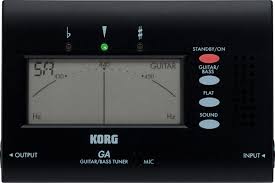
You will be forgiven if you don't know what that is. Before a practice or performance a guitarist will often spend minutes hunched over such a box, focussed intently on its flashing lights and arm moving on the screen. The box itself makes no music, but if the guitarist wants her music to sound 'right', even more if she wants to play along with other musicians, the guitar must first be brought into accordance with the box. It is a guitar tuner.

For the same reason, Christians need to spend time as often as possible in prayer and reading the Bible. These precious times allow us to tune our thoughts, desires, and feelings into harmony with God's. When our lives feel dischordant and out of tune our greatest need is to reorientate our inner world according to the music we find in scripture and the great composer we meet in prayer. Then we will know what it is to live in harmony, not with the world around us but the transcendent reality of God. The same God who will one day bring all things into his loving and glorious harmony.

A Fresh Crop of New Blogs

I've been hearing rumours that blogging is making a comeback. Some of us never went away, but I admit, it's been slim picking round ...