Showing posts with label Bible. Show all posts

Tuesday, June 19, 2012

Shoot Me Now: The End Has Come

No thanks to Rachel Held Evans for alerting me to this most disturbing and blasphemous development. Time to hide in the basement with lots of canned food cos this sort of thing can only mean the end is not far away.


Zondervan, you have finally lost all connection with what is sane and proper.

Hopefully there is an illustration of Prov 26:11 with a cute puppy licking up it's own vomit, which is pretty much what I would rather do that own a copy of this abomination.

For all Bible verses that mention dogs, click below

Monday, March 19, 2012

Quote of the Day: Bruce on Biblical Theology and Magical Roundabouts


Our biblical theology must depend on our exegesis, not vice versa. If we allow our exegesis to be controlled by theologoumena, we shall quickly find ourselves involved in circular reasoning. I have friends who say, 'Well, yes; but then all theological reasoning is circular; let us simply make sure that we get into the right circle.' I have no wish to accompany them on this magic roundabout.

F.F. Bruce from The Canon of Scripture, 1988, p333
Pic from Dave Block

Wednesday, October 5, 2011

Subdugating Women With The Bible (again)

Someone has caused a stir by parroting the typical nonsense you hear from more hard line complementarians,

Claude Mariottini takes exception as does Darrell Pursiful.

In a similar vein but with a more positive aproach Rachel Held Evans lists ten biblical reasons for women to be in leadership.

All of which reminds me of an insightful and creative post (even if I do say so myself) from last year on this very topic.  If you missed it, now you have another chance.

Ladies First: Genesis 3 and Gender Roles

Let me know what you think! :-)

Saturday, September 3, 2011

Brick-a-Brack 030911

This prophesy is true, although about 5 years late ;-) (HT Marc)

I’m going to stick my neck out and say that I think I know what the biggest theological debate of the next twenty years is going to be about. It doesn’t sound very exciting – and certainly not as likely to make headlines as hell, or penal substitution, or the roles of men and women, or the various other theological hot potatoes that the last decade has seen chucked around – but fundamentally, it is the issue that drives all the others. It is the question of the doctrine of Scripture: how we read, understand and apply the Bible.
Of course as I was told by my theology teachers in entry level hermeneutics - all Christian theological debate is really a debate about hermeneutics.  One reason why this blog spends so much time on it! (plus it is really interesting!)


These resources are very useful (HT Mark and James)

And this lady is brilliant! (HT Tony)

On airplanes, I dread the conversation with the person who finds out I am a minister and wants to use the flight time to explain to me that he is "spiritual but not religious." Such a person will always share this as if it is some kind of daring insight, unique to him, bold in its rebellion against the religious status quo. [. . .]  Being privately spiritual but not religious just doesn't interest me. There is nothing challenging about having deep thoughts all by oneself. What is interesting is doing this work in community, where other people might call you on stuff, or heaven forbid, disagree with you. Where life with God gets rich and provocative is when you dig deeply into a tradition that you did not invent all for yourself.

But has she actually ever said that to anyone, and would she be willing to say it to certain people i know in exchange for money?

Let me know what you think. :-)

Monday, June 20, 2011

brick-a-brack 20/06/11

Ramachandra gets stuck into the IMF

We have been intimidated for far too long by the pseudo-scientific pronouncements of economists and the lies of politicians. Banking is not so complex that we cannot understand how we are being conned.  Where are the Christians in economics and finance who dare to think “outside the box” and write the kind of books that Susan George writes, explaining to “ordinary” folk how not to be hood-winked by the games the rich play?

Steve ponders whether he is a skeptic or a faith blogger

I know that both the Defenders and the Disillusioned/Deconverted would consider me and the growing numbers of people like me to be living in an untenable state of cognitive dissonance. They would say I am the unreasonable, illusioned defender, denying the fruits of the doubts and disbelief I have uncovered and at times trumpeted.

John Byron points to some useful resources for Bible background

Geoff New levels an indictment against multimedia preaching

Michael Patton struggles with depression as a preacher

Rachel Held Evans champions the church of the uncool

 Enjoy!

Monday, January 3, 2011

How the KJV has influenced English

This will almost certainly be the only mention I make of the KJV's 400th birthday this year so make the most of it.

Even when the KJV was written it read a bit funny and faux archaic.  But by and by some of the snappier phrases got picked up, a couple of my favourite that many people have no idea come from the Bible are "apple of my eye" and "skin of my teeth."  The KJV is worth reading, at least once, as literature, but as scripture it was suspect from the start and for most of us now is of definate limited use due to the way the English language has changed over the 4 centuries since.  But anyway some chap is blogging through all the phrases that have made their merry way into English usage and you may want to check him out, after I tip my hat to Richard Walker.

Giles Fraser's excellent Guardian post is also worth a read.  A snippet:

Except, of course, that is precisely what the KJB was: an attempt by the Church of England to control the religious and cultural agenda. A team of academics was established in 1604 to translate the Bible in such a way that it bolstered the authority of the established church. James I gave the specific instruction that the translation must toe the official line on the importance of bishops. The Greek word ekklesia was to be translated as "church", rather than "congregation" or "assembly" – the translators thus giving the impression that the Bible proposes a top-down form of ecclesiastical authority.

Unfortunately even modern translations still often continue the tradition of translations that support the status quo, those in power and the peculiar pruderies of dusty old scholars. 

Wednesday, November 17, 2010

Quote of the day: John Hobbins on Bible Translation

Welcome back John, nice to see you blogging again,

Most widely used Bible translations are products of committees that adjudicate by bowing to consensus. They are products of a herd mentality.

Tee hee, he is cheeky.  Read the rest here.

Tuesday, November 16, 2010

ANZABS Papers Dec 6-7


Here is the lineup for this years ANZABS conf. in Auckland hosted by the Good Shepherd College.  I've enboldended the ones I'd be especially keen to hear.  I'm pretty sure I'm gonna go, I might just take the time to read the abstracts and make sure.
  • Paul Trebilco, “The Distribution of Self-Designations in Acts”
  • Carlos Olivares, “A Narrative and Textual Critical Analysis of Matt 27:16-17: Jesus Barabbas or Barabbas?”
  • Keith Stuart, “1 Kings 4:19 - 8:22 Text as Artefact - an Archivist's Perspective”
  • Jacqui Lloyd, “The Contribution of the Women in Luke 8.3”       
  • Chris Marshall, “Why Didn't They Stop? The Priest, the Levite and the Bystander Effect”
  • Don Moffat, “The Identity of the Exiles in Ezekiel and Ezra”
  • Vince David, “The Matthean Great Commission”
  • Debra Anstis, “Judas Iscariot as Necessary: A Typological Approach to Yom Kippur”
  • Bob Robinson, “Christ the Exegete: a Theological Reading of Luke 4:16-30 in a Contemporary Context of Religious Plurality”
  • Sean du Toit, “Conversion in 1 Thessalonians”
  • Yael Klangwisan, “The Enigma of Life and Death in the Song of Songs”
  • Geoff Aimers, “Redeeming the Joban Satan”
  • Robert Myles, “The Flight to Egypt and Jesus’ Dislocation”
  • Mark Keown, “Paul and Rome”
  • Tim Harris, “Paul's Former Self as a Dialogue Partner in his Letter to the Romans.
  • Sarah Hart, “Recent Research on the Tent of Meeting" 
  • James Harding, “Theological Hermeneutics/Engendering False Prophecy: A response to Walter Moberly's reading of false prophecy in Jeremiah”

To register email Yael

Monday, November 15, 2010

briack-a-brack 15/11/10 Bumper Edition

So much on the blogosphere in the last few days, this is almost another carnival. Sorry if i have missed a hat tip or three, but you know i've linked to your blog before and will do so again so let me off for a rush job in marking season please!

Biblical Studies

Mike Bird shares a couple of papers responding to NT Wright
Another couple of papers on Paul and Scripture
Mark Goodacre has a trio of papers on Mark's gospel
Daniel Kirk shares an insanely interesting post on ancient readers
Jim makes a hash of 1 Cor 7, I'd love to show why he's wrong, but not today
John Byron decides God doesn't hate divorce in Mal 2:16 after all
There is a new tool for the study of Paul's letters, it does look luscious!
Hurtado gives his list of important recent developments in NT/Chritsian origins and it is a doozy!
Duane thinks some more about snake omens and their possible relation to Gen 3

Theology

Byron Smith offers some help for all those struggling with converging global crises
Scott McKnight reflects on the difficulty we have getting the gospel clear
William Birch considers God's feminine side
Jason shares some radical Dorothy Day quotes
Bruce Hamil preaches on Luke 20:27-38
Ben Myers wants us to stop smiling
Richard Beck on complicity, which has long been an ethical topic i've wanted to research

Misc

Rich Walker contemplates the future of global english
Some wisdom from Eberhard Jungel on answering stupid questions
The mighty John Hobbins on which Bible translation to use

Monday, November 1, 2010

Oktoberfest Biblical Studies Blog Carnival Extravaganza!

Haere mai, tena koutou katoa.  Welcome one and all to New Zealand for the October 2010 Biblical Studies Carnival.  Don't worry, sausages have a strong presence this month as rather presciently suggested by the carnival's rather larger and better lubricated Deutsche namesake.  Thanks go to Jim West for reviving the dormant carnival and coordinating hosts. Thanks to all those bloggers who plugged the carnival on their own blogs, and if you didn't - shame on you.  Thanks also to everyone who nominated posts, if you nominated it, it is here somewhere.  Special thanks to those very few who nominated other people's posts.  If I lovingly sought out your post and chose it for the carnival without asking anything in return, then you are very welcome.  If you haven't been mentioned and you think you should be, then you should have nominated yourself and you only have yourself to blame - go and sulk elsewhere.  If you find a link that doesn't work let me know in the comments.  For any sins of omission or comission or typographee I unreservedly apologise.  Otherwise, enjoy!


OT & ANE

John Byron considers the flood and human wickedness.

Konrad Schmid opposes Genesis to Moses as stories of Israel's origin. 

The very humble Targuman takes a literary/theological approach to Genesis in contradistinction to the prevailing winds of biblioblogdom.

Darrell Pursiful reflects on Abraham's era.

Matt Flanagan looks at the killing of innocents and the story of Abraham and Isaac

Chris Heard defend Ishmaels reputation against charges of sexual impropriety, sometimes a laugh is just a laugh

John Anderson's dissertation is going to be published: Jacob and the Divine Trickster: A Theology of Deception and YHWH’s Fidelity to the Ancestral Promise in the Jacob Cycle sounds like fun!

Duane's been busy pursuing his abnormal interests trying to see if he can identify differences in the semantic ranges of the verbal use of the root ktb in various cognate Northwest Semitic languages, as you do.  He has also been translating Akkadian fragments from Egypt not to mention the Akkadian snake omens.

Israel Finkelstein on the united monarchy

Claude Marionetti has a penetrating 3 parter on Solomon and social oppression, 1, 2, 3.

Bob MacDonald finally completed his thorough review of the Oxford Psalms Conference.  


Intertestamental

John Byron finds some useful videos on the period.

Loren Rosson takes us on a quick spin of fig trees in the literature from OT through Maccabees to the gospels.


NT

SBL and Logos have produced a Greek New Testament edition.

Darrell Pursiful asked When Did the New Testament Become the "New Testament"? and also channelled Dr Seuss whilst translating Matthew 13:44-50.

Richard Fellows has graciously produced a summary of his fascinating Titus = Timothy hypothesis for those of you too lazy to read the whole thing.

John Byron reflects on teaching and translating Romans

James McGrath observes the interesting convergence of the traditional and the account of Jesus' burial in Mark's gospel.

James was also got inspired to offer a critique by Mark Goodacre's post on the orthodox redaction of Mark  

Matthew Montonini interviews Ramsey Michaels about his new commentary on John and Tim Gombis on Ephesians.

Jim West gives us some enticing previews of Maurice Casey's new book on the historical Jesus. (#3 was my fave)

Ken Schenck has been sharing freely (like someone who believes in prevenient grace!) from his forthcoming Paul book, his thoughts on the day of the Lord and how to be saved are worth a look.

Larry Hurtado posts some thoughts on the diversity and inclusivity of the New Testament.

Phil Harland has a podcast on his religions of the Mediterranian blog about Jesus as a student


Early Church


Mark Goodacre has been thinking about the talking cross in the Gospel of Peter which reminded Steve Douglas of a talking cross tradition from another time and place.

Larry Hurtado argues for the importance of the second century NT manuscripts

Ken Schenk reads Ignatius on the Sabbath

Scott McKnight starts a series looking afresh at Constantine.

A lapsed mythicist wonder what's next and incurs the ire of enraged mythicist commentors! (No wonder McGrath loves to bait and taunt them! If you are trying to boost your traffic, it could be a good subject to get into)

Steve Demler, having recovered from last month's carnival provides us with an imagined essay evaluating Athanasius' "On the Incarnation" against the assumed normativity of Nyssa's "On Not Three God's" and also a brief essay comparing and contrasting Athanasius' "On the Incarnation" with/against Origen's"Peri Archon."


Interpretation

Daryll Pursiful unveils his research on the "Schofield paradox"

Cynthia Nielsen hosts a couple of stonking guest posts on slavery and violence.
 
Bacho Borjadze on Brevard Childs, Isaiah and exegesis

Brian LePort makes an empassioned plea for Lukan theology

The new intercultural theology blog points you to some fabulous resources

Periman raises some questions about reading other people's mail

Peter Enns tackles the challenge of being religiously critical, or was it critically religious, in his Bible reading.

James McGrath shares a massive roundup of posts on creation and inerrancy.

Marc Cortez does a quick round up and commentary on recent discussion of Christian gender roles.

Daniel J Kirk expounds his narrative Christology

Richard Walker compares the temptations of Adam and Christ

Bob McKlusky wonders if 1 John teaches that Christians cannot sin


Scholarship and Biblioblogging


Peter Lemenche argues that we need Biblical studies to undermine orthodox Christianity but Hector Avalos disagrees, we need to undermine Biblical studies to expose orthodox Christianity, or something.  I can't help but feel the poor tortured souls just need to spend more time in prayer and Bible study, and home baking.

Tim Bulkely calls for a revolution in the rules of the academic game and he is not alone.

And never in the history of the world have more posts been written by so few people on the offensiveness of the word sausage in academic discourse.  Personally I am very grateful for Roland's fine work in upholding academic freedom.  I feel like I just witnessed the Battle of Britain.

And biblioblogdom finally makes it into world (pulp) literature!


Obituraries

Two Biblical scholars of note left this mortal coil this month

Edward Netzer

Jan Alberto Soggin


Misc 

Madeline Flanagan would like to teach atheists Legal Interpretation 101 but how would they feel about it?

If you fancy another carnival why not check out Four Stone Hearth, an anthropolgy/archaeology carnival?

Deane Galbraith examines the mathematics of resurrection.

Tom Verenna doesn't like surveys

------

There you go, thanks for stopping by.
If I missed something vital drop the link in the comments.
Don't be a stranger now, add me to your feed reader.
Leave a comment and let me know what you think :-) 
Pax vobiscum

Wednesday, October 27, 2010

Michael Coogan on Biblical Interpetation and Why He's Wrong

Individual biblical texts should not be appealed to selectively: Such cherry-picking is all too easy because of the nature of the Bible as a multi-authored book. Rather, as with another formative text, the Constitution, one needs first to understand it historically -- what did its words mean when they were written -- and then attempt to determine what its underlying values are, not just what it says in a specific passage. Only in this sense can the Bible be considered to have timeless relevance that transcends the historical particularities of its authors.
From CNN, HT 

It sounds so good, and he starts well, but he is wrong, the timeless relevance is not despite the historical particularity of the Bible but because of it.  According to Coogan's hermeneutic we could just dispense with the Bible altogether because all we really need is a one sentence principle that tells us to be nice to each other. 

Friday, October 22, 2010

Margaret Davies on Prostitution and the Bible

Google Books really is a splendid resource, and it is getting to the satge now that undergraduate students can probably find enough information on it to not have to read any real book at all for assignments.  Margaret Davies has a chapter in The Bible in Human Society called "On Prostitution" (pp225-49) and it is that piece of work that I knew I would find soon after submitting my thesis that I would have loved to be able to interact with in my thesis.  But such is life!  Only the first part of the essay is visible via Google Books, but there is enough in there to still be a very worthwhile read.  I was very interested that for a feminist biblical scholar she seemed intent on interpreting the biblical evidence in the worst possible way.  This may reflect my own personal bias but I think there is something extraordinary about the Bible in its historical context that means that its message seems to be more contrast than correspondence with the misogyny of the world around it and should be interpreted accordingly.  Her all too brief but very interesting treatment of 1 Cor 6:12-20 (p240) fits in well with my own thesis.


She also briefly touches on Dio Chrysostom's treatment of prostitution (p242) and gives him credit for trying to marshall public opinion against the exploitation of prostitutes in the 2nd century while the Christians did no such thing.  To which I would respond, 1) the Christians were in no position to do any such thing, and 2) my own analysis of Chrysostom's argument does not put him in such a noble light although Davies' statement is essentially true, her failure to even refer to the particular passage of Chrysostom's (it would be Discourse 7:133-37) suggests she may not have read it herself yet.

Tuesday, October 12, 2010

Keller on the Bible's Message

This is pretty good, although as always with youtube videos the kid putting pictures on doesn't always get it quite right, and the Aesop's fable type moral at the end of the clip is just plain annoying.  But a very pithy and helpful presentation overall I think.  (HT)


Personally, I would probably want to say one more thing, it is first about Jesus, and only then about you as far as you are included in Christ, or, to say it is first about God, and only then about you as far as you are God's people.

Let me know what you think :-)

Thursday, September 9, 2010

Burning the Q'ran, a theological T-shirt for you, a worship test, etc


[Pic by ASBO Jesus]
Well I really didn't want to weigh in on all the hullaballoo about that unregenerate fundamentalist moron Terry Jones, because all I'll do is get angry and be rude, and I try to keep blogging a positive experience.  James does better and suggests a positive alternative to burning books, while Jim just goes on and on (but he's dead right, apart from the first link, which is just wrong on so many levels).

In Europe, however, this


is just one of a number of fasinating Christian T-shirts exegeted by TSK, well worth studying them all.

And in the UK, Alex proposes a new way of testing if people in your church are really paying attention or just going through the motions:


Other posts worthy of note
Let me know what you think, :-)

Friday, August 6, 2010

Jesus is Lord of the Bible Too

Continuing to reflect on differences between Christianity and Islam (for background see previous post) I've been struck by the fact that although Christians often say that they "start with the Bible" they really don't.  At least, most of them don't, and those that do are usually a little unhinged.  This is because the Christian faith starts for most of us with an encounter of Christ through his Spirit and/or through his community and/or through his word.  We are not called as Christians primarily to submit to a book, however inspired, but to submit to Christ.  It is not that Muslims submit to a book, per se, but their submission to Allah is controlled and completed by their adherence to the Q'ran.  That is because the Q'ran was written to codify a religion, in Muslim belief dictated by the angel Gabriel to Mohammed.  In many ways while there might have been muslims, there was no religion of Islam until the Q'ran was written to codify it (I realise that the Q'ran was received over time, but the essence of what I say is, I hope, correct.  If it is not please correct me).

But because Christianity, while "a religion of the book," is first and formost a religion of a person: Jesus the Christ, it is more than possible to be a Christian without knowing or having access to the Bible.  Indeed, many Christians throughout history and even today had and have no access to the scriptures.  The New Testament was collected subsequent to the emergence of Christianity, and most of the documents it contains are not self consciously intended as scripture.  The works that comprise the New Testament were collected and recognised only on the basis of their adherence to an unwritten "rule of faith," that is the oral testimnoy and teaching of the apostolic and sub-apostolic church about Christ.

So here is another fundamental contrast in Islamic and Christian approaches to their scriptures.  For the Muslim Mohammed was the receiver of the the Q'ran, and consequently the greatest and seal of all the prophets.  But Christ did not give Christians the Bible, it was written about him, to testify to him.  Mohammed's authority came from the Q'ran as Allah's dictated word.  But, in Christian belief, Jesus does not derive his authority from the scripture but the other way round.  Scripture is only authorative as and in that it testifies to Christ.  This is important and true, for Christians, not just of the New Testament, but of the Old also.  For when Christ talks of fulfilling scripture, or the NT describes ways in which he does, it is not meant that the OT has prescribed who and what Jesus must do to be the Christ, but rather it describes the one who is to come, whose reality gives shape to all creation and the whole story of God's salvation.

And here we, the Christians, might start an argument for Jesus' divinity (and from there the Trinity), because it is the very shape of scripture that testifies that Jesus was not just a man who happened to fit the necessary mould to be the Christ, but that the whole of God's work of salvation, starting with God's promises to Abraham, has been moulded around Jesus Christ, predicated on his reality.  Jesus Christ did not come into being to complete the plan.  The plan came into being to express the reality of Jesus Christ.

Let me know what you think :-)

Thursday, August 5, 2010

Bart Simpson Swears on the Bible

Conversation in the staff room at lunch today reminded me of a certain Simpsons episode where Bart and Milhouse go through the Bible (KJV) to find swear words that they can use with impunity (because they are in the Bible).  The list they come up with has five words:
  • Hell
  • Dumb
  • Ass
  • Whore
  • Leviticus
The scene is really funny, especially when Bart and Milhouse argue over the status of Leviticus as a "swear," unfortunately I couldn't find a video of it, only this sound clip.  Does anyone know if there is a clip of this anywhere, or will i have to buy the box set?

So, what do you read the Bible to find?

[By the way, never google "dumb, ass, whore," there are some areas of interent land where only Interpol should go.  Thankfully no pictures were displayed!]

Wednesday, August 4, 2010

Why Muslims don't get Christian Hermeneutics

I was in the audience for a debate between a Christian and a Muslim about whether or not God was a Trinity yesterday.  It has given me heaps to reflect on, it was a fascinating event to witness on many levels.  Hopefully this is the first of a series of reflections coming out of that event.  One fascinating insight, that I perhaps should have forseen but didn't, was how much of the debate boiled down to hermeneutics (how you interpret scripture).

Muslim Scripture
One human author
Dictated
Untranslated - Arabic
A religious textbook
Intended to found a religion

Christian Scripture
40 human authors (or there abouts)
Inspired
Translated from original languages - Hebrew, Aramaic, Greek
An eclectic library of documents loosely arranged in a narrative sequence
A library collected by religious groups (Jews and Christians) who found those texts representative of their already established religions

Without an articulation of these essential differences between our very conceptions of what constitutes scripture Muslims and Christians will find it impossible to meaningfully discuss the issues that arise from those scriptures.  That said, I could not fault my Muslim cousins for their hermeneutics yesterday because there are plenty of (misguided) Christians who treat the Bible as if it were the Q'ran.  At least the Muslim has the excuse that the Bible is not his or her holy scriptures!

Thursday, April 22, 2010

Carson on the dangers of Biblical Scholarship

A peculiar form of pride may be located in our sheer enjoyment of discovery as we work through texts, write essays or books, and prepare sermons and lectures. Those who work in other disciplines may enjoy their work and discoveries just as much as we enjoy ours. The difference, of course, is that microbiologists and  Shakespeare scholars are unlikely to think they are entitled to a high place in the spiritual sphere because they have unravelled an arcane point within their disciplines. They may be exhilarated by their discoveries, but they are unlikely to think that because of these discoveries they are spiritually superior. But that is the kind of temptation we face. We exult in mastery of certain texts, but because those texts are the texts of Scripture, we think our mastery confers on us a more profound knowledge of God. We do not always recognize that the mark of true growth in the study of Scripture is not so much that we become masters of the text as that we are mastered by the text.
[From here p11-12, HT Mike Bird]

Tuesday, April 13, 2010

Are there really no imperfect people in heaven?

OK, quick rant here, in the last couple of months I have come across two different evangelistic messages (and it's not like I read a lot of them, being already converted and all!) which have as a central premise in their description of the human problem of sin the fact that we cannot get into Heaven because we are sinners and only perfect souls/people can get in.  There are huge problems with this for all sorts of reasons but the most glaring one is that such an idea contradicts the Bible even upon the most cursory and literalistic reading.

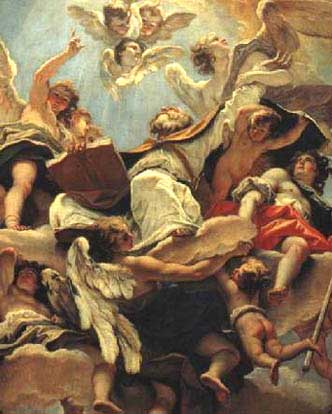
[The Ascension of Enoch, from here]
Three people are recorded in scripture as bodily going to Heaven to be with God.  Enoch (Gen 5:24), Elijah (2 Kigs 2:11), and Jesus (Acts 1:11).  How many of them were perfect, or were perfected before they were "taken up"?  I count one, the other two were presumably as flawed as the rest of us.  This fundamental tenent of some evangelistic tracts is thus fundamentally wrong.  Not being able to "get into Heaven" for one reason or another is not a part of the human problem.  If God wants you there, God is more than capable of getting you in!

Xenos has moved!

 I am now blogging at  https://jonathanrobinsonblog.wordpress.com hopefully more regularly. I'll delete this site eventually, but it wil...