My earlier post about the story of Lot came down particularly hard on Lot for his callous attitude to his virgin daughters. However, it seems I may have fallen for a narrative trap and committed an injustice of my own. George Athas suggests an intriguing alternative in his article Has Lot lost the Plot?
It is free to view on Academia.edu so click on it, and don't forget to tell him I sent you. :-)
Let me know what you think.
Showing posts with label Genesis. Show all posts
Showing posts with label Genesis. Show all posts
Thursday, October 13, 2016

Tuesday, June 19, 2012
Thompson on Preaching
Matthew Montonini kindly pointed to some videos of Bible scholar Marrianne Meye Thompson gives us some handy hints on preaching. Enjoy!
Sermons that stick
LJO Thompson - A Memorable Sermon from Ogilvie Institute on Vimeo.
Sermons that are wise
LJO Thompson - Wise Preaching from Ogilvie Institute on Vimeo.
Jesus was a Jedi master
LJO Thompson - Challenges in Preaching John's Gospel from Ogilvie Institute on Vimeo.
More videos if you click on the link to Ogilvie inst,
Let me know what you think, :-)
Sermons that stick
LJO Thompson - A Memorable Sermon from Ogilvie Institute on Vimeo.
Sermons that are wise
LJO Thompson - Wise Preaching from Ogilvie Institute on Vimeo.
Jesus was a Jedi master
LJO Thompson - Challenges in Preaching John's Gospel from Ogilvie Institute on Vimeo.
More videos if you click on the link to Ogilvie inst,
Let me know what you think, :-)
Wednesday, October 5, 2011
Subdugating Women With The Bible (again)
Someone has caused a stir by parroting the typical nonsense you hear from more hard line complementarians,
Claude Mariottini takes exception as does Darrell Pursiful.
In a similar vein but with a more positive aproach Rachel Held Evans lists ten biblical reasons for women to be in leadership.
All of which reminds me of an insightful and creative post (even if I do say so myself) from last year on this very topic. If you missed it, now you have another chance.
Ladies First: Genesis 3 and Gender Roles
Let me know what you think! :-)
Claude Mariottini takes exception as does Darrell Pursiful.
In a similar vein but with a more positive aproach Rachel Held Evans lists ten biblical reasons for women to be in leadership.
All of which reminds me of an insightful and creative post (even if I do say so myself) from last year on this very topic. If you missed it, now you have another chance.
Ladies First: Genesis 3 and Gender Roles
Let me know what you think! :-)
Tuesday, December 14, 2010
brick-a-brack 14/12/10
- A Douglas Campbell interview
- Paula Fether riffs on the theme of diaspora
- Marc shares a quote about an apophatic anthropology
- Duane wonders where the craftiness of the serpent came from (Gen 3)
- Mike Bird directs us to a trio of interesting posts about women in leadership (sometimes I feel embarassed to even be having this discussion, but it still needs to be had, although one of the links in particular show how silly this can get, i'll let you work out which one)
Nicole on Biblical Egalitariansim
Roger Nicole, reformed Baptist theologian has passed on. One thing that serparated him from many of those now extolling his virtues was his outspoken egalitarianism.
Since biblical egalitarianism is still viewed by many as inconsistent with biblical inerrancy, it is desirable to state in a very brief manner my position on this subject.
The matter of the place of women in the home, in society, and in the church is not an issue that can be conclusively determined by a few apparently restrictive passages that are often advanced by those who think that subordination represents God’s will for women.
The starting point must be at the creation of humanity, as our Lord himself exemplified by quoting Genesis 1:27 and 2:24 in response to a question by the Pharisees (Matt. 19:4-5, Mark 10:6-7). The climactic point must be at the consummation of the redemptive plan in the wedding supper of the Lamb (Rev. 19:9, 21-22), as St. Paul notes in discussing marriage in Ephesians 5:22-33. These two moments are the only ones in which sin has not damaged the institution. Thus, the line that connects creation and the eschaton of redemption represents the relationship of males and females in its unadulterated form. What comes in between may include factors due to human “hardness of heart” (Matt. 19:8).
Rest of his article on this subject available here.
Wednesday, October 13, 2010
brick-a-brack 13/10/10
- A meditation on Noah and God's guidance
- A dense and nourishing Newbiggin quote
- a poem of the postmodern creed and an historian's critique of evangelicals (HT)
- An interesting conflict between feminists and Maoridom in Te Papa
- Some predictions about Jesus' return (from here):

- Thoughts on the sinners prayer (from here):

- A world map of the web (HT):

Tuesday, September 21, 2010
Unity is bad for Human Health
Whilst sitting in on a lecture on Gen 11, I was struck by Tim's remarks concerning the way human unity is always bad for someone. Unity is always at the expense of someone, usually a minority. For example in Iraq, Sudan and Burma conflict is occuring primarily because some factions are trying to bring unity to a geographical area where other resident factions exist which want to maintain their diversity (or bring a different sort of unity).
In NZ there is a popular polemic against difference that suggests everyone in NZ is simply Kiwi, but of course what they mean is that those in ethnic minorities should simply confrom to the majority (pakeha/european). In conversation with a Maori Christian leader I was told that the churches are always saying to Maori that we should be one in Christ, but the Maori response is "one what?" Because the implicit message they receive is that to have unity they need to become european. And yet Christ's prayer in John 17 was for the unity of his church and in Acts 2, 13, Eph 2-4 and Rev 5, (among many others) we are confronted with a vision of a church where in difference and diversity there is unity around Christ.
And as if that wasn't enough, today we had a Kenyan missionary to NZ speaking and who told us that using other languages and singing the odd song from a different culture wasn't enough but he wanted the church to be interested in the "way" he wanted to worship as an African and that once a year they should let him lead worship. So I had this vision of him stood up front of his Kiwi church exhorting them to be temporarily more African which I just couldn't see going well.
My hunch is that true multicultural church needs to follow the model of Antioch (Acts 13) and have multicultural leadership. Are there any churches out there today that are truly managing to be multicultural? If so what do they look like and how do they do it?
In NZ there is a popular polemic against difference that suggests everyone in NZ is simply Kiwi, but of course what they mean is that those in ethnic minorities should simply confrom to the majority (pakeha/european). In conversation with a Maori Christian leader I was told that the churches are always saying to Maori that we should be one in Christ, but the Maori response is "one what?" Because the implicit message they receive is that to have unity they need to become european. And yet Christ's prayer in John 17 was for the unity of his church and in Acts 2, 13, Eph 2-4 and Rev 5, (among many others) we are confronted with a vision of a church where in difference and diversity there is unity around Christ.
And as if that wasn't enough, today we had a Kenyan missionary to NZ speaking and who told us that using other languages and singing the odd song from a different culture wasn't enough but he wanted the church to be interested in the "way" he wanted to worship as an African and that once a year they should let him lead worship. So I had this vision of him stood up front of his Kiwi church exhorting them to be temporarily more African which I just couldn't see going well.
My hunch is that true multicultural church needs to follow the model of Antioch (Acts 13) and have multicultural leadership. Are there any churches out there today that are truly managing to be multicultural? If so what do they look like and how do they do it?
Monday, September 20, 2010
Masturbation 1: What Not To Say
Jim asks whether or not masturbation is a sin. Which is a good question, even in these days when objective right and wrong are so unpopular. Before the topic can be approached in its own right, a few misunderstandings need to be laid to rest.
First, "the sin of Onan" was not masturbation but coitus interuptus, a form of natural birth control. His sin was not pleasuring himself, or using birth control, but failing to do right by his dead brother and continue the family line (Gen 38:8-10). Thus we exhaust all possible references to masturbation in the Bible.
Second, the advice given to Jim by his pastor and advice I have heard given elsewhere, that as long as you masturbate "without lust," i.e. not thinking about someone, is crazy talk. I once heard a youth pastor tell her flock that as long as you thought about something non-sexual while doing it it was OK, and so she recommended thinking of shopping trolleys! This ignores the possibility that, "Sexual responses can become attached to formerly neutral stimuli by pairing them with masturbation." Simply put, you run a severe risk of developing a sexual orientation towards shopping trolleys (or whatever else you might be thinking of). This may have the consequence of inhibiting normal sexual expression at a later date and/or of making visits to the supermarket an uncomfortable experience.
Third, advice about masturbation is usually given to young men who also suffer from another issue related to their adolescant sex drive: "nocturnal emmissions," AKA wet dreams. Accordingly I have a heard a youth pastor teach that boys should avoid masturbation, which makes them lustful, and instead enjoy their wet dreams, which, while may be every bit as lustful, they cannot be held responsible for because they are only dreaming. However this in no way spares boys from their lustful desires but merely makes them prey to their subconscious which is likely even more depraved than their waking imaginations.
And so the question becomes, given that all the above are dead ends, how should we begin to construct a Christian ethic regarding masturbation? What do you think?
First, "the sin of Onan" was not masturbation but coitus interuptus, a form of natural birth control. His sin was not pleasuring himself, or using birth control, but failing to do right by his dead brother and continue the family line (Gen 38:8-10). Thus we exhaust all possible references to masturbation in the Bible.
Second, the advice given to Jim by his pastor and advice I have heard given elsewhere, that as long as you masturbate "without lust," i.e. not thinking about someone, is crazy talk. I once heard a youth pastor tell her flock that as long as you thought about something non-sexual while doing it it was OK, and so she recommended thinking of shopping trolleys! This ignores the possibility that, "Sexual responses can become attached to formerly neutral stimuli by pairing them with masturbation." Simply put, you run a severe risk of developing a sexual orientation towards shopping trolleys (or whatever else you might be thinking of). This may have the consequence of inhibiting normal sexual expression at a later date and/or of making visits to the supermarket an uncomfortable experience.
Third, advice about masturbation is usually given to young men who also suffer from another issue related to their adolescant sex drive: "nocturnal emmissions," AKA wet dreams. Accordingly I have a heard a youth pastor teach that boys should avoid masturbation, which makes them lustful, and instead enjoy their wet dreams, which, while may be every bit as lustful, they cannot be held responsible for because they are only dreaming. However this in no way spares boys from their lustful desires but merely makes them prey to their subconscious which is likely even more depraved than their waking imaginations.
And so the question becomes, given that all the above are dead ends, how should we begin to construct a Christian ethic regarding masturbation? What do you think?
Saturday, September 11, 2010
NT Wright on being "Literal"
Wednesday, September 8, 2010
Ladies First? Genesis 3 and Gender Roles
I once heard a young woman tell me, "women shouldn't take the initiative in relationships because it was Eve who took the initiative in Eden and caused the fall." I think her point was, not that women shouldn't take the initiative because they were responsble for the fall, but that the fall proved that women were never meant to take the initiative. From there it seems a short step to this kind of thinking,
It is fair to say that there are a number of women in Genesis who take the initiative with negative results and in ways that disobey God. Apart from Eve, the examples of Sarai telling Abram to impregnate Hagar (Gen 16) and Potiphar's wife attempting to seduce Joseph (Gen 39) come to mind. However, in none of those examples is there any indication that the problem with their actions is that they are women. In each instance those actions are simply expressions of sin regardless of gender. Adam, Abram, and Potiphar, hardly serve as shining examples of ethical initiative taking in those narratives either.
On the other hand, in two significant narrative sections women take the initiative in highly unorthodox ways, and yet, within the world view of Genesis, are richly rewarded. The first story is that of Lot's daughters, to our modern minds a tale of depravity and incest, but in Genesis actually the story of how Lot's daughters take the initiative when their father is too scared and useless to find them husbands and ensure the survival of the family by nay means necessary. Their reward is that their offspring become two great nations, the Moabites and the Ammonites, the women are vindicated by history (Gen 19:30-38). The second story is of Judah and Tamar, where in a scarcely less sordid episode Judah's daughter in law has to disguise herself as a prostitute in order to seduce him and preserve the family line. She is rewarded by success and the recognition that her actions were righteous (Gen 38, not to mention Matt 1:3). None of this is to suggest that women's place is only in preserving the family line, i.e. breeding, but in Genesis that is pretty much all anyone, male or female, cares about. The point is that women take the initiative throughout Genesis, sometimes it results in bad and sometimes in good, just like it does with the men.
If anything, Gen 3 actually shows the Eve taking some responsibilty and admitting being deceived (3:13), whereas Adam just tries to blame both Eve and God for putting Eve in the garden with him (3:12).
It is fair to say that there are a number of women in Genesis who take the initiative with negative results and in ways that disobey God. Apart from Eve, the examples of Sarai telling Abram to impregnate Hagar (Gen 16) and Potiphar's wife attempting to seduce Joseph (Gen 39) come to mind. However, in none of those examples is there any indication that the problem with their actions is that they are women. In each instance those actions are simply expressions of sin regardless of gender. Adam, Abram, and Potiphar, hardly serve as shining examples of ethical initiative taking in those narratives either.
On the other hand, in two significant narrative sections women take the initiative in highly unorthodox ways, and yet, within the world view of Genesis, are richly rewarded. The first story is that of Lot's daughters, to our modern minds a tale of depravity and incest, but in Genesis actually the story of how Lot's daughters take the initiative when their father is too scared and useless to find them husbands and ensure the survival of the family by nay means necessary. Their reward is that their offspring become two great nations, the Moabites and the Ammonites, the women are vindicated by history (Gen 19:30-38). The second story is of Judah and Tamar, where in a scarcely less sordid episode Judah's daughter in law has to disguise herself as a prostitute in order to seduce him and preserve the family line. She is rewarded by success and the recognition that her actions were righteous (Gen 38, not to mention Matt 1:3). None of this is to suggest that women's place is only in preserving the family line, i.e. breeding, but in Genesis that is pretty much all anyone, male or female, cares about. The point is that women take the initiative throughout Genesis, sometimes it results in bad and sometimes in good, just like it does with the men.
If anything, Gen 3 actually shows the Eve taking some responsibilty and admitting being deceived (3:13), whereas Adam just tries to blame both Eve and God for putting Eve in the garden with him (3:12).
Wednesday, August 18, 2010
Lev 24:10-23, Blasphemy, the Lex Talionis and the Imago Dei
So there I am, minding my own business, reading through Leviticus with my lady wife one evening, when suddenly I realise, with great anger, that the person responsible for paragraphing my Bible (in this instance an ESV) has started a new paragraph complete with section heading in the middle of a narrative unit. What a wally. But then again, you could understand why someone might think v17 starts a new subject on account of the fact it moves from the topic of blasphemy to lex talionis (the law of retaliation). The section starts in verse 10 with the introduction of a new character:

What occurred to me as I pondered this was whether or not this might relate to Gen 9:6, where we have another lex talionis (kind of), that "whoever sheds the blood of a human, by a human shall that person's blood be shed; for in his own image God made humankind." (NRSV) Isn't the justification for this lex talionis that murder equates in someway to blasphemy against the image of God in one's fellow human? In which case the link between blasphemy and murder has already been made. In Lev 24:10-23, that link is simply made in another direction, possibly predicated on Gen 9:6. The punishment for blasphemy is death, and murder is itself a form of blasphemy, so it is simple move to go from talking about blasphemy (of the name) to murder (of the image bearer). However the law is careful to differentiate between the life of an animal and the life of a human, because the animal does not bear the image (v18, 21; animal rights activists take note!). On the other hand it is equally careful to remove differentiation between citizen and alien in this matter, all human life is equally sacred, it is not dependent on nationality (v16, 22).
Ok, so here are some questions:
1) How come all the conservative Christians that want the death penalty for murder don't campaign equally vigorously for the death penalty for blasphemy?
2) Those of you who don't support the death penalty for murder, what does that say about your valuing of the human life that was taken?
3) Matt 5:38-42 anyone?
pic from here
That is him in the middle, the offspring of a Danite woman and an Egyptian man. It seems like he was visiting his mum (maybe he had had a row with dad?) and then, perhaps because someone made an unkind remark about his parentage, and then got into a fight and whilst he was fighting blasphemed (v11). So the Israelites, who until that point had been enjoying watching a good fight, put him in custody until Moses could tell them what God wanted them to do (v12). So far so good, the Lord then speaks to Moses explaining the method for dealing with blasphemers and also pointing out that the same rule applied to both aliens and citizens, one rule for all (v13-17). But then God seems to go off on a tangent,'If anyone takes the life of a human being, he must be put to death. Anyone who takes the life of someone's animal must make restitution—life for life. If anyone injures his neighbour, whatever he has done must be done to him: fracture for fracture, eye for eye, tooth for tooth. As he has injured the other, so he is to be injured. Whoever kills an animal must make restitution, but whoever kills a man must be put to death. You are to have the same law for the alien and the native-born. I am the LORD your God.' Lev 24:17-22Which you might think started a new subject, except for the fact it cannot, because the story that started with the introduction of the half-Israelite half-Eygyptian blasphemer is yet to finish, and does in fact finish in the next verse, where his story ends with his violent death (v23). So what is the connection between blasphemy and the lex talionis, so that the author would place the two together like that? (if indeed they needed to "placed" together in the first place)
What occurred to me as I pondered this was whether or not this might relate to Gen 9:6, where we have another lex talionis (kind of), that "whoever sheds the blood of a human, by a human shall that person's blood be shed; for in his own image God made humankind." (NRSV) Isn't the justification for this lex talionis that murder equates in someway to blasphemy against the image of God in one's fellow human? In which case the link between blasphemy and murder has already been made. In Lev 24:10-23, that link is simply made in another direction, possibly predicated on Gen 9:6. The punishment for blasphemy is death, and murder is itself a form of blasphemy, so it is simple move to go from talking about blasphemy (of the name) to murder (of the image bearer). However the law is careful to differentiate between the life of an animal and the life of a human, because the animal does not bear the image (v18, 21; animal rights activists take note!). On the other hand it is equally careful to remove differentiation between citizen and alien in this matter, all human life is equally sacred, it is not dependent on nationality (v16, 22).
Ok, so here are some questions:
1) How come all the conservative Christians that want the death penalty for murder don't campaign equally vigorously for the death penalty for blasphemy?
2) Those of you who don't support the death penalty for murder, what does that say about your valuing of the human life that was taken?
3) Matt 5:38-42 anyone?
Wednesday, August 11, 2010
Gen 1:27 and the Gendering of God
You hear people saying all sorts of stupid things about the Bible and if I blogged each one I would never stop blogging. However a particularly choice example was the time I was told, with great enthusiasm, that Gen 1:27 tells us that God is both male and female, because God created male and female in his image. (wait for it, that wasn't the most stupid bit) Because God is both male and female, but humans in his/her image are only male or female, when a man and woman have sex they bring those two aspects of God together and so when we have sex it is the closest we come to bearing the complete image of God! I might forgive the person who said that, because they were single and so had no first hand experience that might dissuade them that coitus resulted in such a elevated state. No I blame the supposed Bible teacher who told her that.

In fact the male and female is not what makes us "in God's image" at all, but in actual fact gives us something in common with the animals. Hence the Hebrew, zachar unekevah (זָכָר וְּנְקֵבָה), are the same words that you would use to refer to male and female animals. And this is why, for Christians, sex, although a good gift from God, has nothing to do with being more or less close to God because eternal life does not involve marriage or procreation (Mark 12:25). Being male and female is a consequence of the need to go forth and multiply, not of being made in God's image. Consequently those who are single/celibate are no less bearers of the image of God than those who are married. Finally it needs to be pointed out that if God were both male an female he would be an hermaphrodite. No offence to hermaphrodites, but God has no body so for him/her to have any sexual organs, let alone both sets, is not possible. God only gets called "him" or "her" because English has no gender neutral personal pronoun, which is pretty inconvenient, just ask an hermaphrodite.
Male and female fairy wrens, from here
The verse reads:So God created man in his own image,The point of course, is that God created them in his own image and he also created them male and female. The point is not that male and female make up different aspects of God's image, but that BOTH male and female bear God's image equally.
in the image of God he created him;
male and female he created them.
In fact the male and female is not what makes us "in God's image" at all, but in actual fact gives us something in common with the animals. Hence the Hebrew, zachar unekevah (זָכָר וְּנְקֵבָה), are the same words that you would use to refer to male and female animals. And this is why, for Christians, sex, although a good gift from God, has nothing to do with being more or less close to God because eternal life does not involve marriage or procreation (Mark 12:25). Being male and female is a consequence of the need to go forth and multiply, not of being made in God's image. Consequently those who are single/celibate are no less bearers of the image of God than those who are married. Finally it needs to be pointed out that if God were both male an female he would be an hermaphrodite. No offence to hermaphrodites, but God has no body so for him/her to have any sexual organs, let alone both sets, is not possible. God only gets called "him" or "her" because English has no gender neutral personal pronoun, which is pretty inconvenient, just ask an hermaphrodite.
Saturday, August 7, 2010
Sermon on Genesis 11:27-12:5, Galatians 3:6-9

Key concepts: the identity of God's people, whakapapa, introductions, pregnancy, faith, the gospel
BTW for non NZ listeners whakapapa ("wh" sounds "f") is a Maori word/concept which denotes ancestry, lineage, stories of identity and history. See here for more details.
Friday, July 23, 2010
Pedagogy of Genesis
It is common in our society to think that for a book of the Bible, whether Genesis or any other, to be practical and relevant, it must give us a course of action. It is more common in the Old Testament for its practical teaching to give us a way of thinking . . . The practical lessons of Genesis offer us a new way of thinking that will inevitably result in life changes.
- Walton, Genesis, NIVAC, 2001, 55
[T]he narrators interests are historical . . . his interests are also inseparably didactic and aesthetic. Unlike a geometry textbook that may aim to be only didactic, Genesis is literature because it communicates doctrine in an artful way; it is ideological art.
- Waltke, Genesis, 2001, 31
Monday, May 17, 2010
The 10th Plague and the Problem of Evil
Tim, in his podcast on the passover, finds God's cold blooded killing of all the firstborn in Egypt (Ex11:4-8, 12:29-32) too much to stomach and too hard to believe. As a compassionate human being, I find myself agreeing with Tim. I said as much to the group that I am going through the E-100 readings with and got pretty short shrift from them.

But I wonder if this kind of casuistry is a little beside the point. Part of the punishment was for the firstborn of all the animals to die, the first born of all the animals that had already been killed in the 5th plague (Ex 9:1-7). Which suggests in at least one account, if not both, a little exageration is taking place. This is not deception, because it is there in the text, as plain as the nose on your face. If you read it you will see it, and its author/s must have seen it too. My friend's second point, having lived in the Middle East, was that he could testify that that culture contains a lot more ambiguity than our modernist Western one. So the rather absolute language of Ex11:4-8 and 12:29-32 could legitimately be taken with a grain of salt.
But I'm not sure how much that helps me either. The real question is not, how can I get this text to fit in with what I think is acceptable or not for God to do? The real question, or at least what I think they try and teach us at Bible college, is to ask what is this text trying to say to us? It blatantly does not give a tinkers fart as to whether or not we think God's actions are proportionate or even historical. The story's concern is with God's distinction between the oppressed (in this instance Israel) and the oppressors (in this instance Egypt) (Ex 11:7). The story's concern is to show how God is keeping his promises to Abraham (Gen 12:1-3), i.e. the survival of the people of Israel, ultimately how God is going to redeem all creation. The story's concern is to tell us about . . . God.
This was my friend's most helpful insight today: A year ago, after his back had been broken, he had been praying and hoping for healing. And yet in the last year, from being wheelchair bound and suffering in a number of other respects, he can see all the things he has learnt about God through his infirmity. Now he isn't really that interested in praying for healing.
Such an idea is disgusting. How can he possibly justify God for his crippled state when he should be enjoying health and wealth and prosperity like any deserving child of the western world. How can he possibly understand his suffering as something positive? Is knowing God really better than walking and using a toilet? Is it really worth the death of all those Egyptian first born humans and animals for God to accomplish his promise to Abraham?
Well I don't know the answer to that question, I've never lost my legs or a child, I hope I never do. But I do wonder if maybe I have the problem of evil all wrong, maybe evil looks so bad to me because I think the point of it all is for me to have a nice life. What if the point of it all is to know God? A god who prefers the poor and oppressed, a god who is redeeming creation, a god who doesn't appreciate my need for no one to get hurt, or at least for me not to get hurt, but is willing to hurt anyone and everyone if that is what it takes? I don't know if that is a god I can believe in, I don't know if I have the guts for that, but I think that might be the sort of god that the Bible believes in. . .
Let me know what you think,
image from here
One friend, who had his back broken in a car accident while working as a missionary in Egypt pointed out that this was God's judgment upon the Egyptians for their mistreatement of the Israelites (Ex 1). That is a fair point, if indeed we do believe in justice, in the punishment fitting the crime. The Egyptians had tried to kill every son of the Israelites, and were presumably only keeping the girls alive in order to take advantage of them, so this punishment seems proportionate, even a little lenient.But I wonder if this kind of casuistry is a little beside the point. Part of the punishment was for the firstborn of all the animals to die, the first born of all the animals that had already been killed in the 5th plague (Ex 9:1-7). Which suggests in at least one account, if not both, a little exageration is taking place. This is not deception, because it is there in the text, as plain as the nose on your face. If you read it you will see it, and its author/s must have seen it too. My friend's second point, having lived in the Middle East, was that he could testify that that culture contains a lot more ambiguity than our modernist Western one. So the rather absolute language of Ex11:4-8 and 12:29-32 could legitimately be taken with a grain of salt.
But I'm not sure how much that helps me either. The real question is not, how can I get this text to fit in with what I think is acceptable or not for God to do? The real question, or at least what I think they try and teach us at Bible college, is to ask what is this text trying to say to us? It blatantly does not give a tinkers fart as to whether or not we think God's actions are proportionate or even historical. The story's concern is with God's distinction between the oppressed (in this instance Israel) and the oppressors (in this instance Egypt) (Ex 11:7). The story's concern is to show how God is keeping his promises to Abraham (Gen 12:1-3), i.e. the survival of the people of Israel, ultimately how God is going to redeem all creation. The story's concern is to tell us about . . . God.
This was my friend's most helpful insight today: A year ago, after his back had been broken, he had been praying and hoping for healing. And yet in the last year, from being wheelchair bound and suffering in a number of other respects, he can see all the things he has learnt about God through his infirmity. Now he isn't really that interested in praying for healing.
Such an idea is disgusting. How can he possibly justify God for his crippled state when he should be enjoying health and wealth and prosperity like any deserving child of the western world. How can he possibly understand his suffering as something positive? Is knowing God really better than walking and using a toilet? Is it really worth the death of all those Egyptian first born humans and animals for God to accomplish his promise to Abraham?
Well I don't know the answer to that question, I've never lost my legs or a child, I hope I never do. But I do wonder if maybe I have the problem of evil all wrong, maybe evil looks so bad to me because I think the point of it all is for me to have a nice life. What if the point of it all is to know God? A god who prefers the poor and oppressed, a god who is redeeming creation, a god who doesn't appreciate my need for no one to get hurt, or at least for me not to get hurt, but is willing to hurt anyone and everyone if that is what it takes? I don't know if that is a god I can believe in, I don't know if I have the guts for that, but I think that might be the sort of god that the Bible believes in. . .
Let me know what you think,
Tuesday, April 13, 2010
Are there really no imperfect people in heaven?
OK, quick rant here, in the last couple of months I have come across two different evangelistic messages (and it's not like I read a lot of them, being already converted and all!) which have as a central premise in their description of the human problem of sin the fact that we cannot get into Heaven because we are sinners and only perfect souls/people can get in. There are huge problems with this for all sorts of reasons but the most glaring one is that such an idea contradicts the Bible even upon the most cursory and literalistic reading.
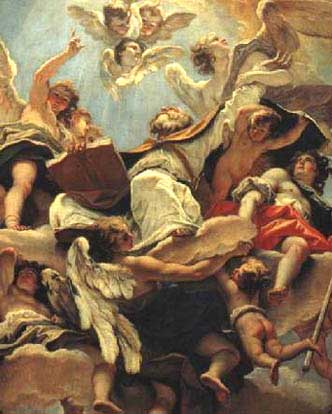
[The Ascension of Enoch, from here]
Three people are recorded in scripture as bodily going to Heaven to be with God. Enoch (Gen 5:24), Elijah (2 Kigs 2:11), and Jesus (Acts 1:11). How many of them were perfect, or were perfected before they were "taken up"? I count one, the other two were presumably as flawed as the rest of us. This fundamental tenent of some evangelistic tracts is thus fundamentally wrong. Not being able to "get into Heaven" for one reason or another is not a part of the human problem. If God wants you there, God is more than capable of getting you in!
Wednesday, April 7, 2010
Masculinity and Leisure
Richard Beck, while reflecting on Mark Driscoll's appeal, makes the interesting thesis that education feminises men (HT Steve). As many pastors tend to be well educated this means that male pastors have a tendency to be femininised, to the potential detriment of their ability to connect with blue collar "manly" males. What is interesting is that Beck's criteria for the femininity of educated men are actually not to do with physical appearance or language (which you might consider primary in terms of interpersonal relationships) but are based on leisure. Hence if a man chooses to take up knitting he is behaving in a feminine way, but if he prefers to hunt he is being more masculine. So feminity here, while correlated to education, is actualy a function of leisure.
This gave me some food for thought. What is it about education that should cause men to change their leisure habits? I am reasonably educated but I also love hunting, fishing, mountain biking, motorbikes and power tools. But I don't get to do much of any of them because they are just not a priority for me. Instead most of my leisure time (and I don't get much due to having small children at home) gets spent doing things like reading, playing music, and soduku - I'm a girl! It's not that I don't like doing manly things, I just don't have enough drive to do those things regularly.
Here's my stab at some pop-psychology:
Men who have acheived educationally tend to get jobs where they are affirmed in their competencies, respected, and given decision making power. Thus while their jobs may not look especially "manly" they feel affirmed as men through their work and are free in their leisure time to do whatever they want, having expressed their masculinity satisfactorily through their work.
On the other hand, blue collar workers, though doing man-ual labour, are often at the bottom of the tree in their working environments, undermined and with little power or authority when it comes to making decisions (and yes I have worked in both construction and manufacturing). Hence they have a greater drive to use their leisure time for the purpose of reinforcing their masculinity. These manly leisure activities generally involve asserting control over the environment (MTB or DIY!), machines (cars, bikes, computers) or over other creatures (hunting, fishing, coaching sports) and thus are designed to make up for what is lacking in the work place.
Nietzsche might see that as a product of the will to power, but perhaps a Christian could see it as God's gift of dominion to humanity (Gen 1:26) trying to assert itself in frustrated men. Let me know what you think :-)
This gave me some food for thought. What is it about education that should cause men to change their leisure habits? I am reasonably educated but I also love hunting, fishing, mountain biking, motorbikes and power tools. But I don't get to do much of any of them because they are just not a priority for me. Instead most of my leisure time (and I don't get much due to having small children at home) gets spent doing things like reading, playing music, and soduku - I'm a girl! It's not that I don't like doing manly things, I just don't have enough drive to do those things regularly.
Here's my stab at some pop-psychology:
Men who have acheived educationally tend to get jobs where they are affirmed in their competencies, respected, and given decision making power. Thus while their jobs may not look especially "manly" they feel affirmed as men through their work and are free in their leisure time to do whatever they want, having expressed their masculinity satisfactorily through their work.
On the other hand, blue collar workers, though doing man-ual labour, are often at the bottom of the tree in their working environments, undermined and with little power or authority when it comes to making decisions (and yes I have worked in both construction and manufacturing). Hence they have a greater drive to use their leisure time for the purpose of reinforcing their masculinity. These manly leisure activities generally involve asserting control over the environment (MTB or DIY!), machines (cars, bikes, computers) or over other creatures (hunting, fishing, coaching sports) and thus are designed to make up for what is lacking in the work place.
Nietzsche might see that as a product of the will to power, but perhaps a Christian could see it as God's gift of dominion to humanity (Gen 1:26) trying to assert itself in frustrated men. Let me know what you think :-)
Tuesday, March 30, 2010
Some more observations on Genesis 1-3
I am hoping to do a proper study on Genesis later this year for all sorts of reasons (do I need a reason?) but had a few thoughts last night while reading and this is a good place to drop them down, till later.
So two very different creation narratives put next to each other and of course it is often observed that things happen in the opposite order. In the first one the order of creation is plants, animals, humans. In the second it is man, plants, animals, woman. By wodging (a technical term!) the two narratives together two things happen.
The other point is that last time I made some observations on Genesis ETB suggested that the serpent might have been a winged beast rather than a legged one. But that seems contrary to the text's designation of the serpent as a חַיַּת הַשָּׂדֶה (beast of the field, 3:1) as opposed to a כָּל־עֹוף הַשָּׁמַיִם (bird of the air, cf. 2:19). So the old saw about the snake 'not having a leg to stand on', still stands, if you catch my drift. :-)
So two very different creation narratives put next to each other and of course it is often observed that things happen in the opposite order. In the first one the order of creation is plants, animals, humans. In the second it is man, plants, animals, woman. By wodging (a technical term!) the two narratives together two things happen.
- A chiasm of sorts is created around the Sabbath which is bookended on either side by the creation of man. Could this be significant?
- In the first story creation is completed by the creation of humanity, both male and female, but in the second creation is only completed by the creation of woman. Both stories place the creation of a whole humanity (both genders) as the telos of creation. What is the compound effect of these two narratives with such high anthropologies?
The other point is that last time I made some observations on Genesis ETB suggested that the serpent might have been a winged beast rather than a legged one. But that seems contrary to the text's designation of the serpent as a חַיַּת הַשָּׂדֶה (beast of the field, 3:1) as opposed to a כָּל־עֹוף הַשָּׁמַיִם (bird of the air, cf. 2:19). So the old saw about the snake 'not having a leg to stand on', still stands, if you catch my drift. :-)
Tuesday, March 9, 2010
Paul, Philo, Adam and the Imago Dei
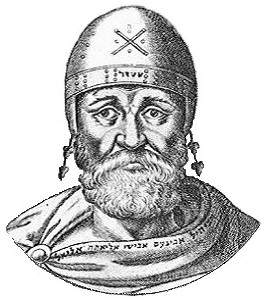
* R.A. Horsley, “Pneumatikos vs Psychikos: Distinctions of Spiritual Status among the Corinthians,” Harvard Theological Review, 69, 1976, p269-288.
** Philo, Legum Allegoriae, 1:31
Thursday, March 4, 2010
Is Adam Israel?

[pic from here]
I know a number of people who read this blog are concerned how to understand the fall if theistic evolution is accepted. Peter Enns offers here one suggestion for a way forward [HT Mike]. Very, very, interesting stuff. Enns is planning to follow up by looking at Paul's understanding of Adam. One idea I have for a project after I finish my MTh is to do a study of how Gen 1 and Gen 2-3 are treated in Second Temple Judaism as an attempt to understand why Paul uses Gen 2-3 so much but never goes near the theologically fertile ground of Gen 1 (unlike the gospel of John for instance). Or am I wrong about that? Any thoughts?
Subscribe to:
Posts (Atom)
-
Just been reading a fun little article with an approach to Jesus' preexistence in Mark's Gospel that I haven't come across befor...
-
James McGrath's blog really is a mighty blog. He is single handedly responsible for sending over 80 readers to this weeks carnival. If y...
-
Haere mai, tena koutou katoa. Welcome one and all to New Zealand for the October 2010 Biblical Studies Carnival. Don't worry, sausages...
