Showing posts with label Judaism. Show all posts

Monday, July 26, 2010

NT Wright on the Kingdom of God

The phrase 'kingdom of God', therefore, which occurs only sporadically in texts of this period, functions, when it occurs, as a crucial shorthand expression for a concept which could be spoken of in a variety of other ways, such as the impossibility of having rulers other than Israel's god, or the divine necessity of reversing the present political situation and re-establishing Israel, Temple, Land and Torah.   This complex concept picks up and join together the whole social, political, cultural and economic aspiration of the Jews of this period, and invests it with the religious and theological dimension which, of course, it always possessed in mainline Jewish thinking. (p303)


To speak of the kingdom of this god does not, therefore, mean that one is slipping into a dualistic mode of thought, or imagining that the event which is to come would be related only marginally to space-time events.  This kingdom was not a timeless truth, nor an abstract ethical ideal, nor the coming end of the space time universe.  (p307)

The texts in question are those of 2nd Temple Judaism, but if we accept Wright's analysis of them then this should also factor in our interpretation of the NT use of the same phrase.  The question is not whether or not Jesus re-interpreted the phrase when he used it, he did, but how did he do so and what areas of conceptual and aspirational overlap remained?

Monday, April 26, 2010

McGrath, The Only True God: A Book Review

James F. McGrath, The Only True God: Early Christian Monotheism in Its Jewish Context

[With thanks to the author for a review copy]

McGrath’s book has an argument that for many would seem counterintuitive, that the early Christians did not diverge from Jewish monotheism, even despite their veneration of Jesus. For McGrath this is simply because the modern conceptions of monotheism are not how 1st Century Jews would have defined their monotheism.  The book’s thesis is that while Christians, post Nicaea, are used to thinking about monotheism in terms of ontology, 1st Century Jews defined their devotion to the one God in terms of worship.  While Christians did worship Christ in some respects, McGrath argues that only sacrificial worship to Christ would have made Christ equal to God in a way that would constitute a breach of 1st Century Jewish monotheism.

The book itself has the rare virtue of being blessedly short, a mere 104 pages of text (not including notes, bibliography and index).  That being the case, what McGrath achieves within those pages is all the more impressive.  The book is intended to be accessible to those without a detailed knowledge of the field.  Thus the first chapter takes pains to explain clearly the important concepts and relevant methods.  This is done in a thorough but economical style.  In the second chapter McGrath turns to the question of how Jews in the Greco-Roman era would have understood their own monotheism in the context of a world where the worship of many gods was commonplace.  Given the book’s intention to be accessible to the non-expert it is a shame that some of the more obscure source passages referenced, e.g. Hecataeus of Abdera, do not appear in translation, instead the reader is reliant on McGrath’s précis of the relevant points.  Having established a working definition of 1st Century Jewish monotheism McGrath moves on to examine the writings of Paul (chp 3), the Gospel of John (chp 4), and Revelation (chp 5), against this definition.  In each chapter McGrath continues to develop his thesis and in each case finds the Christian elevation of Christ to be within the bounds of his definition of 1st Century Jewish monotheism.

The sixth chapter moves on from the Biblical material to discuss the “two powers heresy” within rabbinic literature.  McGrath argues that after the destruction of the Jerusalem Temple Jewish monotheism was forced to redefine itself.  One result of this process was the rabbinic response to the two powers heresy which while probably originally targeted at the Gnostics came to encompass the Christians also.  McGrath concludes that certain ideas that were condemned in the late 2nd and early 3rd centuries need not have been controversial in the 1st century.  Thus the schism between Christianity and Judaism over their respective understandings of monotheism is re-dated from the 1st to the 3rd century and, surprisingly, is a result of a change in the boundaries of Jewish monotheism rather than a developing Trinitarianism.  The final chapter briefly summarises the book’s findings and then offers some thoughts on their historical and theological implications.

McGrath’s book is excellently written, the only hindrance to the reader’s enjoyment being the use of endnotes instead of footnotes.  It consistently progresses through his argument with nuance but without wasting space on peripheral issues.  It engages with other scholarship in a respectful but efficient manner and represents a significant contribution to the field.  McGrath’s concluding thoughts are balanced and show a concern for further discussion and for the appropriation of the work by theologians.  I would suggest it is essential reading for anyone interested in NT background, Christology, or the historical development of Trinitarian theology.

Thursday, March 4, 2010

Politics and Theology in 1st Century Israel


Cartoon from here
According to Josephus, the Sadducees believed in free will. Just as I am inclined to think that Josephus’ description of the Pharisaic blend of free will and fate is a depoliticized code for their balance between waiting for Israel’s god to act and being ready to act on his behalf if necessary, so I am inclined to think that the Sadducean belief in free will has little to do with abstract philosophy and a great deal to do with the politics of power: Israel’s god will help those who help themselves. This is a comfortable doctrine for those in power, who maintain themselves there by taking whatever measures seem necessary, just as its mirror image, belief that divine action can only be awaited, not hastened, is a consoling doctrine for those out of power, who see no hope of regaining it by their own efforts.

NT Wright NTPG p211

Which is funny because I would have thought it was the other way round, that conservatives (i.e. those who rather like the staus quo) would be more inclined to assert that the way things are is a matter of unavoidable fate, whereas those who desire to challenge it, radicals, are more likely to emphasise the importance of taking action according to free will rather than the current social norms.  Of course both free will and fate are almost impossible to hold to in absolute terms for any one.  But I think Wright is totally right (no pun intended) that theology and politics tend to actually be the same thing just presented in more or less pious language depending upon the perceived audience.  Which is why you cannot take religion out of politics, and vice versa, all political discourse is inherently theology, and vice versa.

Is Adam Israel?

 
[pic from here]
I know a number of people who read this blog are concerned how to understand the fall if theistic evolution is accepted.  Peter Enns offers here one suggestion for a way forward [HT Mike].  Very, very, interesting stuff.  Enns is planning to follow up by looking at Paul's understanding of Adam.  One idea I have for a project after I finish my MTh is to do a study of how Gen 1 and Gen 2-3 are treated in Second Temple Judaism as an attempt to understand why Paul uses Gen 2-3 so much but never goes near the theologically fertile ground of Gen 1 (unlike the gospel of John for instance).  Or am I wrong about that?  Any thoughts?

Friday, January 22, 2010

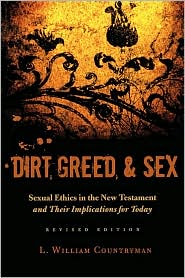
Countryman - Dirt, Greed, and Sex: A Book Review


William Countryman, Dirt, Greed, and Sex, Fortress 2007.

This book is a brilliant and challenging survey of New Testament sexual ethics.  What is unique about it (at least in my experience) is that it approaches these issues, not through the grid of our own modern approach to such matters but seeks to reconstruct the grid which those in the world of the NT would have used.  This book is frequently cited in other literature and usually accompanied by the word "provocative."  I took this to mean that not everyone liked the conclusions but they weren't interested in arguing the point right now.  How ever I think it is a fair word to use of the book.  It has two levels to it.  On one level it is an excellent attempt at bring the reader into a different way of looking at sex and, as far as I can tell, from the point of view of 1st century Christians.  On the other hand this book is not written into a vacuum and while the book is hardly dedicated to the gay debate it is nonetheless intended as a contribution to it and it is where things come closest to this topic that I think the book is at it weakest. 

The first major section is dedicated to the concept of purity, drawing heavily on the work of Mary Douglas Countryman first shows how purity considerations operated in the OT and 1st century Judaism.  He argues that while we moderns hapily differentiate between say food hygene and sexual purity, the ancient world had no concept of germs, genetics or STDs and treated all purity considerations as of one set.  Countryman then goes on to show how the NT reframes purity considerations from external matters (food, dead people, sex, etc) to that of the heart (motive, intention, love, hate, etc).  Countryman concludes that for the NT purity considerations are no longer binding on the conduct of Christians for any area of life, including the sexual.

The second section moves onto what for Countryman is the other major ancient concept for sexual ethics, property.  Countryman persuasively demonstartes how sexual transgressions were primarily conceived of as transgressinos against the property of another.  he demonstrates the OT and second temple judaism backgrounds for this and then shows how the NT both retains this understanding but also radically modifies it.  This section of the book is the most exciting as Countryman skillfully explicates how Jesus' prohibition against divorce served to deconstruct the system of patriarchy.  Countryman then traces this impetus through Paul but concludes that the later NT writings show evidence of a reversion to patriarchy and that even Paul was never consistent in applying this new radical approach to the equality of the sexes.

The final (and shortest) section contains a summary and then Countryman's suggestions for how his exegesis of NT sexual ethics might be aplied today.  This is by far the weakest section.  Countryman's arguments here lack the thoroughness and consistency he (generally) applied to the earlier sections.  While many of his conclusions are hard to disagree with his ethical method is rather slipshod and he spends too little time working on how to move from the NT to today but merely seems to muse on how his findings affect his selection of topics.

With regard to the gay debate, Countryman's own agenda appears to affect the exegesis negatively at a couple of points, not least his discussion of malkoi and arsenokoitai  in 1 Cor 6:9-11 (pp195-6) and of Luke 7:1-17 (pp75-6, 246, 327).  1 Cor 6:9-11 especially is a big issue and I hope to blog specifically on it later as it bears on my own thesis.   What he succeeds in doing, very well, is showing the ambiguity of those NT texts which are often used to forbid homosexuality.  This is a point that needs to be made, however to the educated it should hardly be surprising as "homosexuality" per se was not a concept for either Jew or Gentile in the first century, it is a modern idea.

Overall I am grateful for a very well written book that has given me a lucid and extremely helpful introduction to NT sexual ethics.  By comparison the other books I've read have tended to both treat NT ethics as if they were written about our (modern) problems and be as dull as ditch water.  In particular the insight that NT sexual ethics revolve around concepts of property (why has no one else pointed this out to me!!!???) is a vital insight for my work on 1 Cor 6:12-20 and will be an important shaping factor for my final conclusions.  Already it is an insight that has made sense of a lot of loose ends for me and I'll be keeping the book close for the next few months.

[I have also quoted from the book here and here.]

Monday, December 14, 2009

Wright on Story, Worldviews and Theology

Telling stories was (according to the synoptic gospels) one of Jesus' most characteristic modes of teaching. And . . . it would clearly be quite wrong to see these stories as mere illustrations of truths that could in principle have been articulated in a purer more abstract form. They were ways of breaking open the worldview of Jesus' hearers, so that it could be remoulded into the worldview which he, Jesus, was commending. His stories, like all stories in principle, invited his hearers into a new world, making the implicit suggestion that the new worldview be tried on for size with a view to permanent purchase. . .

If it is true that all worldviews are at the deepest level shorthand formulae to express stories, this is particularly clear in the case of Judaism. Belief in one god, who called Israeli to be his people, is the very foundation of Judaism. The only proper way of talking about a god like this, who makes the world and then acts within it, is through narration. To 'boil off' an abstract set of propositions as though one were thereby getting to a more foundational statement would actually be to falsify this worldview at a basic point.


NT Wright, NTPG, p77

Monday, November 30, 2009

The Danger of Apologetics

The most neglected theme of this blog is the one of diaspora. But it is one I am keen not to lose grip on because it is a metaphor that has many insights to offer and is an important antidote to many vices that are the hangover from "Christendom." In recent past the church in NZ has probably been most noticeable in the public arena regarding the evolution/creation debate, same sex marriage, and to a lesser extent the anti smacking bill. All of these issues stem not from essential Christian doctrines but from Christians trying to answer challenges the wider society has given.
The Jews of the Hellenistic Diaspora thus found themselves interpreting their particularity in terms of a thought-world that bore no original relationship to it. The particularity of Israel was sometimes a burden to them in relationships with Gentiles, but it was also essential to their own sense of national and religious identity. Without it, they could not survive as a people. yet they could not survive with it, either, unless they were prepared to explain and defend it in terms intelligible to the larger world, and the very process of explanation and defense tended to alter the characteristic of the thing being explained.

From, Dirt, Greed and Sex, by L. William Countryman.

The great problem with today's Christian public interaction is that it is largely reactive and so the agenda has been set from outside the church. The result is that the church becomes increasingly positioned over and against secondary and marginal issues which in turn become much greater and assume a more central significance than they should have. In defending our faith against these attacks we run the danger of becoming a caricature of ourselves and losing sight of what really makes us who we are. Apologetics is very important, even essential, to maintaining a diaspora identity but it must be done wisely with an eye on the effect engaging in such a defense has on us. The first task of apologetics should not be to convince the scoffer but to preserve the integrity of that which is being defended. Otherwise even if we win such battles they will be only Pyrrhic Victories.

Thursday, September 10, 2009

Home away from home

I'm just reading (or rather skipping through) Erich Gruen's excellent book, Diaspora: Jews amidst Greeks and Romans (Harvard, 2002). In it he suggestes there were two ways in which the Jews related to their situation as diaspora, i.e. living being away from their homeland. The first was negative, to think in terms of "exile, a bitter and doleful image, offering a bleak vision that leads either to despair or to a remote reverie of restoration." Or a positive approach, to seek "refuge in a conforting concept: that Jews require no territorial sanctuary or legitimation. They are "the people of the Book." Their homeland resides in the text." (p232) And how did the diapora Jews "make their home in the text"? Well, primarily by meeting regularly with each other, to read and interpret those texts in their diaspora locality (p116).

I think this is an important concept for us Christians given how much pressure, traditional forms of church, and especially the 'sermon' is currently under. As a diaspora ourselves we need to maintain our emphasis on making our home in the text and not the world. We need to ensure that in the desire to do something different we do not lose that diaspora imperative to regularly meet for the reading and interpretation of the text that gives us our identity, that we don't stop being 'people of the Book.'

Xenos has moved!

 I am now blogging at  https://jonathanrobinsonblog.wordpress.com hopefully more regularly. I'll delete this site eventually, but it wil...