Showing posts with label Thesis. Show all posts

Thursday, December 16, 2010

Thesis Now Online

Discovering Paul’s Theological Ethic in 1 Corinthians 6:12-20

My MTh thesis is now available as a PDF online. Read and enjoy! If you are new to the blog why not add me to your feed reader, you never know, you might like it and you can always delete me if you don't. 

My thesis conclusion is here and my examiners' comments are here if you want to do some research before diving right in. 

PS. If you do read it and find any mistakes or bones of contention !

Tuesday, November 30, 2010

Thesis Results

Not much time today but thought you might be interested to know my MTh thesis has returned to me, having been anonymously marked by two NT scholars (but there aren't that many in NZ to choose from - so feel free to guess who) and they both liked it, giving it 9.0 or an A+.  Just a few typo and grammar errors to sort and I should be publishing it online shortly.  In the interests of bragging I thought I would share with you some of the comments.  I promise I will return to my usual humble self soon.


And the second marker was also very kind, 


How do you like them apples?  Well it isn't really bragging, it is more promoting the forthcoming (online) publication.

Friday, October 22, 2010

Dio Chrysostom vs Paul on Prostitution


Among the Greeks, only Dio Chrysostom addressed the subject of prostitution directly and at length,[1] although the discussions of sexual morality by both Musonius Rufus (Fragment 12) and Seneca (Epistle 94.25-6) indirectly condemn the use of prostitutes.[2]  Chrysostom’s treatment (Discourse 7:133-37) warrants examination as it represents the only extant sustained treatment of the subject by one of Paul’s near contemporaries.[3]  Chrysostom’s target is those who rule the city (7:136-7) and his concern the way in which they deal with the “brothel keepers” (πορνοβοσκῶν, 7:133).   In line with other Greek moralists he considers that sex should not only be reserved for marriage, but also for procreation (7:134-5).[4]  He presents a number of ethical concerns.  Chrysostom considers it wrong to profit by human misfortune, assuming prostitutes to be slaves by either war or purchase (7:133; cf. 7:52).  He refers to the “hapless women and children” involved as σώματα (7:133).  Nevertheless, he does not show any concern for rescuing those hapless bodies, only that it is beneath the dignity of a moral man to exploit them.  Furthermore, such sexual activity outside of a productive marriage is a source of shame (αἰσχύνω) to its participants and constitutes disrespect of the gods (7:133-5, cf. 1 Cor 4:14; 6:5).[5]  Although much of Chrysostom’s treatment is humane, ultimately his concern is with the effect unrestricted prostitution has on the overarching morality of the city (7:140-52; cf. 1 Cor 5:6-13).  The holiness that is potentially defiled is not that of the individuals involved but of the “government buildings and temples” (7:133-4).  Moreover, Chrysostom’s injunctions are not absolute; the city rulers must moderate their response to this immorality according to what is “practicable” (7:137). 

It is noticeable how different Paul’s approach is from Chrysostom’s.  Admittedly they are addressing very different audiences.  One might expect Paul to share the humanitarian concern for the unfortunate prostitutes.  One might expect Paul to be concerned about the effect of prostitution on the rest of the church community (cf. 1 Cor 5:1-13).[6]  Instead we are presented with Paul’s detailed attempt to realign a wrong application of a correct principle of Christian life:  Christian freedom, “πάντα μοι ἔξεστιν”!  The moral landscape has to be reset to the new reality in Christ and a new ethic has to be constructed on the basis of this new reality.  Neither does Paul appeal to a rule or a demand for sexual purity, because to do so would contradict this freedom.[7]  Nor does he show any concern that the prostitute is an outsider to the community; 1 Cor 7:12-16 shows conclusively that sex with outsiders was not the issue.  Even so, there is no reason the prostitute could not have been a member of the community herself.  Prostitutes were usually slaves, and there were certainly slaves in the Corinthian church (cf. 7:21).  Finally, Paul’s concern for what is “practicable” only emerges later in his discussion of marriage (e.g. 7:1-7); his command to “flee sexual immorality” (6:18a) leaves no room for compromise or negotiation.


[1] Stambaugh and Balch, The New Testament in Its Social Environment, 158.
[2] Cf. Abraham Malherbe, Moral Exhortation: A Greco-Roman Sourcebook (Philadelphia, Phil.: Westminster, 1986), 128, 152-54.
[3] Dio Chrysostom, Dio Chrysostom: Discourses 1-11, trans. J.W. Cohoon, LCL 257, (1932), 364-65.
[4] Cf. Malherbe, Moral exhortation, 152, 154.
[5] The absence of any discussion of procreation in 1 Cor 6:12-7:40 is a noticeable lacuna in Paul’s sexual ethics there and NT ethics generally.
[6] Cf. Gupta, “Which Body is a Temple?,” 527.
[7] See §2.1, especially §2.1.5, para 5.

Margaret Davies on Prostitution and the Bible

Google Books really is a splendid resource, and it is getting to the satge now that undergraduate students can probably find enough information on it to not have to read any real book at all for assignments.  Margaret Davies has a chapter in The Bible in Human Society called "On Prostitution" (pp225-49) and it is that piece of work that I knew I would find soon after submitting my thesis that I would have loved to be able to interact with in my thesis.  But such is life!  Only the first part of the essay is visible via Google Books, but there is enough in there to still be a very worthwhile read.  I was very interested that for a feminist biblical scholar she seemed intent on interpreting the biblical evidence in the worst possible way.  This may reflect my own personal bias but I think there is something extraordinary about the Bible in its historical context that means that its message seems to be more contrast than correspondence with the misogyny of the world around it and should be interpreted accordingly.  Her all too brief but very interesting treatment of 1 Cor 6:12-20 (p240) fits in well with my own thesis.


She also briefly touches on Dio Chrysostom's treatment of prostitution (p242) and gives him credit for trying to marshall public opinion against the exploitation of prostitutes in the 2nd century while the Christians did no such thing.  To which I would respond, 1) the Christians were in no position to do any such thing, and 2) my own analysis of Chrysostom's argument does not put him in such a noble light although Davies' statement is essentially true, her failure to even refer to the particular passage of Chrysostom's (it would be Discourse 7:133-37) suggests she may not have read it herself yet.

Friday, October 8, 2010

Proverbs 6:20-35, Background to Paul's Sexual Ethics?

I just came across this in my devotional reading recently and was kicking myself for not spotting it earlier as this may have been something that would contribute to my already submitted thesis.

In Prov 6:20-35, we have the interesting juxtaposition of the act of adultery with the stealing of a loaf of bread, and while the bread thief will have to answer for what he has done (v31), no one thinks any the worse of him (v30), but the adulterer's punishment and disgrace are endless (v32-35).  Interestingly the prostitute's fee (a loaf) is compared with the price of adultery - death (v26).

This passage could well be important background for 1 Cor 6;12-20 and 1 Thess 4:1-8.  In 1 Cor 6:12-20 Paul contrasts the eschatologically indifferent act of the consumption of food to sexual immorality (1 Cor 6:13-14).  In 1 Cor 6:12-20 it is not the prostitute who is condemned but the adulterous believer.  In 1 Thess 4:1-8 Paul warns against adultery with the promise of vengeance (v6).  In both cases the part of wronged husband from Proverbs is assumed by God as the one to whom the believer belongs (1 Cor 6:19-20, cf. Prov 6:29) and as the one who will avenge (1 Thess 4:6, cf. Prov 6:34). 

Obviously, to show any connection would require a good deal more work, but I think there are some interesting parallels there.  Let me know what you think.  :-)

Tuesday, September 7, 2010

Thesis Conclusion: Paul’s Theological Ethic in 1 Cor 6:12-20

[This is the conclusion from my thesis which I just submitted for marking yesterday, remember this is not a bunch of unfounded assertions but the conclusion to 40,000 words of argument worked out over a year and a half of research.  Not that that means you should agree with them, but remember this is just a teaser, before I publish the whole thing online.  I'm interested in your reactions, especially which areas you would like me to share/argue in more detail on the blog, but if you spot a typo don't tell me, it's too late! PS the cartoon is not in the actual thesis, but seemed appropriate for my premature moment of triumph. :-)]

 
This study has examined the notorious crux that is 1 Cor 6:12-20.  It has arrived at a reading which traces a clear and logical progression of thought through the pericope that is fully coherent with Pauline thought on Christian freedom elsewhere.  Attentiveness to the images and metaphors underlying Paul’s logic, and a desire to let them all influence the reading without privileging one over another, has exposed the intricacy and the consistency of Paul’s argument.   Even though some statements might appear un-Pauline in isolation, within the context of the pericope every phrase operates as Paul’s own words.  It is, consequently, unnecessary to attribute any of the phrases therein to the Corinthians as slogans. 

Within the pericope the citation of Gen 2:24 (1 Cor 6:16) functions as a central explanatory concept, both for the arguments preceding and the statements to follow.  For Paul, the sexual act constitutes an “oath-sign” which creates “one flesh” from the joining of the two bodies.  Πορνεία results in the removal of the believer from union with Christ, because union with Christ excludes such behaviour.  The believer unwittingly makes the prostitute his wife but treats her as if she was as insignificant as food, there only to serve an appetite.  The statement of 1 Cor 6:18, that only fornication is a sin against/into the σῶμα, is to be understood as hyperbolic, indicative of the unique seriousness with which Paul views πορνεία, rather than an absolute statement.  The pericope’s emphasis on σῶμα is indicative of a wider concern within 1 Corinthians to increase the Corinthians’ esteem for the body.  For Paul, the σῶμα is not a discrete part of the human being but an integral aspect, one that is essential both for glorifying God in this life and for the believer’s future hope.  Paul’s argument reveals how he understands the believer’s σῶμα relates to God as creator and eschatological judge, to Christ as “husband” and redeemer, and to the indwelling Holy Spirit.  When this argument is examined it is found to be theological in both form and content, constituting a dinstinctive Trinitarian argument against πορνεία, which stands in stark contrast to 1st cent. Jewish or Greek treatments of the same subject. 

Ultimately, the study of 1 Cor 6:12-20 yields rich insight into Paul’s understanding of and response to fornication.  It shows how Paul interpreted the received tradition of Jesus’ life and teaching to formulate and apply a Christian ethic in Corinth, a place removed geographically and culturally from Palestine of the same era.  It is an ethic that is radically opposed to an anti-somatic spirituality or to traditional notions of uncleanness and defilement.  It is also an ethic rooted in religious experience.  It demands that the believers situate their bodies in a matrix of relationships with God, Christ and Spirit, and also with the prostitute they seek to use for their own gratification.  Only when the Christian is attentive to their relationships with God, Christ, Spirit, and the human other can they truly exercise their Christ bought freedom as freedom from domination and as freedom for the good.

[Let me know what you think. :-)]

Monday, August 30, 2010

Sex in the City of God


Gerald Hiestand a fellow of the Society for the Advancement of Ecclesial Theology writes, regarding his book Raising Purity, "As a pastor striving to write robust eccleisal theology, a book on dating seems a bit off topic."  I have a review copy waiting on my desk, so I can't tell you if it is any good or not yet, stay tuned.  However, his story rang bells for me, because my thesis on Paul's approach to prostitution in 1 Cor 6:12-20, where I had to spend a whole year thinking about sex in the ancient world (among other things), started as an examination of Paul's use of the "body of Christ" as a metaphor for the church.  My entire 40,000 word masters thesis is in fact a (necessary) digression before I could approach the topic I was really interested in.  So why is there such a connection between sexual ethics and ecclesiology, and should it be so surprising?  Some ideas:
  • Being God's people means being holy to/for God, appropriate sexual conduct has always been one of the ways of maintaining that holiness
  • Being God's people involves us in a complex network of relationships, as with all human relationships, sexual conduct must be regulated in order to keep those relationships in harmony
  • Being God's people makes us a diaspora in the world, to maintain our unique identity in the world means resisting conformity to the world's patterns in all areas of life, including sexuality
  • Especially in light of our increasingly permissive society God's people stand in need of a distinctive, gospel centred and persuasive sexual ethics that works not as a barrier to but as an apologia for the church
  • The church's public image (protestant and catholic) has been destroyed in recent decades by sexual scandal, there is an urgent need to get our house in order if we are to have a credible moral witness
  • The "gay" debate is dividing churches and yet most pastors cannot give a properly theological rationale for either position, the debate is currently characterised by people not listening to each other, anyone who cares about the church needs to be engaged in this

Any other thoughts?

Saturday, August 28, 2010

Finally, A Thesis Title

Drumroll please . . .

After much struggle and debate I have finally got a title for my thesis which I intend to submit for examination next week:

Sex, Slogans, and Σώματα: 
Discovering Paul's Theological Ethic in 1 Corinthians 6:12-20


Should sell like hot cakes.

Wednesday, July 14, 2010

Deut 23:18, Rentboy or Dog?, Abuse of Nature or Insult to God?

[Warning: what follows is a little esoteric, but maybe useful as NT background?]

I know many of you have been staying up at night reading Deut 23:18 (v.19 LXX) and the footnote in your NRSV, NIV, or NLT, and wondering whether it is the wages of a dog or a male prostitute which you are disallowed from bringing into the house of God.  Well while I cannot answer for Moses, a slightly less ancient Jew gives an unequivocal interpretation:

Josephus, Antiquities, 4.8.9/§206: 
You are not to offer sacrifices out of the hire of a woman who is a harlot, for the Deity is not pleased with anything that arises from such abuses of nature; of which sort none can be worse than this prostitution of the body. In like manner no one may take the price of the covering of a bitch, either of one that is used in hunting, or in keeping of sheep, and thence sacrifice to God. (Trans. Whiston)
Ἐκ μισθοῦ γυναικὸς ἡταιρημένης θυσίας μὴ τελεῖν• ἥδεσθαι γὰρ μηδενὶ τῶν ἀφ’ ὕβρεως τὸ θεῖον, χείρων δ’ οὐκ ἂν εἴη τῆς ἐπὶ τοῖς σώμασιν αἰσχύνης• ὁμοίως μηδ’ ἂν ἐπ’ ὀχεύσει κυνὸς ἤτοι θηρευτικοῦ ἢ ποιμνίων φύλακος λάβῃ τις μισθόν, ἐκ τούτου θύειν τῷ θεῷ.

Pic of Canaan Dog from here

The wages of a prostitute are compared to the price given for the servicing of a bitch, and both are deemed unsuitable for offering sacrifices to God.  The profits from selling sexual intercourse, whether human or canine, are tainted with the shame of that intercourse.

Whiston’s translation does, however, mislead a little.  His translation, “abuses of nature,” suggests that Josephus is referring here to the idea of things being according to or against nature (φύσις), a common enough way of arguing (cf. Rom 1:26; 1 Cor 11:14; Atemidorus, Oneirocritica, 1.78, 60; etc).  The text, ἥδεσθαι γὰρ μηδενὶ τῶν ἀφ’ ὕβρεως τὸ θεῖον, might be bettered rendered “for the Deity is not pleased with anything that arises from such an insult [to the Deity].”  The idea is not that nature (φύσις) is being contravened but that God is insulted by anything bought with income from such a source.  This insult stems from the fact that prostitution involves the shaming of the body (τοῖς σώμασιν αἰσχύνης).  Apart from the significant (to my study) use of σῶμα in this context, it is interesting that Josephus does not condemn the owning or use of prostitutes or dogs, only the use of profits from their sexual activities for sacrifices.  The uncleanness of the sex act somehow attaches itself to the money made through it.  In the case of the dogs, the shame does not spread to the sheep they keep or the game they catch.  In the same way, Josephus gives no indication that the shame of prostitution affects those who own or use prostitutes.

Thursday, June 17, 2010

Going Quiet for a Bit

This is just a courtesy post to all my lovely readers that things are going to be a bit quiet on Xenos probably at least until the end of July.  I don't want to, but I currently am trying to put the finishing touches to my research thesis, have two major speaking engagements in July, and am being swamped with marking.  On top of that I need all the mental space I have spare for working out (in collaboration with my partner in marriage) what I'm going to do with my life once my studies have come to an end.  So I think I really need to swear off blogging for a period as it has a tendency to eat up more time than it warrants when life is busy.

However the good news is, expect Xenos to be back with a vengeance after that, because once all that is done I'll be fit to burst my blogging bladder!

For those of you following thesis progress, I have completed a first draft and my supervisor is happy with it, so it really is just a case now of dealing with the myriad grammar, footnote, and tone issues (apparently I tend to put things "a bit strong"! - those who know me will be smiling at that) and working through my notes and a last few books to pad out the references.  I'm really pleased with how it's turned out and will probably publish it online once it is examined. 

Wednesday, May 12, 2010

Jensen on Sex, Slavery and the NT

This is another rare instance of a NT scholar noticing the elephant in the room of the sexual use of slaves.  This comes at the end of Jensen's clinical demolition of an earlier article by Bruce Malina that argued that porneia, a NT term for sexual immorality, did not include non commercial and non-cultic extra-marital sex. My only complaints are that he does not discuss the fact that male slaves might also be preyed upon and he neglect the evience of Philemon and 1 Cor 7:21 as Paul's implicit desire to see slaves freed.

The following remarks venture into what may be called purely indirect evidence.  This is less satisfactory, but nevertheless it seems necessary to ask whether we can suppose that the New Testament was wholly silent on the difficult and delicate question of relations between master and famle slave.

The was a close connection bewteen slavery and prostitution in the Hellenistic world.  Liddell-Scott give the probable derivation of porne, prostitute, from pernemi, because "Greek prostitutes were commonly bought slaves."  But also frequent was the use of female household slaves, who were subject to the whims of their masters for sexual relations.  In Israel too, this sort of relationship was l;egitimated.  Exod. xxi 7-11 deals with the Israelite girl sold as a slave and Deut. xxi 10-14 with the prisoner of war.   The basic protection offered each is that she might not later be sold.

It can hardly be supposed that this srt of behaviour was tolerated in the Christian community, but the silence of the New Testament is surprising.  Paul is aware of the hold a master can have over his slave for evil, for he uses it as an illustration (Rom vi 16), but this has no place in his exhortations.  Instead we find the New Testament writers exhorting slaves not to seek their freedom (1 Cor vii 21-23); to obey wilingly (Eph vi 5-8); to render their masters respect for the sake of God and the church, mst especially if the masters are Christian (1 Tim vi 1-2); to try to please them in every way and not contradict them (Tit ii 9); to obey not only good and reasonable masters but even those who are harsh (1 Pet ii 18-20).

Human Nature being what it is, the abuse of female slaves would tend to persist, even in Christian circles, especialy those subject to hellenistic influences, unlessthe standard moral teaching made the matter clear.  The exhortations we have in the epistkles merely tell slave owners not to threaten (Eph vi 9) and to be just and fair (Col iv 1).  Unless we are willing to suppose that this important matter was completely ignored, we must suppose that the early Christians understood it to be included in the frequent exhortations addressed to all about avoiding porneia and that, therefore, the term included this as well as other sorts of extra-marital intercourse.
Novum Testamentum, Vol. 20, Fasc. 3 (Jul., 1978), pp. 161-184 

Let me know what you think :-)

Wednesday, March 31, 2010

Sex in the City of Corinth: It gets complicated

Sheila Briggs is my hero of the day, as finally I find someone who discusses the elephant in the room of 1 Cor 6-7, or in fact any discussion of sex in relation to the world of the NT, that is the fact that if you were a slave in the ancient world you didn't have much choice over who you had sex with, so for many NT Christians contemporary evangelical ideals of sexual conduct were simply unattainable. She writes,
Sexual exploitation of slaves, if it occurred within the Christian community, would raise several problems for Paul. He linked his discussion of marriage in 1 Corinthians 7 to his condemnation of visiting prostitutes in the previous chapter by bidding each man, who is unable to remain celibate, to have his own wife dia tās porneias (7:2). The direct addressee here is the free male Christian. Certainly, the urban and upwardly mobile male slave could have aspired to the same ideal of marriage. Paul was not just talking about the narrower legal definition of marriage, which would have excluded the liaisons of slaves and many of the low-status and unpropertied free, but the wider practice of social monogamy in the Greco-Roman world. It is also the case that slave as well as free men frequented the brothels. Paul’s prohibition of visiting brothels would have affected poor men, slave or free, more than prosperous men, because the former would not have had the resources (nor often, in the case of the slave, the owner’s permission) for social monogamy. The wealthier men, however, would have had the sexual use of their slaves and therefore their sexual activity would have been less restricted by not visiting brothels. Paul’s statement in 1 Cor. 7:4 that both wife and husband have control over each other’s body indicated that the free male did not have unrestricted use of his body and therefore implied that, since his own body in relationship to his wife has become a slave’s body, his own sexual use of slaves’ bodies has become illegitimate. This conclusion, however, Paul never makes explicit.
From Sheila Briggs, "Paul on Bondage and Freedom in Imperial Roman Society," 
in Horsley (ed) Paul and Politics, Trinity 2000, pp110-123, p115

Monday, February 15, 2010

More on Paul and Sexual Purity

I've just been readnig Jerome Neyrey, Paul in Other Words, 1990, in particular the section on "Body Language in 1 Corinthians," (pp102-46).  Like Countryman, Neyrey makes extensive use of Mary Douglas' work on purity.  However while Countryman shows how Jesus and Paul radically reinterpret (or even subvert) the ancient Hebrew conceptions of purity found in the Torah, Neyrey seems determined to shoehorn almost anything Paul says into the polarised anthropological model he has distilled from Douglas.  Paul is thus portrayed as an authoritarian obsessed with physical and social purity.

As far as my own research goes a crucial illustration of the sort of thing Neyrey does that I dont find convincing is his treatment of 1 Cor 5-6.  Countryman observes that the common theme is that of property rights, the incestuous man has not respected his father's sexual property by having sex with his step-mum, other Corinthian Christians are taking their brothers to court to defraud them of their property rights, and Christian men are visiting prostitutes (or being tempted to do so) and thus defrauding God of his property rights over their bodies (Countryman 195-6). 

But for Neyrey 1 Cor 5-6 are held together by Paul's obsession with genitals as the marginal points of the body (Neyrey, 114).  That proposal fails because it cannot explain the presence of the discussion of law suits and neither does it account for the way Paul treats each of the "sexual" issues.  In treating the sexual issues of 1 Cor 5-6 Paul shows no concern for the mechanics of sexual purity but is deeply concerned about those who have what they should not (their father's wife or their brother's property) or who are being had by whom they should not be had (prostitutes!). 

Regarding social purity (1 Cor 5:6-8) the isue is not so clear cut, but it is worth pointing out that Paul's primary concern seems to be that the offender is brought to repentence and thus "saved in the day of the Lord." The remarks about the leaven might refer to the man's offense but more probably refer to the communty's "boasting."  It would not be then that the offender was tainting the community but that the community's boasting was.  After all in the NT the sin of others has lost its ability to stick to us (cf. 1 Cor 5:10) but our boasting (and resultant pride) can have terrible effects.  

The following section (1 Cor 5:9-13) about judging immorality is then an expression of concern that those who are living destructive lifestyles are brought to repentance through ostracism.  That may sound funny, but notice how not eating "with such a one" is not to avoid contamination but to bring them under "judgement." 

Let me know what you think :-)

Friday, February 5, 2010

Sex isn't icky for Paul

One of the fascinating results of my thesis research (IMHO) has been to realise how much we tend to impose modern evangelical conceptions of sexual purity onto the NT texts (even if we don't hold to them ourselves).  In the Torah sex has a defiling potential so, to use Lev 15:16-18 for example, an emmission of semen requires a ritual bath (for the man and for the woman if she is involved) and a wait until evening before they can be cosidered clean again.  Sex is apparently dirty and needs to be dealt with to avoid contaminating other things and rendering them dirty too.

But in NT Christianity purity ceases to revolve around that which is dirty and becomes an issue of the heart's intentions.  The classic text where this revolution takes place is Mark 7:17-23.  In this text Jesus denies the ability of any external physical thing to make someone "unclean."  As witnessed to by Jesus' ministry this included corpses, lepers, and women with bleeding, all of whom should never have been touched under the Torah's purity regulations.  And yet through his miracles Jesus showed that his "pure" compassionate intentions were stronger than the defiling capacity of those external facts, he could touch and remain undefiled.  Instead his "purity" often spread to those he touched, as evidenced by their healing.

Unfortunately readers of Paul often come to the passages where he talks about sexual purity and think that he has reverted back to the Levitical idea of sex being "icky".  That it is something dirty which will stick to you and make you dirty too.  But although Paul uses purity language in regard to his exhortations regarding proper sexual conduct, careful reading reveals that the purity Paul is concerned with stems not from a revulsion towards icky sex but from other considerations.  In both 1 Cor 6:12-7:40 and 1 Thes 4:3-8, which are the two key Pauline passages on sex, the driving concerns are not the potential for contamination but,
  1. the respect of people's sexual property "rights" (1 Thess 4:6; 1 Cor 6:20; 7:4)
  2. the demonstration of the self-control that comes from a Spirit filled life, i.e. not being dominated by the gratification of one's urges (1 Cor 6:13, 19; 7:9; 1 Thess 4:4, 7)
  3. the maintenance of the believer's right relationship with members of the community and with God/Christ (1 Cor 6:15, 1 Thess 4:1, 6, 8)
Within those concerns Paul's purity language is consistently used regarding the interior, spiritual, and social effects of sexual immorality, the consequences of the sexually immoral acts not the external fact of the act at all.  To my mind this means that contemporary Christian sexual ethical reasoning must move away from purity language because we are unable to get out of our heads that certain external actions are just plain "icky" in and of themselves.  Instead, if we are going to critique promiscuity, homosexuality, or pre-marital sex, we need to do so from a point of view of how these acts actually effect those who particpate in them and the society in which they live and what motivates those actions. 

Apart from being "Biblical," the other real advatnage to this approach is that it both allows us to argue in terms that a non-believer can meaningfully engage with (i.e. personal and social consequences), but also forces us to respect the fact that a key reason for our own sexual restraint is maintenance of a relationship with God, an aim many non-believers don't share (funnily enough).  This alone should cause us to slow down if we are under the impression we need continually agitate to legislate Christian sexual morality in our secular nations.

let me know what you think :-)

Thursday, February 4, 2010

σκεῦος = penis

Most of your Bible translations have two possible rendering of 1 Thes 4:4, something along the lines of either
that each one of you know how to control your own body in holiness and honour (NRSV)
or
that each one of you know how to take a wife for himself in holiness and honour (NRSV, note)
But the word translated variously "wife" or "body" is σκεῦος, which is a very strange word to use for either.  Of course the "wife" translation is especially wierd, as "knowing how" to take a wife presumably has little effect on your behaviour unless you actually do so!  And they are both wierd because if σκεῦος is a metaphor for either, what does the use of that metaphor add to the discussion?  σκεῦος is essentially a word for a useful object and has a semantic range broad enough to cover ship's rigging, kitchen pots, and human functionaries!  Instead, as both FF Bruce and Gordon Fee argue in their respective commentaries on 1&2 Thessalonians, σκεῦος is here best understood as a euphemism for penis.  There is even an example of this usage in the LXX (the Greek version of the OT) in 1 Sam 21:5-6.  

My contribution to this discussion is simply to concur with Fee's (much more detailed- this is just a very brief summary) argument and to point out that this would help explain Paul's use of τιμή (honour) here as in 1 Cor 12:23 he also talks about how the less presentable parts need to be treated with special τιμή (honour).

My translation suggestion?
that each one of you know how to control your own thingy in holiness and honour
Let me know what you think, :-)

Friday, January 22, 2010

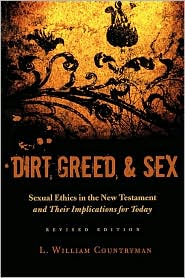
Countryman - Dirt, Greed, and Sex: A Book Review


William Countryman, Dirt, Greed, and Sex, Fortress 2007.

This book is a brilliant and challenging survey of New Testament sexual ethics.  What is unique about it (at least in my experience) is that it approaches these issues, not through the grid of our own modern approach to such matters but seeks to reconstruct the grid which those in the world of the NT would have used.  This book is frequently cited in other literature and usually accompanied by the word "provocative."  I took this to mean that not everyone liked the conclusions but they weren't interested in arguing the point right now.  How ever I think it is a fair word to use of the book.  It has two levels to it.  On one level it is an excellent attempt at bring the reader into a different way of looking at sex and, as far as I can tell, from the point of view of 1st century Christians.  On the other hand this book is not written into a vacuum and while the book is hardly dedicated to the gay debate it is nonetheless intended as a contribution to it and it is where things come closest to this topic that I think the book is at it weakest. 

The first major section is dedicated to the concept of purity, drawing heavily on the work of Mary Douglas Countryman first shows how purity considerations operated in the OT and 1st century Judaism.  He argues that while we moderns hapily differentiate between say food hygene and sexual purity, the ancient world had no concept of germs, genetics or STDs and treated all purity considerations as of one set.  Countryman then goes on to show how the NT reframes purity considerations from external matters (food, dead people, sex, etc) to that of the heart (motive, intention, love, hate, etc).  Countryman concludes that for the NT purity considerations are no longer binding on the conduct of Christians for any area of life, including the sexual.

The second section moves onto what for Countryman is the other major ancient concept for sexual ethics, property.  Countryman persuasively demonstartes how sexual transgressions were primarily conceived of as transgressinos against the property of another.  he demonstrates the OT and second temple judaism backgrounds for this and then shows how the NT both retains this understanding but also radically modifies it.  This section of the book is the most exciting as Countryman skillfully explicates how Jesus' prohibition against divorce served to deconstruct the system of patriarchy.  Countryman then traces this impetus through Paul but concludes that the later NT writings show evidence of a reversion to patriarchy and that even Paul was never consistent in applying this new radical approach to the equality of the sexes.

The final (and shortest) section contains a summary and then Countryman's suggestions for how his exegesis of NT sexual ethics might be aplied today.  This is by far the weakest section.  Countryman's arguments here lack the thoroughness and consistency he (generally) applied to the earlier sections.  While many of his conclusions are hard to disagree with his ethical method is rather slipshod and he spends too little time working on how to move from the NT to today but merely seems to muse on how his findings affect his selection of topics.

With regard to the gay debate, Countryman's own agenda appears to affect the exegesis negatively at a couple of points, not least his discussion of malkoi and arsenokoitai  in 1 Cor 6:9-11 (pp195-6) and of Luke 7:1-17 (pp75-6, 246, 327).  1 Cor 6:9-11 especially is a big issue and I hope to blog specifically on it later as it bears on my own thesis.   What he succeeds in doing, very well, is showing the ambiguity of those NT texts which are often used to forbid homosexuality.  This is a point that needs to be made, however to the educated it should hardly be surprising as "homosexuality" per se was not a concept for either Jew or Gentile in the first century, it is a modern idea.

Overall I am grateful for a very well written book that has given me a lucid and extremely helpful introduction to NT sexual ethics.  By comparison the other books I've read have tended to both treat NT ethics as if they were written about our (modern) problems and be as dull as ditch water.  In particular the insight that NT sexual ethics revolve around concepts of property (why has no one else pointed this out to me!!!???) is a vital insight for my work on 1 Cor 6:12-20 and will be an important shaping factor for my final conclusions.  Already it is an insight that has made sense of a lot of loose ends for me and I'll be keeping the book close for the next few months.

[I have also quoted from the book here and here.]

Friday, September 18, 2009

Thesis update: another narrowing

Well folks I began this thesis doing a study of Paul's use of the Body of Christ as a metaphor for the Chruch, then I narowed it to only its use in 1 Corinthians, but even that was too big, I got stuck on 1 Cor 6:12-20 and have just had approval to write my whole thesis just on these verses.... good in that it is a lot less ground to cover, but bad in that:

"1 Cor. 6:12-20 is widely acknowledged to be one of the most difficult passages in the Pauline corpus. Commentators have described the paragraph as "disjointed," "obscure," "unfinished," "imprecise," "extravagant," and even "incoherent." Gordon Fee notes with understatement: "the passage is full of unique, and in some cases difficult expressions, which in turn have given rise to equally unique interpretations." Bruce N. Fisk rightly states that "[s]cholars continue to puzzle over the meaning and rhetorical function of 1 Corinthians 6.12-20."" From Brain Rosner, "Temple Prostitution in 1 Cor 6:12-20," Novum Testamentum, 40:4, 1998, 336.

Anyway, I'm having fun with it, and who knows I may even be the one to finally crack the nut and bring consensus to the troubled world of 1 Corinthians scholarship! (But I'd settle just to get the thing written.)

Biblical versus 'Greek' anthropology

I am really enjoying the book by Gundry mentioned in the last post. One important thing his book does is to really crush the argument that 'Hebrew' or OT anthropology only knew humanity as animated bodies rather than a body/soul duality. And so what I wrote earlier on this subject definately needs some modification. So here are some thoughts about the differences between OT/NT Duality and Platonic Dualism.

  • In biblical thought both the body and soul sin, in platonic thought the body is sinful, the soul pure.
  • In biblical thought the soul survives the body but is diminished by the loss, in platonic thought the soul is liberated by the loss.
  • In biblical thought salvation is either the preservation or the reunification of the body and soul, in platonic thought it is a purely spiritual affair.
  • In biblical thought 'you' are truly your body and soul, but for the platonist 'you,' the soul, have a body.

Of course ancient Greek thought was pretty diverse and so any generalisations are by nature somewhat blunt and inaccurate.

Thursday, September 17, 2009

Pauline Anthropology

Just came across this great quote from Robert Gundry in this book. A very useful sumary of Paul's anthropology.

“As a matter of fact, Paul’s anthropological duality does not display itself in a formally consistent use of any two terms. Sōma always refers to the physique, but so does sarx at times. A number of words refer to the incorporeal side of man and functions thereof: pneuma, psychē, kardia, nous, dianoia, phrenes, syneidēsis, ho esō anthrōpos. For the whole man, Paul uses anthrōpos. In other words, there is an ontological duality, a functional pluralism, and an overarching unity.” -p84

loose translation of terms:
Sōma = body
sarx = flesh
pneuma = spirit
psychē = self/soul/life
kardia = heart
nous = mind
dianoia = understanding
phrenes = thought
syneidēsis = conscience
ho esō anthrōpos
= the inner human (man)
anthrōpos = human (man)

And another good point:

“Paul is not interested in anthropology as an independent motif. Rather, he treats man as the object of divine dealings and as the subject of activity in the order which God created.” - p84-5

I think it is particularly helpful to talk in terms of "functional pluralism", that for Paul it is possible to talk about the different parts of a human, but to emphasise "overarching unity", that a human is not a 'spirit inhabiting a body' or a 'body with a soul' but the human is both the physical and the "inner" and cannot properly exist apart from as both. This is why Gundry uses the term duality - to imply unity, rather than dualism, which implies opposition.

Friday, August 28, 2009

Destroying food and stomachs in 1 Cor 6:13

With regards to the previous post, the loss of speech marks does immediately pose a problem as Paul then appears to be saying "God will destroy stomachs and food" which we, fairly naturally, hear as implying "in the life of the Resurrection there will be no eating." Of course that sounds wrong as we know that both Hebrew and Christian visions of the resurrection life use the image of a feast, and that the resurrected Christ cooked and ate fish as proof of his resurrection. However it is an assumption that this refers to the resurrected life, i.e. that those who are resurrected will experience the destruction of their stomachs. Might it be better to understand this destruction as an act of judgment? After all, here stomach and food have been brought into the discussion not because food is an issue but representing the those deeds which are purely the satisfaction of base desire and those things which have existed purely for the satisfaction of those base desires. The eschatalogical image of feasting is not the joy of having a full stomach but of everyone united in a common act of celebration. And even Jesus' post resurrection acts of eating were focused on his relationship with his disciples (John 21:9-17, Luke 24:36-43). Indeed, later on in 1 Corinthians Paul rebukes the Corinthians for eating and drinking purely to satisfy their appetites instead of showing due regard and love for each other (1 Cor 11). So, perhaps here in 1 Cor 6:13 stomachs and food are a cipher for the gratuitous and selfish satisfaction of base desires which is leading Corinthians Christians to visit prostitutes and it is that that will be destroyed by God along with all other desires and acts which are not rooted in loving communion with God and each other.

Let me know what you think :-)

Xenos has moved!

 I am now blogging at  https://jonathanrobinsonblog.wordpress.com hopefully more regularly. I'll delete this site eventually, but it wil...