Showing posts with label Luke. Show all posts

Tuesday, October 30, 2012

Luke 14:28-33: A new interpretation?

I'm preaching on Luke 14:25-35 this coming Sunday and my companions as I preach through Luke have been the commentaries by Green and Marshall. (I find usually reading more than a couple of commentaries for the purpose of preaching a waste of time). However on the subject of the two parables in Luke 14:28-33 I find them both unconvincing and have subsequently come up with my own interpretation. It probably isn't new or unique, but it seems so satisfactory to me I am surprised neither Marshall nor Green even mention the possibility. I'd appreciate your thoughts, whether you think my alternative reading has any merit, and whether you know any other commentators who have suggested something similar.


What they say

Jesus is talking about the need to hate our families and take up our crosses to be his disciples. He then tells two parables, one about understanding the need to estimate the cost of a building project before starting it to avoid ridicule and one about the need to surrender to and enemy that has greater forces than you. Jesus concludes by saying, "in the same way [as in the parables] any of you who does not give up everything he has cannot be my disciple." Both NIV and NRSV subtitle the section "the cost of discipleship."

For Green Jesus uses these parable to "highlight the importance of considering the conditions he has placed on authentic discipleship" and "by extrapolation [he] insists that such assets as one's network of kin . . . are an insufficient foundation for assuring one's status before God." (Green, NICNT p566)

For Marshall, the parables show "just as one should not attempt a venture without having sufficient resources to complete it . . . so a disciple must be continually ready to give up all he has got in order to follow Jesus. The connection of thought could be smoother, and this confirms that originally independent saying have here been joined together." (Marshall, NIGTC p594-95)

Effectively then, for both Marshall and Green the parables serve as warnings to potential disciples to weigh carefully if they will be able to see their discipleship to the end. In other words, "don't become a disciple unless you are ready to give everything else up." But Marshall does note that this interpretation of the pericope is not very smooth, leading him to doubt the integrity of the passage. Might I be so bold as to suggest it is not the passage that lacks smoothness but that particular reading of it? A reading that renders Jesus warning people off becoming his disciples instead of inviting them to do so?


A better way?

Because we come to this passage with a "cost" mentality we see the parables as primarily about having the resources to see things through, and Jesus demanding that we be willing to give up everything to follow him. But the parables in question do not address resources, in the sense that there is no question or possibility of change in the resources of the characters in the parables. Under the previous reading this becomes a very fatalistic message: either you have what it takes to be a disciple or you don't. But in each parable it is a case of the character realising the true extent of his resources and acting accordingly.

But Jesus does not conclude the thought by saying "in the same way everyone should take stock of their resources for discipleship before following me." He says "in the same way you should give up everything you have." The parables are not about what we can achieve with our resources, but what we should give up.

In v28-30 the character gives up a tower (representing security, stability, wealth?) he cannot build, and in v31-32 a king gives up a kingdom (representing power, autonomy, sovereignty, wealth?) he cannot hold on to. So what point could Jesus be making? Is it not that those things which might come between us and being a disciple of Jesus (our excuses - cf Luke 14:18-20) are not things which we can hold onto or maintain in our own strength anyway? By giving up our social and material possessions to follow Jesus are we not just giving up what we were bound to lose anyway?

In both parables those who "give up" are held up as examples of the wise, and then we too are called to "give up" in order to become dsciples. Suddenly the flow of thought couldn't be smoother, and suddenly rather than trying to put off less committed disciples with a high price Jesus is actually encouraging us to follow him because what he is asking us to give up is beyond us to acheive or hold onto anyway.

In the words of Jim Elliot, martyred missionary, "He is no fool who gives what he cannot keep to gain that which he cannot lose."

Let me know what you think :-)

Thursday, February 9, 2012

The Egalitarian Debate: Finding Truth in the Story

A friend recently sent me a position paper from Redeemer Presbyterian Church of Tim Keller fame on the subject of women in (church) leadership, or what you might call the complementarian/egalitarian debate. To their credit Redeemer are certainly on the "soft" side of complementarianism, they do much to mitigate the potentially caustic effects of the doctrine and I imagine many women would be able to be part of and serve in one of their churches without noticing much, if at all, their complementarian position.  That said, I still don't buy it. 

I don't know how systematically I will be able to work throught a response to the paper, I'd love to do it but my day job these days leaves much less time for blogging than my old one did.  The paper itself has a number of deeply problematic arguments which I'd love to deal to (just so you can see how clever I am of course).  The point I want to make quickly now is simply this that egalitarians (at least the biblical ones) tend to let the narrative of scripture trump the propositional elements, while the complementarians do the opposite.  In some ways this relates to such a deep rooted interpretive bias that constructive conversation between the parties is impossible.  Complementarians simply cannot get their heads round these egalitarians who are ignoring what the Bible plainly says.  Likewise egalitarians cannot get their head round those complementarians who don't see the relevance of the many women used mightily by God in many episodes of salvations history recorded in scripture. 

Now the idea that we have to play off propositional scriptures against narrative scriptures will give most Bible believing Christians indigestion, and I don't believe in the final analysis this is either ideal or necessary.  However, for most people engaged in the debate this is the crux of the conflict (if the argument is based on biblical grounds).

By way of example: In the opening chapters of the gospel of Luke the advent of Jesus the Christ, the son of God, is characterised by the prophetic anouncements and faith of women, Mary and Elizabeth, whose counterpoint is their husbands, one of whom is both rebuked and rendered (temporarily) mute for his lack of faith by an angel while the other barely gets a mention.  In this most momentous moment of salvation history the women lead the charge in both faith and prophecy, this is how the gospel begins. 

So while I am fully aware of some passages that seem to ask women to play second fiddle to men, to be quiet and not to teach, those passages, contained as they are in occassional letters written to troubled churches in complex social and cultural settings, simply cannot carry as much weight as the story we are told.  To say that these passages against women's leadership in congregation of the faithful stand for all time and are universal is to say that God broke his own rules when his only son came incarnate to our world, or at the very least wasn't organised enough to make sure that his own gender role distinctions were properly observed.

Please note that I am not saying that the argument cannot be won by egalitarians on grounds of propositional scripture, they can be, but for most people working with common English translations of scripture and without access to some of the linguistc and cultural subtleties of the epistles this is where the biblical discussion begins, and this is the easiest way for a complementarian to understand (if he or she has an open enough mind) where those stubborn egalitarians are coming from.

Let me know what you think, :-)

Wednesday, February 23, 2011

Christchurch Earthquake: Worse This Time

Half a year after the last one Christchurch has been hit again.  This time there has been considerable loss of life, although again it is noticable how living in a developed country improves your chances in such events. Love and prayers to all in Christchurch.  Those who want to donate should go to the Red Cross or the Salvation Army.  Go here to see before and after pics of the city's cathedral.

A group of new pastors I'm in touch with have been discussing what we will preach on this Sunday in light of the event.  My texts for this Sunday,
  • 1 Kings 19:9-18 (for the children's talk)
  • Luke 13:1-9 (for the grown up's talk)

Thursday, December 16, 2010

Friday, November 19, 2010

brick-a-brack 19/11/10

Enjoy

Monday, October 11, 2010

brick-a-brack 11/10/10

OK, inspired by Marc's, "flotsam and jetsam" I have decided to go with my own coothy phrase to save me thinking of new titles for my internet round up's that don't make me sound like a web based cowhand.

Wednesday, September 22, 2010

Christian Preaching from the Old Testament #1

[This is the first in a serialisation and slight revision of an old essay of mine, in the hope of getting some interaction from others and also making it more accessible.]

Hebrew Scripture for Christian Preaching

One of the Early Church’s most famous heretics, Marcion, decided that the God of the Old Testament and the God revealed in Christ were incompatible.  In what was arguably the first attempt to create a Christian canon of scripture, he sought to dispose of the OT entirely and purge OT references from the New Testament.[1]  Notwithstanding Marcion’s many other theological quirks, his objection to the OT is perhaps something we can still relate to.  It is still not uncommon to hear a Christian today describe themselves as a ‘New Testament Christian’ as opposed to an ‘Old Testament Christian.’  Apart from the apparent dichotomy of legalism and grace between the testaments there are also ethical issues raised by the text: genocide, incest and misogyny, among others.   These and other perceived problems translate into a general neglect of the OT as a source for preaching and, when it is used, uncertainty in the appropriate way to do so.[2]  Three problems confront any Christian wanting to preach from the OT: how to relate the OT and NT, how to correctly exegete the OT, and how to discover the contemporary relevance of any particular OT passage.[3] 

However, evangelicals are rightly restrained from following Marcion’s lead, primarily by the NT itself.  Verses such as Luke 24:44 and John 5:40 show Jesus clearly stating that the OT is in some significant sense about him.[4]  Numerous passages in Acts reveal that apostolic preaching repeatedly argued that Christ fulfilled the OT.[5]  The gospels, epistles and Revelation are laced through with OT quotations and allusions to the OT scripture.[6]  In addition to this, the historical record clearly shows that the primary source for the theological reflection of the early church on Jesus Christ was the OT.[7]  So by using the OT as a source for preaching we are following Christ, the Apostles, the authors of the NT and the Early Church Fathers.

Part of the problem arises in the fact that Christ and his early followers drew upon a deep and established tradition of scriptural interpretation that modern scholars only have limited access to and the ordinary Christian has no understanding of.[8]  Not only so, but many of the hermeneutical devices employed quite satisfactorily in the 1st century appear dishonest and unscientific in the 21st.[9]  If the early church relied on Second Temple era hermeneutics to make Christian sense of the OT should present day preachers use the same methods or can modern hermeneutics also find that the OT speaks of Christ?


[1] John Bright,, The Authority of the Old Testament, (Carlisle: Paternoster, 1997), 16, 60-62; F.F. Bruce, The Canon of Scripture, (Glasgow: Chapter House, 1988), 134-144
[2] Steven Mathewson, The art of Preaching Old Testament Narrative, (Grand Rapids: Baker, 2002) 13, 23-4; Walter Kaiser, Preaching and teaching oorm the Old Testament: A Guide for the Church, (Grand Rapids: Baker, 2003), 10; Graeme Goldsworthy, Preaching The Whole Bible as Christian Scripture, (Grand Rapids: Eerdmans, 2000), VII, XII; SG 15-6; Sidney Greidanus, Preaching Christ from the Old Testament: A Contemporary Hermeneutical Method, (Grand Rapids: Eerdmans, 1999), 15-16, provides statistical data on the subject, un-named denominational statistics show <20% of Sunday sermons are on OT passages and a preaching journal reports <10% of submission are on an OT text.
[3] Martens, Elmer A., ‘Preaching from the Old Testament: A Bibliographic Essay’ Direction  (April 1982 Vol11 no 2, 30-39), 1.  http://www.directionjournal.org/article/?433 (accessed 16/04/08)
[4] David Peterson, Christ and His People in the Book of Isaiah, (Leicester: IVP, 2003), 12; N.T. Wright, Scripture and the Authority of God, 32
[5] Peterson, Christ and His People in the Book of Isaiah, 23; e.g. Acts 2:16-39, 8:30-35. 13:16-41, 17:2-3. 
[6] Grant R. Osborne, The Hermeneutical Spiral: a comprehensive introduction to Biblical interpretation, (Downers Grove: IVP, 1991), 323, ‘There are approximately three hundred quotes and literally thousands of allusions.’
[7] See Donald Juel, Messianic Exegesis: Christological Interpretation of the Old testament in Early Christianity; Wright, Scripture and the Authority of God, 35-6
[8] See Joseph A. Fitzmyer, The One Who is to Come, (Cambridge: Eerdmans, 2007); and G.K. Beale and D.A. Carson (eds), Commentary on the New Testament use of the Old testament, (Grand Rapids: Baker, 2007), XXV
[9] See Peter Enns, Inspiration and Incarnation: Evangelicals and the problem of the Old Testament, (Grand Rapids:Baker, 2005), 158-160; Of course the operative word here is ‘appear’, but the method of NT writers in their use of the OT is still a topic of considerable debate and requiring knowledge of Second Temple Judaism far beyond most pastors, see Osborne, The Hermeneutical Spiral, 332

The relationship between Luke and John's Gospels.

Jim highlights an intriguing and pithy article on the suggestion that Luke's gospel made use of a Johanine oral tradition and used it over and against the Markan tradition.  Strong stuff.  I once asked a Luke scholar about the relationship and she told me forthrightly that it was a Johanine scholar's problem, not hers.  I thought at the time that was a little presumptious and I think this article shows rather nicely that the boot could well need to be on the other scholar's foot after all! 

Sunday, August 22, 2010

Apocalyptic Parables

I know it is really trendy to whinge about N.T. Wright at the moment, but I really enjoy reading him and will usually find something interesting every few pages. If we can legitimately have (and we can) indigenous, feminist, post-colonial, queer, and postmodern readings of scripture, I don't see why some jolly Anglican bishop shouldn't get to put forth his own with out everyone getting in a tizzy because he isn't reformed enough (but Paul didn't MEAN that mummy!) or because he believes in the resurrection (but it's not HISTORICAL mummy!) or doesn't want to ordain gays (but it's not TOLERANT mummy!).  Honestly, get a grip, he's just some dude with a beard.  I digress.

 pic from here
An "aha" moment for me today was Wright's (NTPG) definition of Jesus' parables as apocalyptic, as against "earthly stories with heavenly meanings" or "stories making only one point" (p393).  He suggests that Mark's gospel is a "meta-apocalypse" as it "tells the story of Jesus telling the story of Israel by [apocalyptic] means" (p394).  For me this makes great sense and is a helpful way of steering between outright and uncontrolled allegory and the previously mentioned exegetical deadends.  Wright doesn't at this point mention a particular parable, I'm sure there'll be plenty in the next book, but the one that springs to mind to illustrate this is Mark 4:30-32 (pars. Matt 13:31-2, Luke 13:18-19).
And He said: "How can we illustrate the kingdom of God, or what parable can we use to describe it? It's like a mustard seed that, when sown in the soil, is smaller than all the seeds on the ground. And when sown, it comes up and grows taller than all the vegetables, and produces large branches, so that the birds of the sky can nest in its shade."   (HCSB)
To me there was no way anyone who had read the Hebrew Scriptures would not see in this an impossible to miss reference to Israel's story, in particular Israel's final vindication.  Don't see it?  Try reading Ezek 17 where the image of a tree sheltering birds is used as a parable of the hoped for restoration of Israel.  Or Ezek 31 where the same image is used to describe the extent and power of world dominating pagan empires.  Or even Dan 4:9-16 where the image is used to describe the reign of a world dominating pagan emperor.  (cf also Psalm 104)  Suffice to say, by preaching first, "the Kingdom of God is near," and then saying in a parable, "all the birds of the sky will nest in its shade," Jesus is signalling that the kingdom he is preaching is the fulfillment of the Jewish hope for Israel's restoration and that it will be a force that will grow to dominate the whole world.  The seemingly small beginning of Jesus and his raggedy disciples is going to eventually rival the greatest of empires.  The humble mustard tree (see pic above) is thus dangerously political and eschatological imagery with a clear meaning that should not be reduced to a single principle or a sentimental "heavenly thought."  By evoking such imagery Jesus is tapping into a deep well of deferred national hope and culturally embedded theological interpretation of history.

Surely on this one, Wright is not wrong?   :-)

Wednesday, March 17, 2010

Who is my enemy?

My eldest daughter had her arm broken, accidentally, by a friend at kindergarten on monday.  As we were in the hospital waiting for her arm to be reset, she told me, "when my arm is better I will push Anna (not real name) over."  To a three year old reciprocal violence is a natural instinct.  Of course she wants to do back to Anna what she did to her.  Through an act of violence with unintended consequences Anna has become my daughter's enemy.
[pic from here]
Jesus decisively redefined the concept of "neighbour" in his parable of the good Samaritan, effectively ruling out the dividing walls of society, culture, religion and race from the decision as to what members of the human race we should "love as ourselves."  Hence we are compelled to love our human enemy and not hate them.  But with this recent talk of vengance we seem to be left with a applicational vacuum.  If hate of humans is dissallowed then how can I read (for example) Psalm 137 without missing bits out?  How can baby bashing be words that I sing and pray without denying the command of Christ?  Frankly all that talk of "the psalms teach us to be honest to God about our feelings" doesn't cut it.  Feelings of anti-human anger and revenge are simply dissallowed for those indwelt by the Spirit of Christ.

Well, having a daughter with a broken arm has caused me to reflect on a friend of mine who has had two heavily disabled children, one of whom died after years of painful struggle.  I have heard him talk on more than one occasion about living with extreme suffering and disability.  One of the things he says the struggle has taught him is a hatred of sin.  For my friend sin is not merely the naughty things that we get up to when we think God isn't looking, but the reason that disability, suffering and death entered this world.  His experience of suffering has taught him to hate.  It is a hate I wish more Christians shared.  Sadly the church is better known for its sinful hatred of humans under the influence of sin than for its aggression in leading a life free from sin.

I don't want my daughter to hate Anna, or repay her.  I want her to hate the reason she got pushed in the first place.  The fact that they were fighting over a toy instead of sharing.  The fact that greed and not love was motivating them both at the time.  My daughter's enemy is not Anna.  Her arm was broken by sin.

If we need to hate something to particpate in the psalms, may I suggest one answer might be to hate sin, the sin that is at work in our lives and everyday causes us to hurt those we are commanded to love and frustrates us in our desire to draw near to God.  "Happy is the one who smashes the offspring of sin against the rocks, who destroys sin's work in their own life and frustates its propagation, who cuts sin off in its prime and annihilates it with the love of God in Christ."

Sunday, March 14, 2010

NT Hermeneutics: A Matter of Faith

The fallacy that Jesus and Paul just proof-texted from the OT any old verses to back up what they really wanted to say is sadly hard to refute.  It's hard to refute because it is such a widely held belief as to be almost an orthodoxy.  It's hard to refute because our engagement with scripture, atomised as it is by chapter and verse numbers, is so different from those for whom texts existed in their undivided entirety.  It's hard to refute because for Jesus and Paul the OT texts were not an "old" testament but the very basis for their existence as Jews and for their respective missions as teachers.  They didn't cite individual verses as authorities to prove a point but to connect their own words with the words that had been spoken before.  To integrate their message with the message of the Torah and the Prophets and thus show how they continued, cohered to, and fulfilled them. Compare this with what we tend to do in church and seminary (and blog), and it looks quite strange indeed.

To return to Luke 4 and Isaiah 61.  If Jesus was just selectively choosing a passage of scripture that happened to fit what he wanted to say at that point and then missing out the bits that didn't fit with his message then he is both an idiot and a deceiver.  He is an idiot because his audience would have been familiar with the rest of the text around Is 61:1-2a, an especially cherished messianic text, as a result merely quoting the first bit (if that is all he did, which is by no means certain) would still have evoked in his readers all the consequent bits.  He is a deceiver because he is claiming to fulfill this text.  He is not saying "oh look, here is a nice poem that happens to fit the mood i'm in right now," he claims to be the texts fulfillment: the anointed one that Isaiah was talking about.  That is, he claims the meaning of the text is himself.  If only bits of Isaiah actually apply then he cannot be the meaning of the text, for bits of the text cannot be selected or rejected without the text ceasing to be the text.

This is what really bugs me.  For the Christian, if you do not think Jesus and Paul were being honest in their use of scripture, if you think they were misusing it or applying it dishonestly or incorrectly, then they must be wrong about the way that they were in continuity and fulfillment of it in their respective missions, which means you are wrong to follow them.  If the sceptics wish to suggest that Jesus and Paul were just exegetical incompetents and none of their followers noticed, let them.  But for the believer, doing the hard work of understanding exactly what they were doing when they cited scripture and understanding through their eyes what the OT means is essential.  Without it Jesus and Paul are fraudsters, it is simply a matter of faith.

Thursday, March 11, 2010

But Vengeance IS Good News: A reply to David Ker

David Ker is thinking about skipping the bits of the Bible where vengeance is mentioned.  Given his African context where Christians sometimes seem a bit too keen to hand out divine retribution themselves this is totally understandable. Neither would such an action be without precedent, Ulfilas the 4th century bishop refused to translate parts of the OT into the language of the Goths for fear they might get the wrong end of the stick.

Perhaps more to the point is that anyone who preaches or teaches has to be selective in the texts they use (as there are only so many hours in a life) and so they will naturally use the texts which seem to them the most useful, enlightening, and life giving in their situations.  But I think Ker has a few things backwards, he writes,
Two weeks ago in The Bible is not the Gospel I made the controversial claim that the Gospel is more important than the Bible. We are called to preach the Gospel not preach the Bible. 
Which is true, but not not helpful.  It is a bit like saying a person is not their body, we are called to love peole not their bodies, so I am free to ignore certain bodily needs of others because they are only needs of the body not the person.  The Bible is not the Gospel, but the Bible contains the Gospel in such a way as to make it impossible to distill the Gospel from the Bible and do without the Bible.  Cut holes in the Bible and you are cutting holes in the Gospel, even though the Bible is not the Gospel.  Ker continues,
And the overwhelming witness of the New Testament is that Jesus and all preachers after him used the Old Testament very selectively as a launching point for a message about the Kingdom and its King.
This is one of those ideas that seems to have wide circulation and is used to justify all sorts of "violence" against the OT.  But it just isn't true. No Jesus and Paul and the other NT writers did not systematically make sure they quoted from every genre of scripture but everything they taught presupposed the OT, in its entirety.  The gospel of the NT can only make sense and be understood as its stands on the foundation of the OT.  Not only so but when Jesus and Paul and the others use the OT they do not just proof-text widly but have a profound intertextual hermeneutic.  That this is so is slowly being demonstrated by the new(ish) wave of scholarly interest in the NT use of the OT.

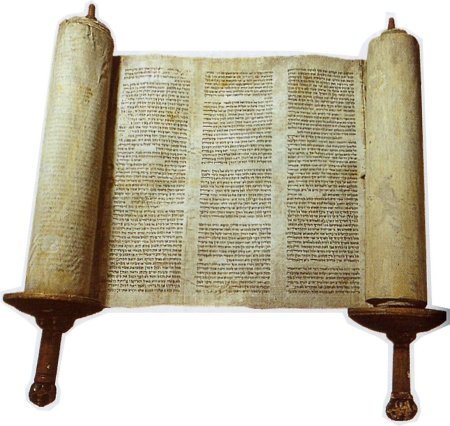
Ker uses as his own proof text the Nazareth manifesto of Luke 4:16-19.  The thing is in Luke it doesn't actually say what Jesus did or didn't read out, it only points us to the place in the scroll that he read from.  This is not evidence of Jesus selectively quoting scripture.  Notwithstanding, Ker suggests two reasons why Jesus missed out the vengeance bit of Isaiah 61:1-2.

First, pragmatically, Jesus was using this passage to kick off his ministry which was to be about God’s favor. Second, and related, is the fact that under the new covenant that God was making with all the peoples of the world, vengeance was set aside, or you could say transferred to Christ who bore all the vengeance of God’s wrath on the cross in our place.
We need to ask what God's favour means to a people living under the oppresive goverment of a foreign power.  It means that their enemies get dealt to.  God's favour is not a "nice" thing and his vengeance "nasty."  In Isaiah 61 the direct result of God's vengeance is the comforting of those who are mourning and grieving.  Why are they comforted because God's vengeance is good news to those who have been oppressed, ruined and devastated.  Vengeance does not mean revenge, it means justice.  More specifically it means God's justice. Revenge is what happens when we take it upon ourselves to deal with those who have oppressed us, to punish them.  It always goes wrong because we are not capable of true justice.  God is.

I would suggest, and humbly because I do not share David's context, that perhaps it is those very vengeance texts that need to be taught and preached so that those Christians who are wronged can rest from their own desire for revenge and trust in God's ultimate justice.  For those who are oppressed and victimised God's vengeance is good news, if you skip that bit they may feel an even greater need to take matters into their own hands.

Pax vobiscum.
Let me know what you think. :-)

Friday, January 22, 2010

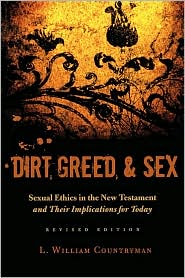
Countryman - Dirt, Greed, and Sex: A Book Review


William Countryman, Dirt, Greed, and Sex, Fortress 2007.

This book is a brilliant and challenging survey of New Testament sexual ethics.  What is unique about it (at least in my experience) is that it approaches these issues, not through the grid of our own modern approach to such matters but seeks to reconstruct the grid which those in the world of the NT would have used.  This book is frequently cited in other literature and usually accompanied by the word "provocative."  I took this to mean that not everyone liked the conclusions but they weren't interested in arguing the point right now.  How ever I think it is a fair word to use of the book.  It has two levels to it.  On one level it is an excellent attempt at bring the reader into a different way of looking at sex and, as far as I can tell, from the point of view of 1st century Christians.  On the other hand this book is not written into a vacuum and while the book is hardly dedicated to the gay debate it is nonetheless intended as a contribution to it and it is where things come closest to this topic that I think the book is at it weakest. 

The first major section is dedicated to the concept of purity, drawing heavily on the work of Mary Douglas Countryman first shows how purity considerations operated in the OT and 1st century Judaism.  He argues that while we moderns hapily differentiate between say food hygene and sexual purity, the ancient world had no concept of germs, genetics or STDs and treated all purity considerations as of one set.  Countryman then goes on to show how the NT reframes purity considerations from external matters (food, dead people, sex, etc) to that of the heart (motive, intention, love, hate, etc).  Countryman concludes that for the NT purity considerations are no longer binding on the conduct of Christians for any area of life, including the sexual.

The second section moves onto what for Countryman is the other major ancient concept for sexual ethics, property.  Countryman persuasively demonstartes how sexual transgressions were primarily conceived of as transgressinos against the property of another.  he demonstrates the OT and second temple judaism backgrounds for this and then shows how the NT both retains this understanding but also radically modifies it.  This section of the book is the most exciting as Countryman skillfully explicates how Jesus' prohibition against divorce served to deconstruct the system of patriarchy.  Countryman then traces this impetus through Paul but concludes that the later NT writings show evidence of a reversion to patriarchy and that even Paul was never consistent in applying this new radical approach to the equality of the sexes.

The final (and shortest) section contains a summary and then Countryman's suggestions for how his exegesis of NT sexual ethics might be aplied today.  This is by far the weakest section.  Countryman's arguments here lack the thoroughness and consistency he (generally) applied to the earlier sections.  While many of his conclusions are hard to disagree with his ethical method is rather slipshod and he spends too little time working on how to move from the NT to today but merely seems to muse on how his findings affect his selection of topics.

With regard to the gay debate, Countryman's own agenda appears to affect the exegesis negatively at a couple of points, not least his discussion of malkoi and arsenokoitai  in 1 Cor 6:9-11 (pp195-6) and of Luke 7:1-17 (pp75-6, 246, 327).  1 Cor 6:9-11 especially is a big issue and I hope to blog specifically on it later as it bears on my own thesis.   What he succeeds in doing, very well, is showing the ambiguity of those NT texts which are often used to forbid homosexuality.  This is a point that needs to be made, however to the educated it should hardly be surprising as "homosexuality" per se was not a concept for either Jew or Gentile in the first century, it is a modern idea.

Overall I am grateful for a very well written book that has given me a lucid and extremely helpful introduction to NT sexual ethics.  By comparison the other books I've read have tended to both treat NT ethics as if they were written about our (modern) problems and be as dull as ditch water.  In particular the insight that NT sexual ethics revolve around concepts of property (why has no one else pointed this out to me!!!???) is a vital insight for my work on 1 Cor 6:12-20 and will be an important shaping factor for my final conclusions.  Already it is an insight that has made sense of a lot of loose ends for me and I'll be keeping the book close for the next few months.

[I have also quoted from the book here and here.]

Tuesday, April 21, 2009

No room at the inn?

Don't you just love it when you start reading a book and before the first chapter is over you are already having to make major pradigm shifts?! Well Kenneth Bailey's Jesus Through Middle Eastern Eyes has done just that and promises much much more to come.

To summarise, too briefly, an excellent scholarly and Biblical argument: the traditional western Christian understanding of Joseph and Mary being refused 'a room at the inn' (Luke 2:1-7) and Jesus being born in a cold dirty stable in Bethlehem is total hogwash and based on a 3rd century novel written about Jesus by a Greek who did not understand Middle Eastern culture.

Instead we should understand that both Joseph and Mary would have been assured of a warm reception in Bethlehem because they both had family in the area and because of the middle eastern culture of hospitality. That most village homes would keep their animals inside at night to guard against theft and to provide heat. They would be in a fenced off area of the large family room. That the word usually translated 'inn' is only translated that way because of this tradition that has sprung up and should be better translated 'guest room' as some village houses would have such a room for guests (cf Luke 22:10-12). And so Jesus, although born in very humble circumstances, was in fact welcomed into the world by the hospitality of the residents of Bethlehem, not left out in the cold.

Time to re-write all your Christmas plays! :-)

Xenos has moved!

 I am now blogging at  https://jonathanrobinsonblog.wordpress.com hopefully more regularly. I'll delete this site eventually, but it wil...