Showing posts with label sex. Show all posts
Thursday, March 8, 2012
Real Sex - Lauren Winner: A Book Review
Winner's book came to me highly recommended. It is a 161 pages and a fairly light read, aimed at the thinking Christian and not requiring any specialist knowledge to engage. Lauren Winner is probably most famous for her two memoirs, Girl Meets God and Still. This book has the odd autobiographical moment but on the whole is a practical theological exploration of the topic of chastity.
Tuesday, December 13, 2011
brick-a-brack 13/12/11
Keener again, this time talking about miracles (HT JB)
Marc Cortez wants someone to write his sermons for him and that's OK
Greg Peters questions the rise of "retreats" and what it says about how churches look after people
Aditya Chakrabortty denounces British Bancrocracy and pairs Rowan Williams with Bill Nighy!
And it appears the cliche of Americans being overpaid, oversexed and over here is true, at least of one rather enthusiatic sperm donor (yet of coure the first thing the Herald does is point out his alleged Christianity).
Monday, August 22, 2011
Paul’s Unconventional Sexual Ethic
This paper is what I presented at the recent Laidlaw-Carey/Otago sponsored colloquium on theological interpretation. If you've already read my thesis, there is nothing new here, but if you haven't will give you a skeletal version of my last chapter. Enjoy!
The Problem
In warning the Corinthians against πορνεία, sexual immorality, Paul does not appeal to OT law or the ruling of the Jerusalem council (Acts 15:20, 29)[1] instead he gives a stricter indictment against prostitution than anything found in the OT.[2] David Horrell argues that Paul’s argument here is based on the “presumption” that sex with a prostitute is illicit, while sex with a spouse, believing or not, is permitted. He claims that, “while Paul uses arguments about holiness and bodily union with Christ to support and promote his sexual ethics, the substantive ethical convictions themselves are not derived from these arguments but are already assumed.”[3]
In Horrell’s reading Paul is using the theological indicative only to support a previously assumed moral imperative.[4] The ethical motivation is theological but the ethical content is merely conventional. On the other hand for Karl Barth, in 1 Cor 6:18, “Paul is speaking of a sin of which only the Christian is really capable.”[5] That is, not only is the ethic not conventional, but even the sin is not conventional! Horrell and Barth cannot both be right.
My argument then is this
There were both Jewish and pagan objections to the use of prostitutes, but Paul’s argument does not resemble those nor show any concern in whatever ways prostitution might have been generally viewed as immoral. Although 1 Cor 6:12 does read in many ways like a general argument from benefit and permission, using the language of similar pagan arguments,[6] Paul expands those principles in vs13-20 in a way that could only apply to the Christian. He does not describe social, moral, or material consequences, norms, or ideals. Instead the command to flee πορνεία is located solely in the Christian’s relationship to God through Christ in the Spirit.
Wednesday, July 27, 2011
Abstract for TI Colloquium
I am presenting a paper at a colloquium on theological interpretation this month. I put myself in for this last year, knowing full well that I would regret it but having committed to do it have to do something. This should hopefully be a reworking of the last chapter of my MTh thesis but I have been away from the material so long I'm worried even I'm not going to be convinced by my arguments! I'm going to get started on the paper in the next few days, be keen to hear any initial reaction or questions to the abstract. This will be my first proper presentation at an academic colloquium and there are some fairly heavy weight contributors so it will be inspiring and perhaps intimidating. It will hopefully also result in a book so will be a first publication for me so I will try not to screw it up!
Paul’s Unconventional Sexual Ethics: A Theological Reading of 1 Cor 6:12-20
ABSTRACT
David Horrell argues that Paul’s argument in 1 Cor 6:12 – 7:16 is based on the “presumption” that sex with a prostitute is illicit, while sex with a spouse, believing or not, is permitted. He claims that, “while Paul uses arguments about holiness and bodily union with Christ to support and promote his sexual ethics, the substantive ethical convictions themselves are not derived from these arguments but are already assumed.” Likewise, Bernard Lategan, in a study on Paul’s ethics in Galatians, comes to a similar conclusion: that the content of Paul’s ethics is merely conventional but that “Paul develops a new understanding of what ethical responsibility entails – an understanding that flows directly from his theological assessment of the new existence in faith.” Thus for Horrell and Lategan Paul’s motivation and responsibility for ethical behaviour may be transformed by his theology, but the actual ethics are both “universal” and “conventional.” In opposition to this view, this paper will give initial consideration to what a conventional 1st century ethic of prostitution might be, with particular reference to Josephus and Dio Chrysostom. Paul’s own ethic will then be explored revealing both a radical contrast to the conventional ethics of his contemporaries and a robustly theological ethic constructed from the perspectives of God, Christ, and the Spirit. Finally it will be argued that, in this instance, a theological reading of the text has served as a valuable corrective to the readings produced by the social science methodology of Horrell and others.
Thursday, December 16, 2010
Thesis Now Online
Discovering Paul’s Theological Ethic in 1 Corinthians 6:12-20
My MTh thesis is now available as a PDF online. Read and enjoy! If you are new to the blog why not add me to your feed reader, you never know, you might like it and you can always delete me if you don't.
My thesis conclusion is here and my examiners' comments are here if you want to do some research before diving right in.
PS. If you do read it and find any mistakes or bones of contention please do let me know!
Monday, October 11, 2010
Woodlice Do It Diagonally
No really, they do, and it is all over in 15 minutes.
Mating occurs at night, and is therefore hard to see. The male climbs onto a receptive female, licks her head and drums on her back with his legs for about five minutes. He then shifts to a diagonal position on the females back and passes sperm to her left side genital opening from his right hand stylets. He then changes his position to the opposite diagonal and deposits sperm in her right hand genital opening from his left hand stylet. Sperm transfer takes about 5 minutes for each side.
Thanks to Gordon's Woodlice Care Sheet.
I was wondering if I could find a pious excuse for blogging this but really it is just so interesting, who knew woodlice had it in them? In NZ they are called "slaters," which I guess isn't the craziest name for them. We found a couple of big ones in the garden yesterday and now the girls have some new pets, hence the need for research on the subject! :-)
Friday, October 8, 2010
Proverbs 6:20-35, Background to Paul's Sexual Ethics?
I just came across this in my devotional reading recently and was kicking myself for not spotting it earlier as this may have been something that would contribute to my already submitted thesis.
In Prov 6:20-35, we have the interesting juxtaposition of the act of adultery with the stealing of a loaf of bread, and while the bread thief will have to answer for what he has done (v31), no one thinks any the worse of him (v30), but the adulterer's punishment and disgrace are endless (v32-35). Interestingly the prostitute's fee (a loaf) is compared with the price of adultery - death (v26).
This passage could well be important background for 1 Cor 6;12-20 and 1 Thess 4:1-8. In 1 Cor 6:12-20 Paul contrasts the eschatologically indifferent act of the consumption of food to sexual immorality (1 Cor 6:13-14). In 1 Cor 6:12-20 it is not the prostitute who is condemned but the adulterous believer. In 1 Thess 4:1-8 Paul warns against adultery with the promise of vengeance (v6). In both cases the part of wronged husband from Proverbs is assumed by God as the one to whom the believer belongs (1 Cor 6:19-20, cf. Prov 6:29) and as the one who will avenge (1 Thess 4:6, cf. Prov 6:34).
Obviously, to show any connection would require a good deal more work, but I think there are some interesting parallels there. Let me know what you think. :-)
Tuesday, September 7, 2010
Thesis Conclusion: Paul’s Theological Ethic in 1 Cor 6:12-20
[This is the conclusion from my thesis which I just submitted for marking yesterday, remember this is not a bunch of unfounded assertions but the conclusion to 40,000 words of argument worked out over a year and a half of research. Not that that means you should agree with them, but remember this is just a teaser, before I publish the whole thing online. I'm interested in your reactions, especially which areas you would like me to share/argue in more detail on the blog, but if you spot a typo don't tell me, it's too late! PS the cartoon is not in the actual thesis, but seemed appropriate for my premature moment of triumph. :-)]
This study has examined the notorious crux that is 1 Cor 6:12-20. It has arrived at a reading which traces a clear and logical progression of thought through the pericope that is fully coherent with Pauline thought on Christian freedom elsewhere. Attentiveness to the images and metaphors underlying Paul’s logic, and a desire to let them all influence the reading without privileging one over another, has exposed the intricacy and the consistency of Paul’s argument. Even though some statements might appear un-Pauline in isolation, within the context of the pericope every phrase operates as Paul’s own words. It is, consequently, unnecessary to attribute any of the phrases therein to the Corinthians as slogans.
Within the pericope the citation of Gen 2:24 (1 Cor 6:16) functions as a central explanatory concept, both for the arguments preceding and the statements to follow. For Paul, the sexual act constitutes an “oath-sign” which creates “one flesh” from the joining of the two bodies. Πορνεία results in the removal of the believer from union with Christ, because union with Christ excludes such behaviour. The believer unwittingly makes the prostitute his wife but treats her as if she was as insignificant as food, there only to serve an appetite. The statement of 1 Cor 6:18, that only fornication is a sin against/into the σῶμα, is to be understood as hyperbolic, indicative of the unique seriousness with which Paul views πορνεία, rather than an absolute statement. The pericope’s emphasis on σῶμα is indicative of a wider concern within 1 Corinthians to increase the Corinthians’ esteem for the body. For Paul, the σῶμα is not a discrete part of the human being but an integral aspect, one that is essential both for glorifying God in this life and for the believer’s future hope. Paul’s argument reveals how he understands the believer’s σῶμα relates to God as creator and eschatological judge, to Christ as “husband” and redeemer, and to the indwelling Holy Spirit. When this argument is examined it is found to be theological in both form and content, constituting a dinstinctive Trinitarian argument against πορνεία, which stands in stark contrast to 1st cent. Jewish or Greek treatments of the same subject.
Ultimately, the study of 1 Cor 6:12-20 yields rich insight into Paul’s understanding of and response to fornication. It shows how Paul interpreted the received tradition of Jesus’ life and teaching to formulate and apply a Christian ethic in Corinth, a place removed geographically and culturally from Palestine of the same era. It is an ethic that is radically opposed to an anti-somatic spirituality or to traditional notions of uncleanness and defilement. It is also an ethic rooted in religious experience. It demands that the believers situate their bodies in a matrix of relationships with God, Christ and Spirit, and also with the prostitute they seek to use for their own gratification. Only when the Christian is attentive to their relationships with God, Christ, Spirit, and the human other can they truly exercise their Christ bought freedom as freedom from domination and as freedom for the good.
[Let me know what you think. :-)]
Monday, August 30, 2010
Sex in the City of God
Gerald Hiestand a fellow of the Society for the Advancement of Ecclesial Theology writes, regarding his book Raising Purity, "As a pastor striving to write robust eccleisal theology, a book on dating seems a bit off topic." I have a review copy waiting on my desk, so I can't tell you if it is any good or not yet, stay tuned. However, his story rang bells for me, because my thesis on Paul's approach to prostitution in 1 Cor 6:12-20, where I had to spend a whole year thinking about sex in the ancient world (among other things), started as an examination of Paul's use of the "body of Christ" as a metaphor for the church. My entire 40,000 word masters thesis is in fact a (necessary) digression before I could approach the topic I was really interested in. So why is there such a connection between sexual ethics and ecclesiology, and should it be so surprising? Some ideas:
- Being God's people means being holy to/for God, appropriate sexual conduct has always been one of the ways of maintaining that holiness
- Being God's people involves us in a complex network of relationships, as with all human relationships, sexual conduct must be regulated in order to keep those relationships in harmony
- Being God's people makes us a diaspora in the world, to maintain our unique identity in the world means resisting conformity to the world's patterns in all areas of life, including sexuality
- Especially in light of our increasingly permissive society God's people stand in need of a distinctive, gospel centred and persuasive sexual ethics that works not as a barrier to but as an apologia for the church
- The church's public image (protestant and catholic) has been destroyed in recent decades by sexual scandal, there is an urgent need to get our house in order if we are to have a credible moral witness
- The "gay" debate is dividing churches and yet most pastors cannot give a properly theological rationale for either position, the debate is currently characterised by people not listening to each other, anyone who cares about the church needs to be engaged in this
Any other thoughts?
Wednesday, August 11, 2010
Gen 1:27 and the Gendering of God
You hear people saying all sorts of stupid things about the Bible and if I blogged each one I would never stop blogging. However a particularly choice example was the time I was told, with great enthusiasm, that Gen 1:27 tells us that God is both male and female, because God created male and female in his image. (wait for it, that wasn't the most stupid bit) Because God is both male and female, but humans in his/her image are only male or female, when a man and woman have sex they bring those two aspects of God together and so when we have sex it is the closest we come to bearing the complete image of God! I might forgive the person who said that, because they were single and so had no first hand experience that might dissuade them that coitus resulted in such a elevated state. No I blame the supposed Bible teacher who told her that.
In fact the male and female is not what makes us "in God's image" at all, but in actual fact gives us something in common with the animals. Hence the Hebrew, zachar unekevah (זָכָר וְּנְקֵבָה), are the same words that you would use to refer to male and female animals. And this is why, for Christians, sex, although a good gift from God, has nothing to do with being more or less close to God because eternal life does not involve marriage or procreation (Mark 12:25). Being male and female is a consequence of the need to go forth and multiply, not of being made in God's image. Consequently those who are single/celibate are no less bearers of the image of God than those who are married. Finally it needs to be pointed out that if God were both male an female he would be an hermaphrodite. No offence to hermaphrodites, but God has no body so for him/her to have any sexual organs, let alone both sets, is not possible. God only gets called "him" or "her" because English has no gender neutral personal pronoun, which is pretty inconvenient, just ask an hermaphrodite.
Male and female fairy wrens, from here
The verse reads:So God created man in his own image,The point of course, is that God created them in his own image and he also created them male and female. The point is not that male and female make up different aspects of God's image, but that BOTH male and female bear God's image equally.
in the image of God he created him;
male and female he created them.
In fact the male and female is not what makes us "in God's image" at all, but in actual fact gives us something in common with the animals. Hence the Hebrew, zachar unekevah (זָכָר וְּנְקֵבָה), are the same words that you would use to refer to male and female animals. And this is why, for Christians, sex, although a good gift from God, has nothing to do with being more or less close to God because eternal life does not involve marriage or procreation (Mark 12:25). Being male and female is a consequence of the need to go forth and multiply, not of being made in God's image. Consequently those who are single/celibate are no less bearers of the image of God than those who are married. Finally it needs to be pointed out that if God were both male an female he would be an hermaphrodite. No offence to hermaphrodites, but God has no body so for him/her to have any sexual organs, let alone both sets, is not possible. God only gets called "him" or "her" because English has no gender neutral personal pronoun, which is pretty inconvenient, just ask an hermaphrodite.
Saturday, July 24, 2010
The Truth About Porn
There is a brilliant Guardian article on Porn here (HT Rich Walker):
One thought provoking suggestion is that association with the prudishness of the religious right has stigmatised the anti-porn movement as being against freedom of speech and expression. For Gail Dines porn is not about art or expression at all, but the hatred of women. She chillingly describes the statistical links between porn use and rape, and paedophilia. So how do we draw the line between liberty for authentic expression of art and censorship for dehumanising depictions of females? The truth is, even in regular media the line has been drawn far over into the latter, meaning women are degraded in front of our eyes everyday on TV, in Magazines, and on Billboards, let alone the sub-mainstream of the porn industry.
A second interesting suggestion is her comparison with the ideological battle against slavery:
She says the blueprint for her aims is the eradication of slavery in the US, which was achieved despite the fact that every single institution was geared to uphold and perpetuate it. "What is at stake is the nature of the world that we live in," says Dines. "We have to wrestle it back."The question for me is, in the light of those two things, would such a fight today be helped or hindered by the participation of Christian organisations? There can be no doubt that this is the sort of thing Christians should be behind, but how would we avoid getting in the way?
Wednesday, May 12, 2010
Jensen on Sex, Slavery and the NT
This is another rare instance of a NT scholar noticing the elephant in the room of the sexual use of slaves. This comes at the end of Jensen's clinical demolition of an earlier article by Bruce Malina that argued that porneia, a NT term for sexual immorality, did not include non commercial and non-cultic extra-marital sex. My only complaints are that he does not discuss the fact that male slaves might also be preyed upon and he neglect the evience of Philemon and 1 Cor 7:21 as Paul's implicit desire to see slaves freed.
The following remarks venture into what may be called purely indirect evidence. This is less satisfactory, but nevertheless it seems necessary to ask whether we can suppose that the New Testament was wholly silent on the difficult and delicate question of relations between master and famle slave.
The was a close connection bewteen slavery and prostitution in the Hellenistic world. Liddell-Scott give the probable derivation of porne, prostitute, from pernemi, because "Greek prostitutes were commonly bought slaves." But also frequent was the use of female household slaves, who were subject to the whims of their masters for sexual relations. In Israel too, this sort of relationship was l;egitimated. Exod. xxi 7-11 deals with the Israelite girl sold as a slave and Deut. xxi 10-14 with the prisoner of war. The basic protection offered each is that she might not later be sold.
It can hardly be supposed that this srt of behaviour was tolerated in the Christian community, but the silence of the New Testament is surprising. Paul is aware of the hold a master can have over his slave for evil, for he uses it as an illustration (Rom vi 16), but this has no place in his exhortations. Instead we find the New Testament writers exhorting slaves not to seek their freedom (1 Cor vii 21-23); to obey wilingly (Eph vi 5-8); to render their masters respect for the sake of God and the church, mst especially if the masters are Christian (1 Tim vi 1-2); to try to please them in every way and not contradict them (Tit ii 9); to obey not only good and reasonable masters but even those who are harsh (1 Pet ii 18-20).
Human Nature being what it is, the abuse of female slaves would tend to persist, even in Christian circles, especialy those subject to hellenistic influences, unlessthe standard moral teaching made the matter clear. The exhortations we have in the epistkles merely tell slave owners not to threaten (Eph vi 9) and to be just and fair (Col iv 1). Unless we are willing to suppose that this important matter was completely ignored, we must suppose that the early Christians understood it to be included in the frequent exhortations addressed to all about avoiding porneia and that, therefore, the term included this as well as other sorts of extra-marital intercourse.
From Joseph Jensen "Does Porneia Mean Fornication? A Critique of Bruce Malina"
Novum Testamentum, Vol. 20, Fasc. 3 (Jul., 1978), pp. 161-184
Let me know what you think :-)
Wednesday, March 31, 2010
Sex in the City of Corinth: It gets complicated
Sheila Briggs is my hero of the day, as finally I find someone who discusses the elephant in the room of 1 Cor 6-7, or in fact any discussion of sex in relation to the world of the NT, that is the fact that if you were a slave in the ancient world you didn't have much choice over who you had sex with, so for many NT Christians contemporary evangelical ideals of sexual conduct were simply unattainable. She writes,
Sexual exploitation of slaves, if it occurred within the Christian community, would raise several problems for Paul. He linked his discussion of marriage in 1 Corinthians 7 to his condemnation of visiting prostitutes in the previous chapter by bidding each man, who is unable to remain celibate, to have his own wife dia tās porneias (7:2). The direct addressee here is the free male Christian. Certainly, the urban and upwardly mobile male slave could have aspired to the same ideal of marriage. Paul was not just talking about the narrower legal definition of marriage, which would have excluded the liaisons of slaves and many of the low-status and unpropertied free, but the wider practice of social monogamy in the Greco-Roman world. It is also the case that slave as well as free men frequented the brothels. Paul’s prohibition of visiting brothels would have affected poor men, slave or free, more than prosperous men, because the former would not have had the resources (nor often, in the case of the slave, the owner’s permission) for social monogamy. The wealthier men, however, would have had the sexual use of their slaves and therefore their sexual activity would have been less restricted by not visiting brothels. Paul’s statement in 1 Cor. 7:4 that both wife and husband have control over each other’s body indicated that the free male did not have unrestricted use of his body and therefore implied that, since his own body in relationship to his wife has become a slave’s body, his own sexual use of slaves’ bodies has become illegitimate. This conclusion, however, Paul never makes explicit.
From Sheila Briggs, "Paul on Bondage and Freedom in Imperial Roman Society,"
in Horsley (ed) Paul and Politics, Trinity 2000, pp110-123, p115
Monday, February 15, 2010
More on Paul and Sexual Purity
I've just been readnig Jerome Neyrey, Paul in Other Words, 1990, in particular the section on "Body Language in 1 Corinthians," (pp102-46). Like Countryman, Neyrey makes extensive use of Mary Douglas' work on purity. However while Countryman shows how Jesus and Paul radically reinterpret (or even subvert) the ancient Hebrew conceptions of purity found in the Torah, Neyrey seems determined to shoehorn almost anything Paul says into the polarised anthropological model he has distilled from Douglas. Paul is thus portrayed as an authoritarian obsessed with physical and social purity.
As far as my own research goes a crucial illustration of the sort of thing Neyrey does that I dont find convincing is his treatment of 1 Cor 5-6. Countryman observes that the common theme is that of property rights, the incestuous man has not respected his father's sexual property by having sex with his step-mum, other Corinthian Christians are taking their brothers to court to defraud them of their property rights, and Christian men are visiting prostitutes (or being tempted to do so) and thus defrauding God of his property rights over their bodies (Countryman 195-6).
But for Neyrey 1 Cor 5-6 are held together by Paul's obsession with genitals as the marginal points of the body (Neyrey, 114). That proposal fails because it cannot explain the presence of the discussion of law suits and neither does it account for the way Paul treats each of the "sexual" issues. In treating the sexual issues of 1 Cor 5-6 Paul shows no concern for the mechanics of sexual purity but is deeply concerned about those who have what they should not (their father's wife or their brother's property) or who are being had by whom they should not be had (prostitutes!).
Regarding social purity (1 Cor 5:6-8) the isue is not so clear cut, but it is worth pointing out that Paul's primary concern seems to be that the offender is brought to repentence and thus "saved in the day of the Lord." The remarks about the leaven might refer to the man's offense but more probably refer to the communty's "boasting." It would not be then that the offender was tainting the community but that the community's boasting was. After all in the NT the sin of others has lost its ability to stick to us (cf. 1 Cor 5:10) but our boasting (and resultant pride) can have terrible effects.
The following section (1 Cor 5:9-13) about judging immorality is then an expression of concern that those who are living destructive lifestyles are brought to repentance through ostracism. That may sound funny, but notice how not eating "with such a one" is not to avoid contamination but to bring them under "judgement."
Let me know what you think :-)
Friday, February 5, 2010
Sex isn't icky for Paul
One of the fascinating results of my thesis research (IMHO) has been to realise how much we tend to impose modern evangelical conceptions of sexual purity onto the NT texts (even if we don't hold to them ourselves). In the Torah sex has a defiling potential so, to use Lev 15:16-18 for example, an emmission of semen requires a ritual bath (for the man and for the woman if she is involved) and a wait until evening before they can be cosidered clean again. Sex is apparently dirty and needs to be dealt with to avoid contaminating other things and rendering them dirty too.
But in NT Christianity purity ceases to revolve around that which is dirty and becomes an issue of the heart's intentions. The classic text where this revolution takes place is Mark 7:17-23. In this text Jesus denies the ability of any external physical thing to make someone "unclean." As witnessed to by Jesus' ministry this included corpses, lepers, and women with bleeding, all of whom should never have been touched under the Torah's purity regulations. And yet through his miracles Jesus showed that his "pure" compassionate intentions were stronger than the defiling capacity of those external facts, he could touch and remain undefiled. Instead his "purity" often spread to those he touched, as evidenced by their healing.
Unfortunately readers of Paul often come to the passages where he talks about sexual purity and think that he has reverted back to the Levitical idea of sex being "icky". That it is something dirty which will stick to you and make you dirty too. But although Paul uses purity language in regard to his exhortations regarding proper sexual conduct, careful reading reveals that the purity Paul is concerned with stems not from a revulsion towards icky sex but from other considerations. In both 1 Cor 6:12-7:40 and 1 Thes 4:3-8, which are the two key Pauline passages on sex, the driving concerns are not the potential for contamination but,
Apart from being "Biblical," the other real advatnage to this approach is that it both allows us to argue in terms that a non-believer can meaningfully engage with (i.e. personal and social consequences), but also forces us to respect the fact that a key reason for our own sexual restraint is maintenance of a relationship with God, an aim many non-believers don't share (funnily enough). This alone should cause us to slow down if we are under the impression we need continually agitate to legislate Christian sexual morality in our secular nations.
let me know what you think :-)
But in NT Christianity purity ceases to revolve around that which is dirty and becomes an issue of the heart's intentions. The classic text where this revolution takes place is Mark 7:17-23. In this text Jesus denies the ability of any external physical thing to make someone "unclean." As witnessed to by Jesus' ministry this included corpses, lepers, and women with bleeding, all of whom should never have been touched under the Torah's purity regulations. And yet through his miracles Jesus showed that his "pure" compassionate intentions were stronger than the defiling capacity of those external facts, he could touch and remain undefiled. Instead his "purity" often spread to those he touched, as evidenced by their healing.
Unfortunately readers of Paul often come to the passages where he talks about sexual purity and think that he has reverted back to the Levitical idea of sex being "icky". That it is something dirty which will stick to you and make you dirty too. But although Paul uses purity language in regard to his exhortations regarding proper sexual conduct, careful reading reveals that the purity Paul is concerned with stems not from a revulsion towards icky sex but from other considerations. In both 1 Cor 6:12-7:40 and 1 Thes 4:3-8, which are the two key Pauline passages on sex, the driving concerns are not the potential for contamination but,
- the respect of people's sexual property "rights" (1 Thess 4:6; 1 Cor 6:20; 7:4)
- the demonstration of the self-control that comes from a Spirit filled life, i.e. not being dominated by the gratification of one's urges (1 Cor 6:13, 19; 7:9; 1 Thess 4:4, 7)
- the maintenance of the believer's right relationship with members of the community and with God/Christ (1 Cor 6:15, 1 Thess 4:1, 6, 8)
Apart from being "Biblical," the other real advatnage to this approach is that it both allows us to argue in terms that a non-believer can meaningfully engage with (i.e. personal and social consequences), but also forces us to respect the fact that a key reason for our own sexual restraint is maintenance of a relationship with God, an aim many non-believers don't share (funnily enough). This alone should cause us to slow down if we are under the impression we need continually agitate to legislate Christian sexual morality in our secular nations.
let me know what you think :-)
Thursday, February 4, 2010
σκεῦος = penis
Most of your Bible translations have two possible rendering of 1 Thes 4:4, something along the lines of either
My contribution to this discussion is simply to concur with Fee's (much more detailed- this is just a very brief summary) argument and to point out that this would help explain Paul's use of τιμή (honour) here as in 1 Cor 12:23 he also talks about how the less presentable parts need to be treated with special τιμή (honour).
My translation suggestion?
that each one of you know how to control your own body in holiness and honour (NRSV)or
that each one of you know how to take a wife for himself in holiness and honour (NRSV, note)But the word translated variously "wife" or "body" is σκεῦος, which is a very strange word to use for either. Of course the "wife" translation is especially wierd, as "knowing how" to take a wife presumably has little effect on your behaviour unless you actually do so! And they are both wierd because if σκεῦος is a metaphor for either, what does the use of that metaphor add to the discussion? σκεῦος is essentially a word for a useful object and has a semantic range broad enough to cover ship's rigging, kitchen pots, and human functionaries! Instead, as both FF Bruce and Gordon Fee argue in their respective commentaries on 1&2 Thessalonians, σκεῦος is here best understood as a euphemism for penis. There is even an example of this usage in the LXX (the Greek version of the OT) in 1 Sam 21:5-6.
My contribution to this discussion is simply to concur with Fee's (much more detailed- this is just a very brief summary) argument and to point out that this would help explain Paul's use of τιμή (honour) here as in 1 Cor 12:23 he also talks about how the less presentable parts need to be treated with special τιμή (honour).
My translation suggestion?
that each one of you know how to control your own thingy in holiness and honourLet me know what you think, :-)
Friday, January 22, 2010
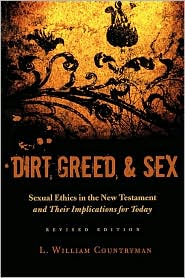
Countryman - Dirt, Greed, and Sex: A Book Review
William Countryman, Dirt, Greed, and Sex, Fortress 2007.
This book is a brilliant and challenging survey of New Testament sexual ethics. What is unique about it (at least in my experience) is that it approaches these issues, not through the grid of our own modern approach to such matters but seeks to reconstruct the grid which those in the world of the NT would have used. This book is frequently cited in other literature and usually accompanied by the word "provocative." I took this to mean that not everyone liked the conclusions but they weren't interested in arguing the point right now. How ever I think it is a fair word to use of the book. It has two levels to it. On one level it is an excellent attempt at bring the reader into a different way of looking at sex and, as far as I can tell, from the point of view of 1st century Christians. On the other hand this book is not written into a vacuum and while the book is hardly dedicated to the gay debate it is nonetheless intended as a contribution to it and it is where things come closest to this topic that I think the book is at it weakest.
The first major section is dedicated to the concept of purity, drawing heavily on the work of Mary Douglas Countryman first shows how purity considerations operated in the OT and 1st century Judaism. He argues that while we moderns hapily differentiate between say food hygene and sexual purity, the ancient world had no concept of germs, genetics or STDs and treated all purity considerations as of one set. Countryman then goes on to show how the NT reframes purity considerations from external matters (food, dead people, sex, etc) to that of the heart (motive, intention, love, hate, etc). Countryman concludes that for the NT purity considerations are no longer binding on the conduct of Christians for any area of life, including the sexual.
The second section moves onto what for Countryman is the other major ancient concept for sexual ethics, property. Countryman persuasively demonstartes how sexual transgressions were primarily conceived of as transgressinos against the property of another. he demonstrates the OT and second temple judaism backgrounds for this and then shows how the NT both retains this understanding but also radically modifies it. This section of the book is the most exciting as Countryman skillfully explicates how Jesus' prohibition against divorce served to deconstruct the system of patriarchy. Countryman then traces this impetus through Paul but concludes that the later NT writings show evidence of a reversion to patriarchy and that even Paul was never consistent in applying this new radical approach to the equality of the sexes.
The final (and shortest) section contains a summary and then Countryman's suggestions for how his exegesis of NT sexual ethics might be aplied today. This is by far the weakest section. Countryman's arguments here lack the thoroughness and consistency he (generally) applied to the earlier sections. While many of his conclusions are hard to disagree with his ethical method is rather slipshod and he spends too little time working on how to move from the NT to today but merely seems to muse on how his findings affect his selection of topics.
With regard to the gay debate, Countryman's own agenda appears to affect the exegesis negatively at a couple of points, not least his discussion of malkoi and arsenokoitai in 1 Cor 6:9-11 (pp195-6) and of Luke 7:1-17 (pp75-6, 246, 327). 1 Cor 6:9-11 especially is a big issue and I hope to blog specifically on it later as it bears on my own thesis. What he succeeds in doing, very well, is showing the ambiguity of those NT texts which are often used to forbid homosexuality. This is a point that needs to be made, however to the educated it should hardly be surprising as "homosexuality" per se was not a concept for either Jew or Gentile in the first century, it is a modern idea.
Overall I am grateful for a very well written book that has given me a lucid and extremely helpful introduction to NT sexual ethics. By comparison the other books I've read have tended to both treat NT ethics as if they were written about our (modern) problems and be as dull as ditch water. In particular the insight that NT sexual ethics revolve around concepts of property (why has no one else pointed this out to me!!!???) is a vital insight for my work on 1 Cor 6:12-20 and will be an important shaping factor for my final conclusions. Already it is an insight that has made sense of a lot of loose ends for me and I'll be keeping the book close for the next few months.
[I have also quoted from the book here and here.]
Wednesday, January 6, 2010
Countryman on Adultery
Among us, sexual activity outside the marriage on the part of either partner is understood as adultery; in antiquity, only such activity on the part of the wife (or the betrothed woman) qualified. The husband could commit adultery only by having intercourse with the wife (or betrothed) of another man; if he had sexual relations with a slave, a prostitute, a concubine, or a divorced or widowed woman, this did not constitute adultery against his own marriage. Again our own explanations of what is wrong in adultery usually focuses on the betrayal of trust and of formal commitments between spouses, whereas the ancient understanding of adultery assumes rather that it is a violation of another man's property. What for us is a kind of betrayal was for them a species of theft.
Countryman, Dirt Greed and Sex, 2007, 154-5
This well written book continues to be quite uncomfortable reading, although I imagine it would be more so for members of Family First et al. This is the conclusion of a very well argued section on the understanding of adultery in the Torah. Once again this highlights the danger of reading our modern conceptions back into the Bible. Is this really the "biblical family values" we want a return to?
Let me know what you think, :-)
Friday, August 28, 2009
Destroying food and stomachs in 1 Cor 6:13
With regards to the previous post, the loss of speech marks does immediately pose a problem as Paul then appears to be saying "God will destroy stomachs and food" which we, fairly naturally, hear as implying "in the life of the Resurrection there will be no eating." Of course that sounds wrong as we know that both Hebrew and Christian visions of the resurrection life use the image of a feast, and that the resurrected Christ cooked and ate fish as proof of his resurrection. However it is an assumption that this refers to the resurrected life, i.e. that those who are resurrected will experience the destruction of their stomachs. Might it be better to understand this destruction as an act of judgment? After all, here stomach and food have been brought into the discussion not because food is an issue but representing the those deeds which are purely the satisfaction of base desire and those things which have existed purely for the satisfaction of those base desires. The eschatalogical image of feasting is not the joy of having a full stomach but of everyone united in a common act of celebration. And even Jesus' post resurrection acts of eating were focused on his relationship with his disciples (John 21:9-17, Luke 24:36-43). Indeed, later on in 1 Corinthians Paul rebukes the Corinthians for eating and drinking purely to satisfy their appetites instead of showing due regard and love for each other (1 Cor 11). So, perhaps here in 1 Cor 6:13 stomachs and food are a cipher for the gratuitous and selfish satisfaction of base desires which is leading Corinthians Christians to visit prostitutes and it is that that will be destroyed by God along with all other desires and acts which are not rooted in loving communion with God and each other.
Let me know what you think :-)
Monday, August 3, 2009
One flesh - what does it really mean?
While we are on the subject of sex, I had a hunch today, as I was working on 1 Cor 6:12-20, that everyone I was reading was being to quick to assume Paul's quotation of Genesis 2:24 was a reference to sex. Now given that the context is a discussion of the theological reasons for not having sex with prostitutes that is perhaps understandable. But it also highlight that among modern Christians "becoming one flesh" has become a euphemism for sex, and perhaps consequently sexual activity has become the defining characteristic of marriage. See for example this or this, both extremely interesting articles from Christianity today. So on this hunch I thought I would consult an expert on what was really meant by one flesh in Gen 2:24. For the Old Testament scholar Gordon Wenham, becoming one flesh, "does not denote merely the sexual union that follows marriage, or the children conceived in marriage, or even the spiritual and emotional relationship that it involves, though all are involved in becoming one flesh. Rather it affirms that just as blood relations are one’s flesh and bone... so marriage creates a similar kinship between man and wife.” [From his Genesis 1-15 commentary, p 71]
So a Biblical view of marriage is not first and foremost about having sex, although that is included, but first and foremost about being family. Joined together, as one flesh, committed and interdependent. I believe this truth, properly applied, could be transformational for many Christian marriages. What do you think?
Now all I have to do is figure out how this changes my understanding of 1 Cor 6:12-20!
Subscribe to:
Posts (Atom)
Xenos has moved!
I am now blogging at https://jonathanrobinsonblog.wordpress.com hopefully more regularly. I'll delete this site eventually, but it wil...
-
Just been reading a fun little article with an approach to Jesus' preexistence in Mark's Gospel that I haven't come across befor...
-
James McGrath's blog really is a mighty blog. He is single handedly responsible for sending over 80 readers to this weeks carnival. If y...
-
Haere mai, tena koutou katoa. Welcome one and all to New Zealand for the October 2010 Biblical Studies Carnival. Don't worry, sausages...