Showing posts with label book reviews. Show all posts
Thursday, March 8, 2012
Real Sex - Lauren Winner: A Book Review
Winner's book came to me highly recommended. It is a 161 pages and a fairly light read, aimed at the thinking Christian and not requiring any specialist knowledge to engage. Lauren Winner is probably most famous for her two memoirs, Girl Meets God and Still. This book has the odd autobiographical moment but on the whole is a practical theological exploration of the topic of chastity.
Wednesday, January 11, 2012
Foyle, Honourably Wounded: A Book Review
I got onto this book from a review by Paul Windsor, its primary target is missionaries, i.e. those involved in cross cultural work as expatriates, and those in home churches involved in sending missionaries. As a (very) secondary target group many of its insights into stress and other issues can be related without too much effort to ministry in churches and other organisations. Foyle is a psychiatrist with decades of experience in India, Nepal and Pakistan and since retirment has continued to research and interview missionaries about stress and its symptoms and solutions.
Monday, January 2, 2012
Dallas, Lessons from San Quentin: A Book Review
Well the idea is good. Let's tell the story of a high flying real estate entrepeneur who gets into legal trouble and by an unfortunate grilfriend related accident gets sent to the wrong prison and instead of serving his time with all the other white collar criminals ends up in maximum security San Quentin with all the bad boys. Add a spirtual awakening and a life turn around and surely nothing can go wrong? John Ortberg even says from the back cover, "Read Bill's story only if you want to risk a changed life." And Chuck Colson, who wrote the excellent Born Again - a similar story of jailhouse redemption, also endorses with, "A riveting story."
Wednesday, December 28, 2011
Davidson, A Public Faith: A Book Review
I try and read at least one church history book a year. Every time I do it always amazes me how different the perspective of a different historian can be. Ivor Davidson is head of St Andrew's divinty school at the moment although he used to be at Otago in NZ. Davidson's book is part of an 8 part Monarch History of the Church, so this book covers 312-600AD (actually we get well into the 600s by the end of the book) and so is a nice medium between one volume church histories and a more detailed study on one characer or controversy. I picked this up in the bargain bin at my local Christian bookstore and have been glad I did. On the strength of this one I'll be looking out for the others in the series.
Wednesday, December 29, 2010
Hezekiah: New Manuscript Discovered
Well I am pleased to be able to bring, what I think may be the first review in the biblioblog top 50 of the recently discovered manuscript of the Book of Hezekiah. You know, the one you always look for somewhere in the minor prophets but cannot find. As much as I hate to contradict the sagely and saintly Claude Mariottini on the origins and content of this important document it is clear that his project to reconstruct this document from oral fragments has failed to result in anything resembling an actual book. By contrast Ian Kammann, a much neglected and misunderstood scholar of the first order, has produced what can only be described as the most convincing reconstruction of the Hezekiah tradition this century, or ever, and it is an actual book. Not only so but it contains a limited reconstruction of the pseudopopapocryphal document, the Book of Hesitations, fitted within a radical new interpretational structure and alongside a helpful excursus on the relationship between the two traditions.
Contrary to the misguided thoughts of some what really sets this edition of Hezekiah apart from any other edition someone might hypothetically produce is the foot notes and helpful introductory sections, concordance and other essential textual aparatus. This book essentially combines the novelty and excitment of cutting edge textual reconstruction with the accessibility of a Thomas Nelson "your-own-peculiar-niche-of-beligerant-Christianity" Study Bible. So don't miss it, available at Amazon or Kammann's own website. This could be the late Christmas present for the pastor or scholar you love that you have been looking for.
Tuesday, December 14, 2010
Popes and Bankers
OK, I have been sweating about how to review this book,
But now I don't have to, Paul Burkhart has written the review that frankly I wasn't man enough to do, and he does it so much more intelligently and gracefully than I would have. So please read his review, because this endorsement of his review is the most I can bring myself to do towards reviewing this book. I'm sorry to say. Also don't miss his analysis of the author in question, he has cleared up a lot of questions for me. It remains however that this was a brilliant idea for a book, and I'd love to see this done well.
Friday, October 8, 2010
Christian Preaching from the Old Testament #3
[This is the second in a serialisation and slight revision of an old essay of mine, in the hope of getting some interaction from others and also making it more accessible. (Part 1 here, Part 2 here)]
Four Evangelical Approaches to Preaching from the Old Testament
John Bright rightly states, ‘as the proof of the pudding is in the eating, so the proof of hermeneutical principles must be in the preaching.’[1] The focus of this series is therefore not the cutting edge of academic debate but present homiletical practice. I have chosen four works which are written by recognised evangelicals who teach in evangelical institutions and whose works on Old Testament Preaching are recommended by other evangelical homileticians. I will briefly summarise each work before bringing them into conversation with each other on specific issues in the following posts.
Monday, August 23, 2010
Best Book Review Conclusion Ever!
Of course, it would be scurrilous (and ad hominem) to point out the irony of professional, hence interested, literary critics arguing for the political utility of their discipline because it exposes the hidden interests of others. It would not in any case invalidate their analysis. However, one does wish to flag the question of at what point this methodology balances hermeneutical suspicion toward other persons, structures, and systems with interpretative charity and self-criticism. This question is pregnant at several points in an otherwise fine volume.
- Michael J. Lakey in his review of Roland Boer and Jorunn Økland, eds. Marxist Feminist Criticism of the Bible, Sheffield, 2008.
Of course, it would be scurrilous (and ad hominem) to point out the irony of using the word "pregnant" in the concluding sentence of a review of a book on Marxist Feminist criticism, so of course I will do no such thing! :-D
Monday, April 26, 2010
McGrath, The Only True God: A Book Review
James F. McGrath, The Only True God: Early Christian Monotheism in Its Jewish Context
[With thanks to the author for a review copy]
McGrath’s book has an argument that for many would seem counterintuitive, that the early Christians did not diverge from Jewish monotheism, even despite their veneration of Jesus. For McGrath this is simply because the modern conceptions of monotheism are not how 1st Century Jews would have defined their monotheism. The book’s thesis is that while Christians, post Nicaea, are used to thinking about monotheism in terms of ontology, 1st Century Jews defined their devotion to the one God in terms of worship. While Christians did worship Christ in some respects, McGrath argues that only sacrificial worship to Christ would have made Christ equal to God in a way that would constitute a breach of 1st Century Jewish monotheism.
The book itself has the rare virtue of being blessedly short, a mere 104 pages of text (not including notes, bibliography and index). That being the case, what McGrath achieves within those pages is all the more impressive. The book is intended to be accessible to those without a detailed knowledge of the field. Thus the first chapter takes pains to explain clearly the important concepts and relevant methods. This is done in a thorough but economical style. In the second chapter McGrath turns to the question of how Jews in the Greco-Roman era would have understood their own monotheism in the context of a world where the worship of many gods was commonplace. Given the book’s intention to be accessible to the non-expert it is a shame that some of the more obscure source passages referenced, e.g. Hecataeus of Abdera, do not appear in translation, instead the reader is reliant on McGrath’s précis of the relevant points. Having established a working definition of 1st Century Jewish monotheism McGrath moves on to examine the writings of Paul (chp 3), the Gospel of John (chp 4), and Revelation (chp 5), against this definition. In each chapter McGrath continues to develop his thesis and in each case finds the Christian elevation of Christ to be within the bounds of his definition of 1st Century Jewish monotheism.
The sixth chapter moves on from the Biblical material to discuss the “two powers heresy” within rabbinic literature. McGrath argues that after the destruction of the Jerusalem Temple Jewish monotheism was forced to redefine itself. One result of this process was the rabbinic response to the two powers heresy which while probably originally targeted at the Gnostics came to encompass the Christians also. McGrath concludes that certain ideas that were condemned in the late 2nd and early 3rd centuries need not have been controversial in the 1st century. Thus the schism between Christianity and Judaism over their respective understandings of monotheism is re-dated from the 1st to the 3rd century and, surprisingly, is a result of a change in the boundaries of Jewish monotheism rather than a developing Trinitarianism. The final chapter briefly summarises the book’s findings and then offers some thoughts on their historical and theological implications.
McGrath’s book is excellently written, the only hindrance to the reader’s enjoyment being the use of endnotes instead of footnotes. It consistently progresses through his argument with nuance but without wasting space on peripheral issues. It engages with other scholarship in a respectful but efficient manner and represents a significant contribution to the field. McGrath’s concluding thoughts are balanced and show a concern for further discussion and for the appropriation of the work by theologians. I would suggest it is essential reading for anyone interested in NT background, Christology, or the historical development of Trinitarian theology.
[With thanks to the author for a review copy]
McGrath’s book has an argument that for many would seem counterintuitive, that the early Christians did not diverge from Jewish monotheism, even despite their veneration of Jesus. For McGrath this is simply because the modern conceptions of monotheism are not how 1st Century Jews would have defined their monotheism. The book’s thesis is that while Christians, post Nicaea, are used to thinking about monotheism in terms of ontology, 1st Century Jews defined their devotion to the one God in terms of worship. While Christians did worship Christ in some respects, McGrath argues that only sacrificial worship to Christ would have made Christ equal to God in a way that would constitute a breach of 1st Century Jewish monotheism.
The book itself has the rare virtue of being blessedly short, a mere 104 pages of text (not including notes, bibliography and index). That being the case, what McGrath achieves within those pages is all the more impressive. The book is intended to be accessible to those without a detailed knowledge of the field. Thus the first chapter takes pains to explain clearly the important concepts and relevant methods. This is done in a thorough but economical style. In the second chapter McGrath turns to the question of how Jews in the Greco-Roman era would have understood their own monotheism in the context of a world where the worship of many gods was commonplace. Given the book’s intention to be accessible to the non-expert it is a shame that some of the more obscure source passages referenced, e.g. Hecataeus of Abdera, do not appear in translation, instead the reader is reliant on McGrath’s précis of the relevant points. Having established a working definition of 1st Century Jewish monotheism McGrath moves on to examine the writings of Paul (chp 3), the Gospel of John (chp 4), and Revelation (chp 5), against this definition. In each chapter McGrath continues to develop his thesis and in each case finds the Christian elevation of Christ to be within the bounds of his definition of 1st Century Jewish monotheism.
The sixth chapter moves on from the Biblical material to discuss the “two powers heresy” within rabbinic literature. McGrath argues that after the destruction of the Jerusalem Temple Jewish monotheism was forced to redefine itself. One result of this process was the rabbinic response to the two powers heresy which while probably originally targeted at the Gnostics came to encompass the Christians also. McGrath concludes that certain ideas that were condemned in the late 2nd and early 3rd centuries need not have been controversial in the 1st century. Thus the schism between Christianity and Judaism over their respective understandings of monotheism is re-dated from the 1st to the 3rd century and, surprisingly, is a result of a change in the boundaries of Jewish monotheism rather than a developing Trinitarianism. The final chapter briefly summarises the book’s findings and then offers some thoughts on their historical and theological implications.
McGrath’s book is excellently written, the only hindrance to the reader’s enjoyment being the use of endnotes instead of footnotes. It consistently progresses through his argument with nuance but without wasting space on peripheral issues. It engages with other scholarship in a respectful but efficient manner and represents a significant contribution to the field. McGrath’s concluding thoughts are balanced and show a concern for further discussion and for the appropriation of the work by theologians. I would suggest it is essential reading for anyone interested in NT background, Christology, or the historical development of Trinitarian theology.
Wednesday, April 7, 2010
Habets, The Anointed Son: Book Review Part 2
[Following on from Part 1.]
Habets' next two chapters deal with both the NT scholarship and Habets' own appropriation of NT Testament theology respectively.
4 Interpreting the Evidence: Christology in New Testament Scholarship
The fourth chapter begins with a brief summary of approaches to NT Christology, especially regarding how the different Christology of the NT corpus are to be reconciled (or not) to each other. From the beginning Habets suggests that one of the reasons scholarship has struggled with this question, to the extent it has, is that it has presupposed a Christology from above and then tried to read that back into the NT accounts instead of seeing "how and why the earliest communities of faith came to a belief in the deity of Jesus Christ in the first place" (p89). Habets claims that Spirit Christology can provide the "integrative framework" that can be used to hold together all the "NT Teaching on the identity of Jesus" (p102).
The rest of the chapter is then spent arguing for and outlining a "retroactive hermeneutic" and the role of the Spirit in the interpretations of the present (p103). For Habets "The canonical authors are consciously writing to and for Spirit-inspired readers" (p105). He argues that just as the Gospels are examples of reinterpretation of the life of Jesus from the perspective of the believing community so we must read them retroactively, conscious of Christ's presence with us now by the Spirit (p116). As arguing for this hermeneutic is really the function and bulk of the chapter, its title is somewhat misleading. Notwithstanding, the chapter makes a number of important and provoking assertions regarding the role of the Spirit in interpreting and appropriating scripture today, exposing essential issues for anyone who comes to the scriptures from a perspective of faith.
5 Explaining Jesus: The Testimony of the New Testament Writers
This chapter again suffers from something of a title confusion. At 70 pages it is the longest chapter in the book, yet 66 pages are devoted to the Gospels and Acts, 3 to Paul and the rest of the NT barely gets a look in, although Hebrews does receive some mentions. After exposing the diversity of NT Christology in the previous chapter it was a shame not to have it play a fuller part in this one.
The great strength of this chapter is the amount of ground it covers and the depth of the references to secondary literature. Each section of the chapter would function well as a starting point for research into a particular facet of Jesus' life and work. This gives the book its potential to function admirably as a text book for students looking for research topics. Due to the amount of ground covered Habets has to deal quickly with a number of contentious points which he does not have space to argue thoroughly. This leaves plenty of room for debate and exploration on some finer points, especially around the role of the Spirit in the death and resurrection of Christ. However the overall thesis of the chapter, that the NT conceives of Jesus Christ's identity in pneumatological terms, is not undermined.
The chapter takes the reader on a tour of the Gospels from the point of view of the Spirit and provides some fascinating insights. For example, in discussing Jesus' temptations in the wilderness Habets concludes, "The temptations were not levelled at his human weakness but rather aimed at his relationship to God," (p141) and Habets demonstrates the integral connection between Christ and the Spirit using a discussion of the unpardonable sin (p160).
The final instalment of the book review to come soon! Watch this space.
Habets' next two chapters deal with both the NT scholarship and Habets' own appropriation of NT Testament theology respectively.
4 Interpreting the Evidence: Christology in New Testament Scholarship
The fourth chapter begins with a brief summary of approaches to NT Christology, especially regarding how the different Christology of the NT corpus are to be reconciled (or not) to each other. From the beginning Habets suggests that one of the reasons scholarship has struggled with this question, to the extent it has, is that it has presupposed a Christology from above and then tried to read that back into the NT accounts instead of seeing "how and why the earliest communities of faith came to a belief in the deity of Jesus Christ in the first place" (p89). Habets claims that Spirit Christology can provide the "integrative framework" that can be used to hold together all the "NT Teaching on the identity of Jesus" (p102).
The rest of the chapter is then spent arguing for and outlining a "retroactive hermeneutic" and the role of the Spirit in the interpretations of the present (p103). For Habets "The canonical authors are consciously writing to and for Spirit-inspired readers" (p105). He argues that just as the Gospels are examples of reinterpretation of the life of Jesus from the perspective of the believing community so we must read them retroactively, conscious of Christ's presence with us now by the Spirit (p116). As arguing for this hermeneutic is really the function and bulk of the chapter, its title is somewhat misleading. Notwithstanding, the chapter makes a number of important and provoking assertions regarding the role of the Spirit in interpreting and appropriating scripture today, exposing essential issues for anyone who comes to the scriptures from a perspective of faith.
5 Explaining Jesus: The Testimony of the New Testament Writers
This chapter again suffers from something of a title confusion. At 70 pages it is the longest chapter in the book, yet 66 pages are devoted to the Gospels and Acts, 3 to Paul and the rest of the NT barely gets a look in, although Hebrews does receive some mentions. After exposing the diversity of NT Christology in the previous chapter it was a shame not to have it play a fuller part in this one.
The great strength of this chapter is the amount of ground it covers and the depth of the references to secondary literature. Each section of the chapter would function well as a starting point for research into a particular facet of Jesus' life and work. This gives the book its potential to function admirably as a text book for students looking for research topics. Due to the amount of ground covered Habets has to deal quickly with a number of contentious points which he does not have space to argue thoroughly. This leaves plenty of room for debate and exploration on some finer points, especially around the role of the Spirit in the death and resurrection of Christ. However the overall thesis of the chapter, that the NT conceives of Jesus Christ's identity in pneumatological terms, is not undermined.
The chapter takes the reader on a tour of the Gospels from the point of view of the Spirit and provides some fascinating insights. For example, in discussing Jesus' temptations in the wilderness Habets concludes, "The temptations were not levelled at his human weakness but rather aimed at his relationship to God," (p141) and Habets demonstrates the integral connection between Christ and the Spirit using a discussion of the unpardonable sin (p160).
The final instalment of the book review to come soon! Watch this space.
Sunday, February 28, 2010
God and Guinness: a Book and Beer Review
I love God, and although it is very much a lesser and less frequently indulged love, I also love Guinness. I also have a small personal connection with some of the ancestors of the Arthur Guinness who founded the Guinness brewery and dynasty(s). So the title of this book was too hard to refuse. It is well written, light and fast paced, an easy read with lots of fascinating facts and takes the reader from the beggining of the brewery in the 18th century up to the modern day. As a bonus there is a brilliant introductory chapter that introduces the history of beer and civilisation and of beer and Christianity. So far so good, 4/5 stars.
I did dislike a few things though. The book is a little uneven as Stephen Mansfield slips from historian to motivational speaker to preacher, this is OK but in a couple of places he quotes historians without even mentioning their names, i don't expect footnotes, and there is an adequate sources section in the appendix. more annoying than this is that Mansfield manages to mention 3 times in the book that he has also written a book about the faith of Barak Obama, but that doesn't mean that he likes Barak Obama, in fact he is at pains to tell us he is a CONSERVATIVE christian. Frankly, I am reading the book to find out about Guinness not about him. If people are judging him like that, he shouldn't give them the dignity of a response, especially not in an unrelated book. Why waste my time? His "conservative" idea of truth also spoils the historical narrative a couple of times. For example he fails, as a good historian should not, to point out that while an evangelical member of the Guinness family may have thought that Darwin was an "infidel" who profaned Christ and attacked the authority of the Bible, that is not a very fair assement of Darwin himself. You may think that was an ommission but on the next page he describes Darwin's theories as "pseudoscience." I mean, I accept that he may not be a payed up evolutionist, he may even be a dyed in the wool creationist, but to say one of the most influential scientists ever, was only doing "psuedoscience" beggars belief. Mansfield also ends the book with a highly irritating and trite 5 things to learn from the story of Guinness like some half rate preacher who has to list at the end of the sermon all the things he hoped you'd picked up on the way.
So read and enjoy, but as you chew the meat you might have to spit out the bones. Thankfully, Guinness stout is made to a much more exacting standard! And now i'm feeling thirsty! :-)
[With thanks to booksneesze.com's book review blogger program!]
I did dislike a few things though. The book is a little uneven as Stephen Mansfield slips from historian to motivational speaker to preacher, this is OK but in a couple of places he quotes historians without even mentioning their names, i don't expect footnotes, and there is an adequate sources section in the appendix. more annoying than this is that Mansfield manages to mention 3 times in the book that he has also written a book about the faith of Barak Obama, but that doesn't mean that he likes Barak Obama, in fact he is at pains to tell us he is a CONSERVATIVE christian. Frankly, I am reading the book to find out about Guinness not about him. If people are judging him like that, he shouldn't give them the dignity of a response, especially not in an unrelated book. Why waste my time? His "conservative" idea of truth also spoils the historical narrative a couple of times. For example he fails, as a good historian should not, to point out that while an evangelical member of the Guinness family may have thought that Darwin was an "infidel" who profaned Christ and attacked the authority of the Bible, that is not a very fair assement of Darwin himself. You may think that was an ommission but on the next page he describes Darwin's theories as "pseudoscience." I mean, I accept that he may not be a payed up evolutionist, he may even be a dyed in the wool creationist, but to say one of the most influential scientists ever, was only doing "psuedoscience" beggars belief. Mansfield also ends the book with a highly irritating and trite 5 things to learn from the story of Guinness like some half rate preacher who has to list at the end of the sermon all the things he hoped you'd picked up on the way.
So read and enjoy, but as you chew the meat you might have to spit out the bones. Thankfully, Guinness stout is made to a much more exacting standard! And now i'm feeling thirsty! :-)
[With thanks to booksneesze.com's book review blogger program!]
Friday, January 22, 2010
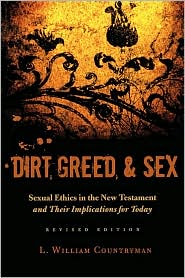
Countryman - Dirt, Greed, and Sex: A Book Review
William Countryman, Dirt, Greed, and Sex, Fortress 2007.
This book is a brilliant and challenging survey of New Testament sexual ethics. What is unique about it (at least in my experience) is that it approaches these issues, not through the grid of our own modern approach to such matters but seeks to reconstruct the grid which those in the world of the NT would have used. This book is frequently cited in other literature and usually accompanied by the word "provocative." I took this to mean that not everyone liked the conclusions but they weren't interested in arguing the point right now. How ever I think it is a fair word to use of the book. It has two levels to it. On one level it is an excellent attempt at bring the reader into a different way of looking at sex and, as far as I can tell, from the point of view of 1st century Christians. On the other hand this book is not written into a vacuum and while the book is hardly dedicated to the gay debate it is nonetheless intended as a contribution to it and it is where things come closest to this topic that I think the book is at it weakest.
The first major section is dedicated to the concept of purity, drawing heavily on the work of Mary Douglas Countryman first shows how purity considerations operated in the OT and 1st century Judaism. He argues that while we moderns hapily differentiate between say food hygene and sexual purity, the ancient world had no concept of germs, genetics or STDs and treated all purity considerations as of one set. Countryman then goes on to show how the NT reframes purity considerations from external matters (food, dead people, sex, etc) to that of the heart (motive, intention, love, hate, etc). Countryman concludes that for the NT purity considerations are no longer binding on the conduct of Christians for any area of life, including the sexual.
The second section moves onto what for Countryman is the other major ancient concept for sexual ethics, property. Countryman persuasively demonstartes how sexual transgressions were primarily conceived of as transgressinos against the property of another. he demonstrates the OT and second temple judaism backgrounds for this and then shows how the NT both retains this understanding but also radically modifies it. This section of the book is the most exciting as Countryman skillfully explicates how Jesus' prohibition against divorce served to deconstruct the system of patriarchy. Countryman then traces this impetus through Paul but concludes that the later NT writings show evidence of a reversion to patriarchy and that even Paul was never consistent in applying this new radical approach to the equality of the sexes.
The final (and shortest) section contains a summary and then Countryman's suggestions for how his exegesis of NT sexual ethics might be aplied today. This is by far the weakest section. Countryman's arguments here lack the thoroughness and consistency he (generally) applied to the earlier sections. While many of his conclusions are hard to disagree with his ethical method is rather slipshod and he spends too little time working on how to move from the NT to today but merely seems to muse on how his findings affect his selection of topics.
With regard to the gay debate, Countryman's own agenda appears to affect the exegesis negatively at a couple of points, not least his discussion of malkoi and arsenokoitai in 1 Cor 6:9-11 (pp195-6) and of Luke 7:1-17 (pp75-6, 246, 327). 1 Cor 6:9-11 especially is a big issue and I hope to blog specifically on it later as it bears on my own thesis. What he succeeds in doing, very well, is showing the ambiguity of those NT texts which are often used to forbid homosexuality. This is a point that needs to be made, however to the educated it should hardly be surprising as "homosexuality" per se was not a concept for either Jew or Gentile in the first century, it is a modern idea.
Overall I am grateful for a very well written book that has given me a lucid and extremely helpful introduction to NT sexual ethics. By comparison the other books I've read have tended to both treat NT ethics as if they were written about our (modern) problems and be as dull as ditch water. In particular the insight that NT sexual ethics revolve around concepts of property (why has no one else pointed this out to me!!!???) is a vital insight for my work on 1 Cor 6:12-20 and will be an important shaping factor for my final conclusions. Already it is an insight that has made sense of a lot of loose ends for me and I'll be keeping the book close for the next few months.
[I have also quoted from the book here and here.]
Tuesday, January 19, 2010
Habets, The Anointed Son: Book Review Part 1
Part 1 of the book review covers the first three chapters of Habets' The Anointed Son.
The first thing that needs to be said is that at the beggining of each chapter Habet's has provided a mouth-watering selection of quotes. The book is probably worth buying just for those selections alone, although maybe they would need to be set over some soft focus photos of inspiring scenery or babies or something (;-)!!).
The second thing that needs to be said is that Habets probably wouldn't divide his book this way. The first 4 chapters constitute the prolegomena and chapters 5-8 are the constructive stuff. But I have only read the first three chapters and I will treat the survey of NT scholarship alongside Habets' own exegesis of the NT in the next part of the review. Which makes sense to me if only because it is my own area of specialization. The third part of the review will cover chapters 6-8 which is where all the fun constructive theology will take place.
1 Spirit Christology: Awaiting the Promise
The first chapter sets about phrasing the question. Habets states that this work will "introduce the doctrine, examine the various mutually exclusive proposals, and offer a constructive Trinitarian proposal." (p7) He signals that he wants to avoid the traditional polarity between Logos and Spirit Christologies and present a Spirit Christology whitch is interwoven with, rather than seperated from, the traditional Logos Christology encapsulated in the creeds (p9).
2 Understanding Jesus: Approaches to Christology
In the second chapter Habets embarks on an extensive discussion of how function (what Christ does) and ontology (who Christ is) relate within Christology. The discussion then moves into a defining of Christologies from "above" and "below." Habets is especially insistent that not all Christologies from "below" are equal. Habets wishes to follow Gunton in asserting that while Christology may begin on the ground, it may not remain there and must move upwards (p42). Habets suggests Kaseman and Pannenberg have helped pave the way in their own treatement of Christology. He shares their refusal to presupose a "pre-formed Trinity" at the beggining of Christological enquiry and argues that instead the confession of Jesus' divinty (and hence the Trinity) should arise out of Christology (p43). This chapter asserts a methodology "that seeks to bridge the gulf between Jesus' humanity and divinity (the two nature Achilles heel of classical Christology) by means of the Holy Spirit."
3 Logos and Spirit
The third chapter surveys the Christology of many of the important theologians from the Apolostolic Fathers through to Chalcedon. Habets observes that in the early church "Spirit Christology was eclipsed by Logos Christology due to the fear of patripassianism [that God the Father suffered in Christ] . . . it enabled Christian faith to be harmonized with the fundamental principles of Greek philosophy." (p63) This tendency is then tracked through to Chalcedon where Habets concludes, "perhaps the most serious problem with Chalcedonian Christology is that it has encouraged the wrong kind of Christology, exclusively from above. It has encouraged the church to start with the deity of the Son of God and then to fit (the problem of his) humanity into the divinity. At all costs the divinity must remain inviolate, while the humanity may be short changed." (pp87-88) Thus the next task is to return to the biblical witness to uncover the Spirit Christology which has lain hidden by such historical tendencies.
I think Spirit Christology is a fascinating and important area of theological development and I am finding myself, thus far at least, in complete agreement with Habets' conclusions and approach, and, more to the point, excited for what will come next.
The first thing that needs to be said is that at the beggining of each chapter Habet's has provided a mouth-watering selection of quotes. The book is probably worth buying just for those selections alone, although maybe they would need to be set over some soft focus photos of inspiring scenery or babies or something (;-)!!).
The second thing that needs to be said is that Habets probably wouldn't divide his book this way. The first 4 chapters constitute the prolegomena and chapters 5-8 are the constructive stuff. But I have only read the first three chapters and I will treat the survey of NT scholarship alongside Habets' own exegesis of the NT in the next part of the review. Which makes sense to me if only because it is my own area of specialization. The third part of the review will cover chapters 6-8 which is where all the fun constructive theology will take place.
1 Spirit Christology: Awaiting the Promise
The first chapter sets about phrasing the question. Habets states that this work will "introduce the doctrine, examine the various mutually exclusive proposals, and offer a constructive Trinitarian proposal." (p7) He signals that he wants to avoid the traditional polarity between Logos and Spirit Christologies and present a Spirit Christology whitch is interwoven with, rather than seperated from, the traditional Logos Christology encapsulated in the creeds (p9).
2 Understanding Jesus: Approaches to Christology
In the second chapter Habets embarks on an extensive discussion of how function (what Christ does) and ontology (who Christ is) relate within Christology. The discussion then moves into a defining of Christologies from "above" and "below." Habets is especially insistent that not all Christologies from "below" are equal. Habets wishes to follow Gunton in asserting that while Christology may begin on the ground, it may not remain there and must move upwards (p42). Habets suggests Kaseman and Pannenberg have helped pave the way in their own treatement of Christology. He shares their refusal to presupose a "pre-formed Trinity" at the beggining of Christological enquiry and argues that instead the confession of Jesus' divinty (and hence the Trinity) should arise out of Christology (p43). This chapter asserts a methodology "that seeks to bridge the gulf between Jesus' humanity and divinity (the two nature Achilles heel of classical Christology) by means of the Holy Spirit."
3 Logos and Spirit
The third chapter surveys the Christology of many of the important theologians from the Apolostolic Fathers through to Chalcedon. Habets observes that in the early church "Spirit Christology was eclipsed by Logos Christology due to the fear of patripassianism [that God the Father suffered in Christ] . . . it enabled Christian faith to be harmonized with the fundamental principles of Greek philosophy." (p63) This tendency is then tracked through to Chalcedon where Habets concludes, "perhaps the most serious problem with Chalcedonian Christology is that it has encouraged the wrong kind of Christology, exclusively from above. It has encouraged the church to start with the deity of the Son of God and then to fit (the problem of his) humanity into the divinity. At all costs the divinity must remain inviolate, while the humanity may be short changed." (pp87-88) Thus the next task is to return to the biblical witness to uncover the Spirit Christology which has lain hidden by such historical tendencies.
I think Spirit Christology is a fascinating and important area of theological development and I am finding myself, thus far at least, in complete agreement with Habets' conclusions and approach, and, more to the point, excited for what will come next.
Tuesday, September 29, 2009
Book Review: Emerson Eggerichs, Love and Respect

This book is essentially a Christian version of "Men are from Mars, Women are from Venus." It's central hypothesis is that men and women see the world differently and have different needs and that because of this misunderstanding often causes problems in marriage. (In this way it is also a bit like the five love languages stuff) The solution according to Eggerichs is that men need to love their wives, and women need to respect their husbands... whether or not they feel they deserve it at that moment in time. Eggerichs helpfully diagnoses the "crazy cycle" which is a vicious circle where withholding love or respect from your spouse causes your spouse to withhold the love or respect that you desire which causes you to withhold even more, etc, etc. This book is very practically focused and I have to say the advice is pretty good. A lot of people would benefit from reading this and I will definitely use some of this material in my own ministry. but I do have some significant issues with this book.
- it is too long and rambling, it needs to be half the length and have a much tighter structure
- Eggerichs never actually defines what exactly he means by love and respect he just takes it as a given, although we do get some clarity from his examples of what constitutes love and respect, these words have a wide potential range of meaning and it needed clarifying
- Eggerichs spends far too much time promoting his ministry and conferences, which is annoying
- Eggerichs overdoes how unique and original his teaching is, which is annoying
- this book is hopelessly stuck in middle America and it would have benefited from being based broader culturally, this limits its usefulness in other contexts
- the use of scripture in this book is appalling, proof texting, paraphrasing and downright inaccuracy abound, although none of his conclusions are 'unbiblical' as such, he behaves as if the scripture were written directly to address middle class 21st C American marital problems, this made it hard for me to recommend
[This book review was done under the Thomas Nelson Book Review Bloggers Program, go to http://brb.thomasnelson.com/ for details.]
Tuesday, September 8, 2009
Book Review: Max Lucado, Fearless
I haven't read anything by Max Lucado for about a decade, I read one book and then overdosed by reading another three or four. Since then I had never felt the urge to return. But when Thomas Nelson offered me a free copy if I review it I thought, "what the hey, a free book is a free book." However, it was no chore to read, this is vintage Lucado, and provided you haven't read too many recently this one comes recommended. Lucado invites us to imagine life without fear, in todays climate of sensationalised crime and terrorist threats it is a welcome invitation. Lucado combines anecdotes and stories with Biblical exegesis which he weaves together artfully. Lucado moves systematially in chapters through the fears that modern western humanity seems to be plagued with. The chapters are short and read deceptively lightly but you have to be careful because there is a lot packed in. In fact read reading Lucado too fast is a bit of a waste, his prose is more like poetry and needs to be savoured. Lucado's use of scripture is a good example of imaginative exegesis where he exposes the metaphoric and emotional resonances of the biblical text. If you are looking for a sustained theological or biblical examination of fear then you will be dissapointed, but if you are looking for a book that reads like a poetic devotional sermon written by a master story teller then you won't be.
[This book review was done under the Thomas Nelson Book Review Bloggers Program, go to http://brb.thomasnelson.com/ for details.]
Subscribe to:
Posts (Atom)
Xenos has moved!
I am now blogging at https://jonathanrobinsonblog.wordpress.com hopefully more regularly. I'll delete this site eventually, but it wil...
-
Just been reading a fun little article with an approach to Jesus' preexistence in Mark's Gospel that I haven't come across befor...
-
James McGrath's blog really is a mighty blog. He is single handedly responsible for sending over 80 readers to this weeks carnival. If y...
-
Haere mai, tena koutou katoa. Welcome one and all to New Zealand for the October 2010 Biblical Studies Carnival. Don't worry, sausages...