Bruce Hamil on how the Bible subverts our consumer culture
Steve on choosing to believe as a basis for theology
Tim on Christian life as diaspora
Showing posts with label strange land. Show all posts
Showing posts with label strange land. Show all posts
Tuesday, June 1, 2010

Monday, May 17, 2010
The 10th Plague and the Problem of Evil
Tim, in his podcast on the passover, finds God's cold blooded killing of all the firstborn in Egypt (Ex11:4-8, 12:29-32) too much to stomach and too hard to believe. As a compassionate human being, I find myself agreeing with Tim. I said as much to the group that I am going through the E-100 readings with and got pretty short shrift from them.

But I wonder if this kind of casuistry is a little beside the point. Part of the punishment was for the firstborn of all the animals to die, the first born of all the animals that had already been killed in the 5th plague (Ex 9:1-7). Which suggests in at least one account, if not both, a little exageration is taking place. This is not deception, because it is there in the text, as plain as the nose on your face. If you read it you will see it, and its author/s must have seen it too. My friend's second point, having lived in the Middle East, was that he could testify that that culture contains a lot more ambiguity than our modernist Western one. So the rather absolute language of Ex11:4-8 and 12:29-32 could legitimately be taken with a grain of salt.
But I'm not sure how much that helps me either. The real question is not, how can I get this text to fit in with what I think is acceptable or not for God to do? The real question, or at least what I think they try and teach us at Bible college, is to ask what is this text trying to say to us? It blatantly does not give a tinkers fart as to whether or not we think God's actions are proportionate or even historical. The story's concern is with God's distinction between the oppressed (in this instance Israel) and the oppressors (in this instance Egypt) (Ex 11:7). The story's concern is to show how God is keeping his promises to Abraham (Gen 12:1-3), i.e. the survival of the people of Israel, ultimately how God is going to redeem all creation. The story's concern is to tell us about . . . God.
This was my friend's most helpful insight today: A year ago, after his back had been broken, he had been praying and hoping for healing. And yet in the last year, from being wheelchair bound and suffering in a number of other respects, he can see all the things he has learnt about God through his infirmity. Now he isn't really that interested in praying for healing.
Such an idea is disgusting. How can he possibly justify God for his crippled state when he should be enjoying health and wealth and prosperity like any deserving child of the western world. How can he possibly understand his suffering as something positive? Is knowing God really better than walking and using a toilet? Is it really worth the death of all those Egyptian first born humans and animals for God to accomplish his promise to Abraham?
Well I don't know the answer to that question, I've never lost my legs or a child, I hope I never do. But I do wonder if maybe I have the problem of evil all wrong, maybe evil looks so bad to me because I think the point of it all is for me to have a nice life. What if the point of it all is to know God? A god who prefers the poor and oppressed, a god who is redeeming creation, a god who doesn't appreciate my need for no one to get hurt, or at least for me not to get hurt, but is willing to hurt anyone and everyone if that is what it takes? I don't know if that is a god I can believe in, I don't know if I have the guts for that, but I think that might be the sort of god that the Bible believes in. . .
Let me know what you think,
image from here
One friend, who had his back broken in a car accident while working as a missionary in Egypt pointed out that this was God's judgment upon the Egyptians for their mistreatement of the Israelites (Ex 1). That is a fair point, if indeed we do believe in justice, in the punishment fitting the crime. The Egyptians had tried to kill every son of the Israelites, and were presumably only keeping the girls alive in order to take advantage of them, so this punishment seems proportionate, even a little lenient.But I wonder if this kind of casuistry is a little beside the point. Part of the punishment was for the firstborn of all the animals to die, the first born of all the animals that had already been killed in the 5th plague (Ex 9:1-7). Which suggests in at least one account, if not both, a little exageration is taking place. This is not deception, because it is there in the text, as plain as the nose on your face. If you read it you will see it, and its author/s must have seen it too. My friend's second point, having lived in the Middle East, was that he could testify that that culture contains a lot more ambiguity than our modernist Western one. So the rather absolute language of Ex11:4-8 and 12:29-32 could legitimately be taken with a grain of salt.
But I'm not sure how much that helps me either. The real question is not, how can I get this text to fit in with what I think is acceptable or not for God to do? The real question, or at least what I think they try and teach us at Bible college, is to ask what is this text trying to say to us? It blatantly does not give a tinkers fart as to whether or not we think God's actions are proportionate or even historical. The story's concern is with God's distinction between the oppressed (in this instance Israel) and the oppressors (in this instance Egypt) (Ex 11:7). The story's concern is to show how God is keeping his promises to Abraham (Gen 12:1-3), i.e. the survival of the people of Israel, ultimately how God is going to redeem all creation. The story's concern is to tell us about . . . God.
This was my friend's most helpful insight today: A year ago, after his back had been broken, he had been praying and hoping for healing. And yet in the last year, from being wheelchair bound and suffering in a number of other respects, he can see all the things he has learnt about God through his infirmity. Now he isn't really that interested in praying for healing.
Such an idea is disgusting. How can he possibly justify God for his crippled state when he should be enjoying health and wealth and prosperity like any deserving child of the western world. How can he possibly understand his suffering as something positive? Is knowing God really better than walking and using a toilet? Is it really worth the death of all those Egyptian first born humans and animals for God to accomplish his promise to Abraham?
Well I don't know the answer to that question, I've never lost my legs or a child, I hope I never do. But I do wonder if maybe I have the problem of evil all wrong, maybe evil looks so bad to me because I think the point of it all is for me to have a nice life. What if the point of it all is to know God? A god who prefers the poor and oppressed, a god who is redeeming creation, a god who doesn't appreciate my need for no one to get hurt, or at least for me not to get hurt, but is willing to hurt anyone and everyone if that is what it takes? I don't know if that is a god I can believe in, I don't know if I have the guts for that, but I think that might be the sort of god that the Bible believes in. . .
Let me know what you think,
Friday, January 22, 2010
Countryman - Dirt, Greed, and Sex: A Book Review
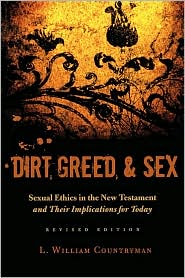
William Countryman, Dirt, Greed, and Sex, Fortress 2007.
This book is a brilliant and challenging survey of New Testament sexual ethics. What is unique about it (at least in my experience) is that it approaches these issues, not through the grid of our own modern approach to such matters but seeks to reconstruct the grid which those in the world of the NT would have used. This book is frequently cited in other literature and usually accompanied by the word "provocative." I took this to mean that not everyone liked the conclusions but they weren't interested in arguing the point right now. How ever I think it is a fair word to use of the book. It has two levels to it. On one level it is an excellent attempt at bring the reader into a different way of looking at sex and, as far as I can tell, from the point of view of 1st century Christians. On the other hand this book is not written into a vacuum and while the book is hardly dedicated to the gay debate it is nonetheless intended as a contribution to it and it is where things come closest to this topic that I think the book is at it weakest.
The first major section is dedicated to the concept of purity, drawing heavily on the work of Mary Douglas Countryman first shows how purity considerations operated in the OT and 1st century Judaism. He argues that while we moderns hapily differentiate between say food hygene and sexual purity, the ancient world had no concept of germs, genetics or STDs and treated all purity considerations as of one set. Countryman then goes on to show how the NT reframes purity considerations from external matters (food, dead people, sex, etc) to that of the heart (motive, intention, love, hate, etc). Countryman concludes that for the NT purity considerations are no longer binding on the conduct of Christians for any area of life, including the sexual.
The second section moves onto what for Countryman is the other major ancient concept for sexual ethics, property. Countryman persuasively demonstartes how sexual transgressions were primarily conceived of as transgressinos against the property of another. he demonstrates the OT and second temple judaism backgrounds for this and then shows how the NT both retains this understanding but also radically modifies it. This section of the book is the most exciting as Countryman skillfully explicates how Jesus' prohibition against divorce served to deconstruct the system of patriarchy. Countryman then traces this impetus through Paul but concludes that the later NT writings show evidence of a reversion to patriarchy and that even Paul was never consistent in applying this new radical approach to the equality of the sexes.
The final (and shortest) section contains a summary and then Countryman's suggestions for how his exegesis of NT sexual ethics might be aplied today. This is by far the weakest section. Countryman's arguments here lack the thoroughness and consistency he (generally) applied to the earlier sections. While many of his conclusions are hard to disagree with his ethical method is rather slipshod and he spends too little time working on how to move from the NT to today but merely seems to muse on how his findings affect his selection of topics.
With regard to the gay debate, Countryman's own agenda appears to affect the exegesis negatively at a couple of points, not least his discussion of malkoi and arsenokoitai in 1 Cor 6:9-11 (pp195-6) and of Luke 7:1-17 (pp75-6, 246, 327). 1 Cor 6:9-11 especially is a big issue and I hope to blog specifically on it later as it bears on my own thesis. What he succeeds in doing, very well, is showing the ambiguity of those NT texts which are often used to forbid homosexuality. This is a point that needs to be made, however to the educated it should hardly be surprising as "homosexuality" per se was not a concept for either Jew or Gentile in the first century, it is a modern idea.
Overall I am grateful for a very well written book that has given me a lucid and extremely helpful introduction to NT sexual ethics. By comparison the other books I've read have tended to both treat NT ethics as if they were written about our (modern) problems and be as dull as ditch water. In particular the insight that NT sexual ethics revolve around concepts of property (why has no one else pointed this out to me!!!???) is a vital insight for my work on 1 Cor 6:12-20 and will be an important shaping factor for my final conclusions. Already it is an insight that has made sense of a lot of loose ends for me and I'll be keeping the book close for the next few months.
[I have also quoted from the book here and here.]
Wednesday, January 6, 2010
Countryman on Adultery
Among us, sexual activity outside the marriage on the part of either partner is understood as adultery; in antiquity, only such activity on the part of the wife (or the betrothed woman) qualified. The husband could commit adultery only by having intercourse with the wife (or betrothed) of another man; if he had sexual relations with a slave, a prostitute, a concubine, or a divorced or widowed woman, this did not constitute adultery against his own marriage. Again our own explanations of what is wrong in adultery usually focuses on the betrayal of trust and of formal commitments between spouses, whereas the ancient understanding of adultery assumes rather that it is a violation of another man's property. What for us is a kind of betrayal was for them a species of theft.
Countryman, Dirt Greed and Sex, 2007, 154-5
This well written book continues to be quite uncomfortable reading, although I imagine it would be more so for members of Family First et al. This is the conclusion of a very well argued section on the understanding of adultery in the Torah. Once again this highlights the danger of reading our modern conceptions back into the Bible. Is this really the "biblical family values" we want a return to?
Let me know what you think, :-)
This well written book continues to be quite uncomfortable reading, although I imagine it would be more so for members of Family First et al. This is the conclusion of a very well argued section on the understanding of adultery in the Torah. Once again this highlights the danger of reading our modern conceptions back into the Bible. Is this really the "biblical family values" we want a return to?
Let me know what you think, :-)
Saturday, November 29, 2008
Living life in the diaspora
A diaspora is a scattered people. The word has been commonly used of the Jewish people who for centuries have been a minority group in nations around the world. In most European countries, the USA, Australia and even New Zealand, Jews live and work, often participating as full citizens of their host nations. The explosion over the last century of global migration has meant that Jews are no longer unique in being a diaspora. Now Europeans, Africans, Asians, Indians, and Pacific Islanders are found throughout world in nations in which they are resident aliens. However much a first generation migrant to a new country tries to assimilate and adapt, she will always be aware of difference. There will be cultural and social norms in their new country that just dont come naturally; stories, beliefs and attitudes that are integral to the host nation but that are foreign to her, and vice versa.
But with each generation those distinctives must be held tightly or the host culture will eventually absorb its immigrants. Many migrant communities hold tightly to their identity and often get criticised for failing to adjust to their new country. In cities throughout the world you will find communities of ethnic minorities that are attempting to maintain their ethnic identity without any change at all. Who can blame them? If they dont they will be completely absorbed in a couple of generations and they will have lost their identity. The middle ground between absorbtion and stuborn refusal to change is a hard place to live. Identity is easy to maintain when you refuse to accommodate yourself to your new country. As soon as you start to make accommodations for your host's culture you are constantly having to draw lines around which parts of your ethnic identity need to be maintained and which can be adjusted to context.
Living in this middle ground, as a distinctive minority who yet engage their host culture, is the task of the church. When we fail to draw those lines well we end up with the crusades, or the inquisition, or George Bush jnr. These failures are the result of absorbtion, a failure to maintain our distinctive identity. But where accommodation is not made at all the church becomes an exclusive ghetto unable to fulfill her mission to bring God's peace, reconciliation, and love to the world.
The task of the church is to maintain our identity and connect with the country in which we are resident aliens. The task of theology is to draw lines in some places and enable accommodation in others. This is done by reading the Bible carefully and respectfully, aware that it, and we, are in a strange land.
But with each generation those distinctives must be held tightly or the host culture will eventually absorb its immigrants. Many migrant communities hold tightly to their identity and often get criticised for failing to adjust to their new country. In cities throughout the world you will find communities of ethnic minorities that are attempting to maintain their ethnic identity without any change at all. Who can blame them? If they dont they will be completely absorbed in a couple of generations and they will have lost their identity. The middle ground between absorbtion and stuborn refusal to change is a hard place to live. Identity is easy to maintain when you refuse to accommodate yourself to your new country. As soon as you start to make accommodations for your host's culture you are constantly having to draw lines around which parts of your ethnic identity need to be maintained and which can be adjusted to context.
Living in this middle ground, as a distinctive minority who yet engage their host culture, is the task of the church. When we fail to draw those lines well we end up with the crusades, or the inquisition, or George Bush jnr. These failures are the result of absorbtion, a failure to maintain our distinctive identity. But where accommodation is not made at all the church becomes an exclusive ghetto unable to fulfill her mission to bring God's peace, reconciliation, and love to the world.
The task of the church is to maintain our identity and connect with the country in which we are resident aliens. The task of theology is to draw lines in some places and enable accommodation in others. This is done by reading the Bible carefully and respectfully, aware that it, and we, are in a strange land.
Thursday, November 27, 2008
Reading the Bible in a strange land
I thought I would start by explicating (or unfolding) the subtitle of this blog a phrase at a time. This will create the 'mission statement' for the blog, so that anyone interested in what might follow will know roughly what to expect.
I live in New Zealand. It is a strange land to read the Bible in for two reasons.
First it is strange for me because I was born and raised in Britain, and New Zealand is a long way away. I still feel new here, although I have now adjusted to the different flavoured Marmite.
But more importantly it is strange for the Bible. The Bible was written in the Hebrew, Aramaic, and Greek of thousands of years ago and in lands thousands of miles away. New Zealand has two official languages Te Reo Māori and English. New Zealand is also a 'developed' democratic nation with the technology, infrastructure, welfare state, and police services that go along with that. When the Bible talks about thirst, poverty, injustice, politics, or even worship, we have difficulty understanding what it could mean because our experiences are so different from those who wrote it. The Bible didn't make it to New Zealand until the 19th century, by which time it was already old, old, old.
When we read the Bible as if someone like us had written it, we are being careless and disrespectful. The Bible is an ancient and strange text, we need to treat it with respect, as an honoured guest. The other day I invited a Malaysian-Chinese family to our home for dinner. I had only recently met them. I knew I did not fully understand their culture, I had to work hard to see if they were comfortable or merely being polite. I had to constantly ask questions out loud and to myself. As host my concern was not that they would fit into my idea of a pleasant meal and conversation, but that I would fit into theirs.
The Bible is not 'my Bible' and it's not 'your Bible' either. If it really is God's word, then it is God's Bible and God is not much like you or me at all (Isaiah 55:8-9). When I read the Bible I must read it as a stranger, eager and careful to please my guest, not to conform the Bible to my idea of what it should be, but to be transformed by it (Romans 12:2).
I live in New Zealand. It is a strange land to read the Bible in for two reasons.
First it is strange for me because I was born and raised in Britain, and New Zealand is a long way away. I still feel new here, although I have now adjusted to the different flavoured Marmite.
But more importantly it is strange for the Bible. The Bible was written in the Hebrew, Aramaic, and Greek of thousands of years ago and in lands thousands of miles away. New Zealand has two official languages Te Reo Māori and English. New Zealand is also a 'developed' democratic nation with the technology, infrastructure, welfare state, and police services that go along with that. When the Bible talks about thirst, poverty, injustice, politics, or even worship, we have difficulty understanding what it could mean because our experiences are so different from those who wrote it. The Bible didn't make it to New Zealand until the 19th century, by which time it was already old, old, old.
When we read the Bible as if someone like us had written it, we are being careless and disrespectful. The Bible is an ancient and strange text, we need to treat it with respect, as an honoured guest. The other day I invited a Malaysian-Chinese family to our home for dinner. I had only recently met them. I knew I did not fully understand their culture, I had to work hard to see if they were comfortable or merely being polite. I had to constantly ask questions out loud and to myself. As host my concern was not that they would fit into my idea of a pleasant meal and conversation, but that I would fit into theirs.
The Bible is not 'my Bible' and it's not 'your Bible' either. If it really is God's word, then it is God's Bible and God is not much like you or me at all (Isaiah 55:8-9). When I read the Bible I must read it as a stranger, eager and careful to please my guest, not to conform the Bible to my idea of what it should be, but to be transformed by it (Romans 12:2).
Subscribe to:
Posts (Atom)
-
Just been reading a fun little article with an approach to Jesus' preexistence in Mark's Gospel that I haven't come across befor...
-
James McGrath's blog really is a mighty blog. He is single handedly responsible for sending over 80 readers to this weeks carnival. If y...
-
Haere mai, tena koutou katoa. Welcome one and all to New Zealand for the October 2010 Biblical Studies Carnival. Don't worry, sausages...
